
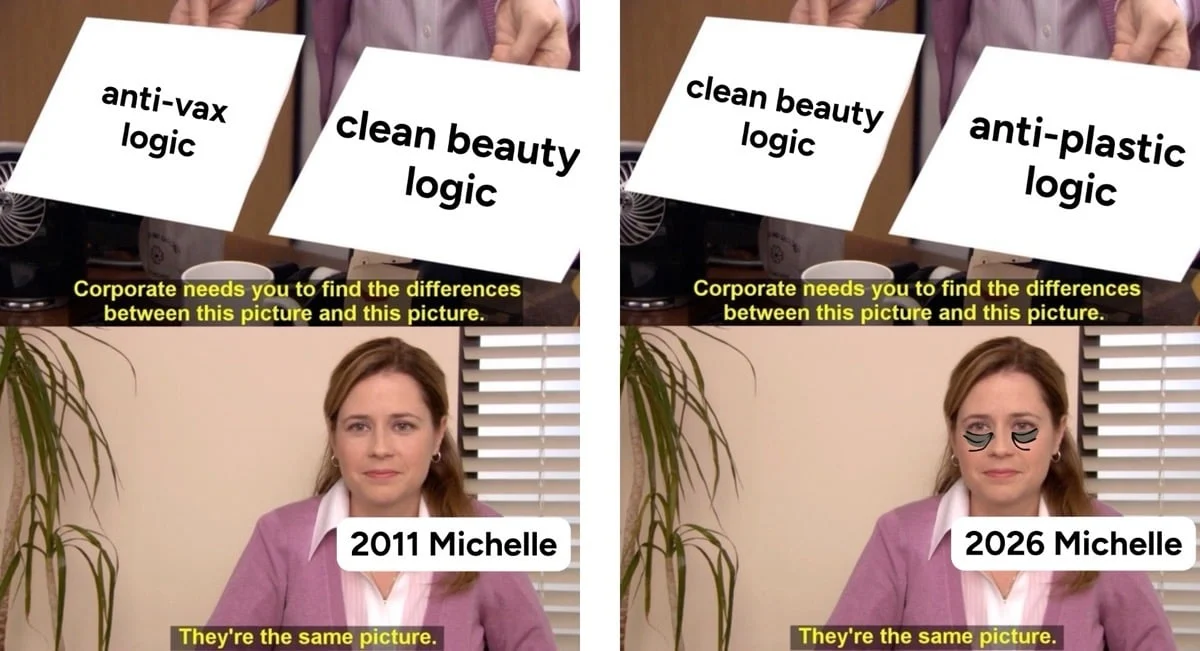
The modern consumer landscape is currently witnessing a profound philosophical shift, marked by an aggressive pivot toward unverified ecological purism. Over the past decade, the beauty and wellness industries have grappled with the rise of "clean beauty"—a marketing phenomenon characterized by the blanket demonization of synthetic chemicals and a rigid reliance on the appeal-to-nature fallacy. Now, science communicators and industry analysts are identifying an identical trajectory in the surging "anti-plastic" movement. While genuine ecological concerns surround plastic waste and microplastic pollution, experts warn that oversimplified messaging, flawed scientific methodologies, and performative corporate greenwashing are threatening to derail legitimate environmental science.
The parallels between clean beauty rhetoric and contemporary anti-plastic sentiment reveal an underlying reliance on psychological shortcuts. Both movements utilize fear-based marketing, reject the fundamental principles of risk assessment and toxicology, and promote lifestyle swaps that frequently increase overall environmental burdens rather than mitigating them. Understanding how these pseudoscientific tropes migrate from niche wellness spaces into mainstream environmentalism is critical for fostering genuine sustainability.
The Evolution of Purity Culture: From Clean Beauty to Plastic-Free Panics
To understand the current anti-plastic narrative, one must examine the origins of the clean beauty movement that gained immense traction in the early 2010s. Science communicator Michelle Wong, founder of Lab Muffin Beauty Science, began engaging in public science education in 2011 after recognizing that the non-toxic clean beauty narrative served as a psychological pipeline to broader anti-science beliefs, including vaccine hesitancy. The underlying logical architecture was identical: both movements relied on invoking fear against specific, demonized substances such as aluminum and formaldehyde while ignoring the foundational toxicological principle that "the dose makes the poison."
In recent years, this exact pattern has reemerged around plastics. Beauty brands and lifestyle influencers routinely deploy blanket "plastic-free" claims and sensationalized warnings regarding microplastics. Although these messages often target a demographic that outwardly acknowledges the pseudoscientific nature of clean beauty, many individuals fail to recognize that their own anti-plastic rhetoric relies on the very same logical fallacies.
This phenomenon is not isolated to social media influencers. Established scientific outlets and consumer watchdogs have occasionally slipped into similar tropes. Historically, even reputable science-based publications and regulatory commentary platforms have published critiques of personal care safety legislation that inadvertently reinforced clean beauty narratives. The migration of these tropes into mainstream environmental discussions demonstrates how easily identity-driven motivated reasoning overrides empirical scrutiny.
Flaws in Sustainability Science: Why End-of-Life Focus Misleads
A central pillar of the anti-plastic movement is the assumption that eliminating plastic packaging is an absolute net positive for the environment. However, sustainability science relies on Life Cycle Assessments (LCAs)—comprehensive, standardized methodologies that evaluate the environmental impact of a product across every stage of its existence, including raw material extraction, manufacturing, distribution, use, and end-of-life disposal.
Public discourse on plastics focuses almost exclusively on the end-of-life phase: marine debris, landfill accumulation, slow degradation rates, and microplastic shedding. While these are legitimate environmental challenges, this hyper-fixation often completely overshadows climate change, which the overwhelming scientific consensus identifies as the most severe environmental threat facing the planet.
When subjected to rigorous LCA scrutiny, plastic packaging frequently outperforms alternatives such as glass, paper, and aluminum in minimizing carbon emissions. Because plastic is lightweight, durable, and structurally efficient, it requires significantly fewer resources to transport. A comprehensive industry analysis conducted by Denkstatt demonstrated that substituting plastic packaging with alternative materials would demand, on average, 3.6 times the raw material mass, 2.2 times the energy, and 2.7 times the carbon emissions.
Furthermore, plastics play a vital role in preventing food and product spoilage, reducing waste, and maintaining product sterility without requiring heavy chemical preservatives. Blanket assertions that plastic-free alternatives are inherently superior ignore these complex trade-offs. While consuming less overall is universally recognized as the most effective sustainable practice, substituting plastic with heavier materials like glass or metal often increases a product’s total carbon footprint. Despite this, some prominent beauty brands actively promote alternative materials while encouraging excessive consumption—such as offering limited-edition merchandise, non-recyclable synthetic accessories, and promotional gifts that undermine their own stated ecological missions.
Methodological Challenges in Microplastic Research
Much of the panic surrounding microplastics is driven by alarming headlines derived from scientific studies suffering from severe methodological limitations. Detecting microscopic polymer particles is analytically difficult, and researchers frequently encounter challenges that yield false positives or drastically exaggerated quantities.
A prominent analytical technique utilized in microplastic quantification is Pyrolysis Gas Chromatography-Mass Spectrometry (Py-GCMS). Without rigorous calibration and corrective experiments, Py-GCMS cannot reliably distinguish between certain biological fats and polyethylene, leading researchers to misidentify organic matter as synthetic polymers. This specific limitation contributed to exaggerated findings in high-profile studies, including those that claimed staggering quantities of microplastics were present in human brain tissue.
Contamination represents another pervasive hurdle in laboratory settings. Because microplastics are ubiquitous in the modern environment—settling out of indoor air and shedding from laboratory gloves and equipment—uncontrolled studies routinely misattribute ambient background particles to the biological samples being tested.
In January 2026, scientific scrutiny reached a turning point when mainstream publications like The Guardian reported on mounting doubts surrounding foundational microplastic research. Rather than blindly accepting sensational claims, independent scientists and public research institutions began publishing formal critiques pointing out these systemic experimental flaws. However, this course correction met immediate pushback from activists who dismissed the reevaluation as an artifact of corporate influence, accusing outlets of being compromised by industrial lobbies—a reaction that exemplifies identity-based motivated reasoning over critical analysis.
Appeal to Nature and the Fallacy of Presence
The ideological foundation of the plastic-free movement rests heavily on the appeal-to-nature fallacy: the unscientific assumption that natural materials are inherently safe and beneficial, whereas synthetic polymers are universally toxic. This binary thinking extends to bioplastics, which are often presumed to be harmless simply because their foundational building blocks originate from biological sources, ignoring the reality that natural substances can be acutely toxic.
Furthermore, public fear is frequently fueled by the logical error of assuming that the mere presence of a substance implies causation of disease. Discovering microplastics within pathological tissues—such as arterial plaque or the brains of dementia patients—does not inherently prove that the polymers caused the pathological condition. Correlation does not equal causation, and alternative explanations, such as sample contamination or incidental accumulation without toxicological consequence, are frequently overlooked by sensationalist reporting. This mirrors historical clean beauty scares, such as the widely criticized studies claiming to find parabens in breast tumors without verifying baseline concentrations in healthy control tissues.
Regulatory Implications and Science-Washing
As consumer demand for eco-friendly goods intensifies, regulatory bodies across major global jurisdictions—including the U.S. Federal Trade Commission (FTC), the UK Competition and Markets Authority (CMA), and the Australian Competition and Consumer Commission (ACCC)—have tightened enforcement against deceptive environmental marketing. Sustainability claims lacking empirical substantiation are increasingly classified as misleading and deceptive trade practices.
Despite regulatory oversight, "science-washing" remains rampant. Brands and influencers frequently utilize pseudoscientific buzzwords, cherry-picked data, and compliant fringe experts to validate anti-plastic narratives. Cosmetic and sustainability scientists emphasize that evaluating financial conflicts of interest is only a preliminary step in critical thinking; true scientific literacy requires evaluating the underlying empirical arguments on their own merits.
Experts stress that while humanity undeniably needs to address global waste management and optimize material lifecycles, uncritical adherence to dogmatic "plastic-free" mandates risks repeating the policy failures of the clean beauty movement. Formulating effective environmental policies requires holistic, data-driven life cycle assessments rather than reactionary panic, ensuring that efforts to protect human and planetary health are guided by rigorous evidence rather than emotional appeal.
