
The debate surrounding hair bond-building products has long centered on a fundamental chemical question: do treatments like Olaplex actually repair broken disulfide bonds within the hair fiber, or do they merely mimic the behavior of those bonds through alternative interactions? For years, industry scientists have theorized that popular formulations rely on hydrogen and ionic bonding rather than the targeted reconstruction of sulfur-sulfur linkages. However, a recent independent study published in the peer-reviewed journal Cosmetics has reignited the scientific controversy by claiming to find direct evidence of Olaplex working at broken disulfide bonds, aligning closely with the brand’s original patent claims.
A rigorous analysis of the paper, titled "Bleached Hair as Standard Template to Insight the Performance of Commercial Hair Repair Products," reveals significant methodological hurdles and chemical inconsistencies. While the study suggests that active ingredients like bis-aminopropyl diglycol dimaleate create new sulfur-carbon bonds measurable via Ellman’s test, organic chemistry principles indicate that the analytical methods deployed may not actually measure the specific bonds in question. This clash between published academic literature and established chemical reality underscores the ongoing challenges of evaluating consumer beauty science through independent research.
Background and Context of Hair Bond Builders
The modern hair care market was revolutionized over a decade ago with the introduction of bond-building treatments designed to restore the structural integrity of hair chemically damaged by bleaching, coloring, and heat styling. Human hair is predominantly composed of keratin, a fibrous protein rich in the amino acid cysteine. Cysteine residues form strong covalent disulfide bonds (S-S) that provide hair with its primary tensile strength, elasticity, and resilience.
Chemical processes such as bleaching oxidize these disulfide bonds, cleaving them into weaker cysteic acid groups or free thiol groups (SH), which leaves the hair porous, brittle, and prone to breakage. Traditional conditioning treatments address this damage superficially by coating the cuticle with oils and silicones, providing temporary slip and moisture management. Bond builders, by contrast, entered the market promising internal molecular repair. According to original patent literature filed by chemists Eric Pressly and Craig Hawker, Olaplex’s active ingredient—bis-aminopropyl diglycol dimaleate—functions via a Michael addition reaction, acting as an acceptor molecule to link broken sulfur groups back together.
Despite these compelling theoretical frameworks, independent hair scientists and researchers from institutions such as TRI Princeton and major personal care laboratories have increasingly questioned whether these molecules actually reform native disulfide bonds. Earlier studies indicated that while bond builders undoubtedly improve the tactile and mechanical properties of damaged hair, they likely achieve this by establishing secondary networks of hydrogen and ionic bonds rather than true covalent restoration of the original S-S architecture. The publication of the 2024 Cosmetics study, therefore, represented a notable pivot, appearing to validate the original patent claims through advanced instrumental analysis.
Methodology of the Independent Study
To evaluate the performance of commercial repair products, the researchers behind the independent study established a standardized testing protocol using human hair samples. First, the hair swatches were subjected to a controlled bleaching process to intentionally degrade their structural integrity and break native disulfide bonds. Twenty-four hours following the bleaching procedure, the damaged hair samples were divided into test groups: one group received no further treatment, another was treated with Olaplex (specifically utilizing Olaplex No. 0, which features the active ingredient at its highest commercial concentration in an aqueous solution), and a third group was treated with K18, a competing peptide-based treatment.
The researchers then subjected these treated hair samples to a battery of analytical techniques to observe molecular and structural changes. These methods included Scanning Electron Microscopy (SEM) and Atomic Force Microscopy (AFM) to evaluate surface morphology and penetration depth, Raman spectroscopy to measure specific molecular vibrations corresponding to disulfide bonds, and Ellman’s test—a classic colorimetric chemical assay traditionally used to quantify free thiol groups or reducible sulfur bonds within protein structures.
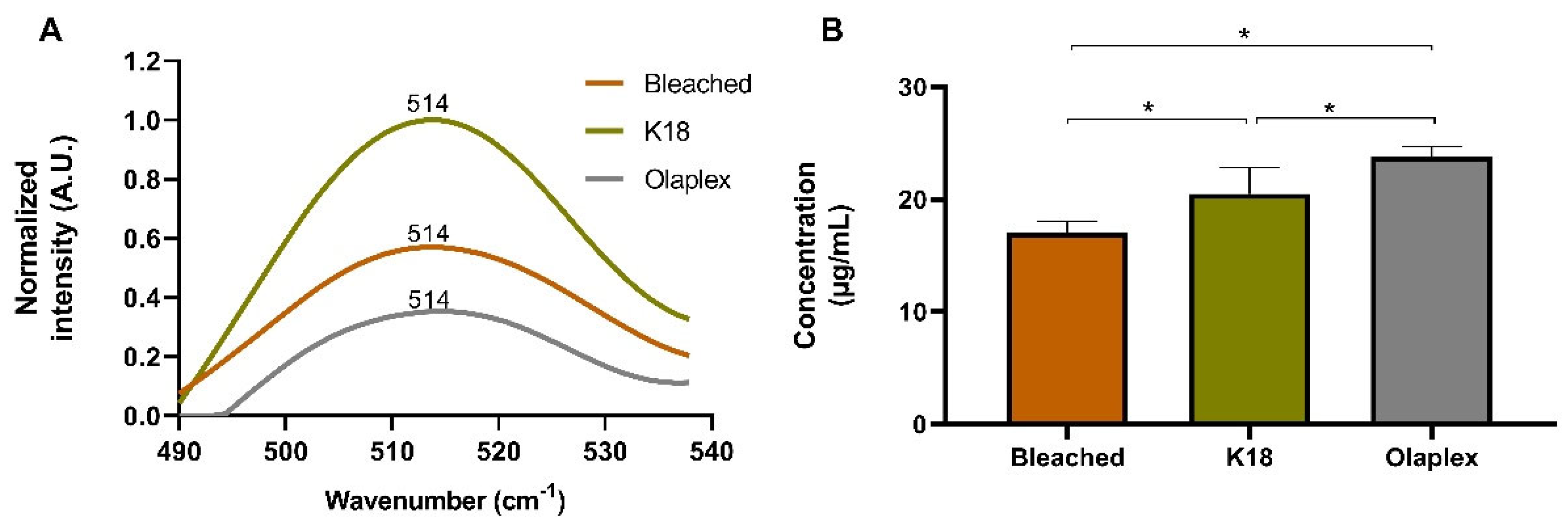
The core of the study’s conclusion hinged on the combined results of Raman spectroscopy and Ellman’s assay. The authors observed that while Raman spectra showed lower signals for specific S-S bonds in Olaplex-treated hair, Ellman’s test yielded higher signals. From this data, the research team deduced that Olaplex’s mechanism of action involves creating new, non-specific sulfur-carbon (S-R) bonds, where the active ingredient acts as a Michael addition acceptor. They concluded that these newly formed S-R bonds were captured by Ellman’s chemical procedure but escaped detection by the specific S-S Raman band, thereby explaining the larger statistical gap between the two analytical measurements.
Critical Analysis of Chemical Inconsistencies
Despite the peer-reviewed status of the study, structural and chemical analysis of the methodology highlights fundamental flaws that undermine its core conclusions. The primary chemical discrepancy lies in the inherent limitations of Ellman’s test and the stability of sulfur-carbon bonds.
Olaplex’s mechanism relies on a precise Michael addition reaction involving specific carbon atoms on the double bond of bis-aminopropyl diglycol dimaleate. It does not generate random or "non-specific" bonds across arbitrary chemical targets. More critically, the chemical assay used to evaluate these bonds—Ellman’s test combined with sodium borohydride reduction—is fundamentally unsuited for measuring sulfur-carbon bonds.
In organic sulfur chemistry, sulfur-carbon (S-R) bonds are remarkably stable. They are not cleaved by mild reducing agents like sodium borohydride, which is traditionally utilized to break disulfide (S-S) bonds, and generally require harsh transition metals or free-radical reactions to disrupt. Borohydride exclusively targets disulfide linkages. Consequently, the chemical rationale that Ellman’s assay successfully quantified newly established S-R bonds generated by Olaplex directly contradicts established organic chemistry principles.
Furthermore, a close reading of the paper reveals internal contradictions regarding what the assay was actually measuring. The methodology section explicitly states that disulfide bond quantification was performed using Ellman’s assay, equating the measurement to S-S bonds. However, the results and discussion section abruptly shifts terminology, claiming that S-R bonds were evaluated using the exact same procedure. This semantic drift points to a potential misunderstanding of the assay’s chemical specificity within the context of complex keratin matrices.
Alternative Explanations for Experimental Results
If Ellman’s test fails to measure sulfur-carbon bonds, the observed differences in assay results between the untreated, Olaplex-treated, and K18-treated hair samples require alternative scientific explanations. Independent scientific evaluation points toward physical and procedural variables rather than genuine bond creation.
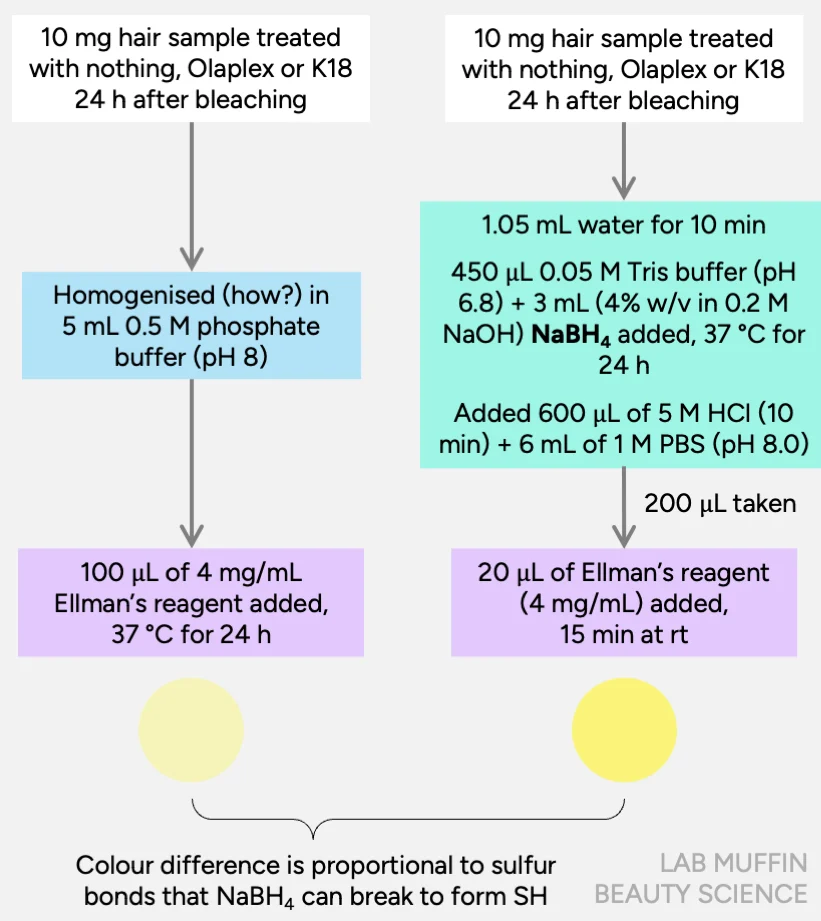
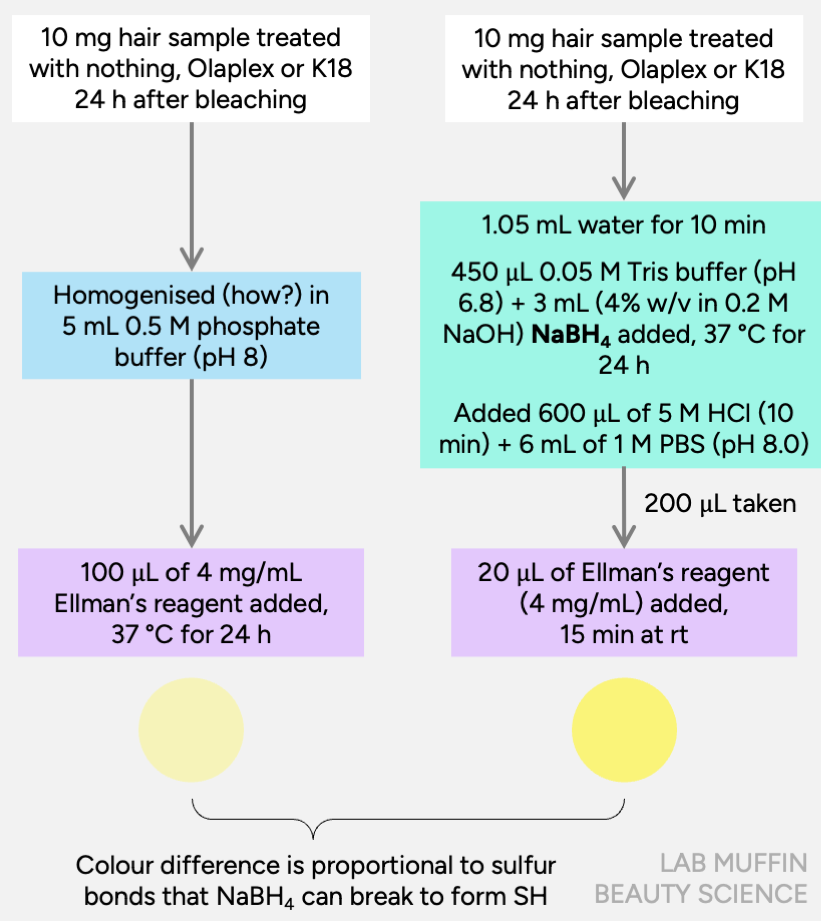
First, hair structure accessibility plays a vital role in colorimetric assays. Keratin proteins are tightly folded, meaning native disulfide bonds can be deeply buried within the fiber matrix. Reagents cannot effectively reach these buried sites unless the hair structure is thoroughly denatured. The two conditions utilized in the study’s Ellman protocol differed drastically. Condition 1 was relatively mild, whereas Condition 2 involved agitating samples in a highly alkaline 0.2 M sodium hydroxide solution (pH approximately 13) for 24 hours—a chemical environment far more extreme than standard depilatory creams. It is highly probable that the extreme alkalinity of Condition 2 completely disrupted the hair’s tertiary structure, exposing buried bonds that remained inaccessible during the milder Condition 1.
Second, bond-building products fundamentally alter how hair interacts with water. Both Olaplex and K18 function, in part, by occupying space within the hair matrix and establishing hydrophobic barriers that restrict water penetration. Water is known to swell and open up the hair’s protein structure; by blocking moisture uptake, these treatments may have decreased the accessibility of internal S-S bonds during the milder Condition 1. Because the K18 formulation evaluated also contained lipophilic conditioning agents like cetearyl alcohol and dicaprylyl ether, it formed an external conditioning layer that further impeded aqueous penetration during initial testing phases.
Finally, technical inconsistencies in the execution of Ellman’s procedure raise questions about data reliability. The concentrations of hair samples and Ellman’s reagent varied wildly between the two testing conditions. Direct mathematical subtraction of colorimetric measurements derived from vastly different concentrations fails to yield meaningful quantitative units. Additionally, the practice of extracting small 200-microliter aliquots from heterogeneous suspensions—where solid micro-particles of hair fiber may unevenly settle—creates significant sampling error, rendering the measurements vulnerable to artifactual variance rather than true biochemical shifts.
Broader Implications for Cosmetic Science Research
The analytical debate surrounding the Cosmetics study serves as a valuable case study in the broader vulnerabilities of contemporary beauty science research. The incident highlights several critical realities regarding how scientific literature is produced, peer-reviewed, and consumed by the public.
Foremost among these is the limitation of the peer-review process itself. Within scientific publishing, peer review does not equate to infallible truth or universally established consensus. It simply indicates that an academic journal’s editor and an assigned panel of reviewers evaluated a manuscript and deemed its methodology and presentation acceptable for publication. The true validation of any scientific claim occurs post-publication, through replication, broader critical appraisal, and synthesis with the existing body of specialized literature.
Additionally, the study underscores the financial and institutional disparities inherent in cosmetic research. Unlike pharmaceutical research, which benefits from substantial public funding and rigorous academic infrastructure driven by clinical necessity, cosmetic science receives comparatively little public grant money. Consequently, much of the independent academic research in the beauty sector is conducted by university or private laboratories that may specialize in broad instrumental analysis—such as spectroscopy and microscopy—without possessing deep, specialized expertise in niche sub-disciplines like organosulfur chemistry or hair fiber physics.
When independent researchers attempt to evaluate complex proprietary technologies without the specialized interdisciplinary consultation of organic chemists and dedicated hair scientists, misinterpretations of assay data can easily occur. Conversely, industry-funded research carries its own inherent biases stemming from commercial conflicts of interest, making uncritical acceptance of corporate white papers equally problematic.
Ultimately, navigating the science of beauty requires rigorous, multi-source critical appraisal. Consumers, industry professionals, and science communicators alike must look beyond the badge of "peer-reviewed" status, examining the underlying chemistry, assay limitations, and potential methodological confounders. As the ongoing discourse among hair scientists demonstrates, true progress in understanding how bond-building technology interacts with human keratin requires a synthesis of advanced instrumental analysis, sound organic chemistry, and a healthy skepticism of oversimplified mechanistic claims.
