

The global community is failing to keep pace with the necessary transitions required to reform international food systems by the close of the decade, according to an expansive, interdisciplinary assessment published in Nature Food. Backed by the United Nations and spearheaded by the Food Systems Countdown Initiative (FSCI)—a collaborative effort involving Johns Hopkins University, Cornell University, the UN Food and Agriculture Organization (FAO), and the Global Alliance for Improved Nutrition—the study serves as a stark warning to policymakers worldwide.
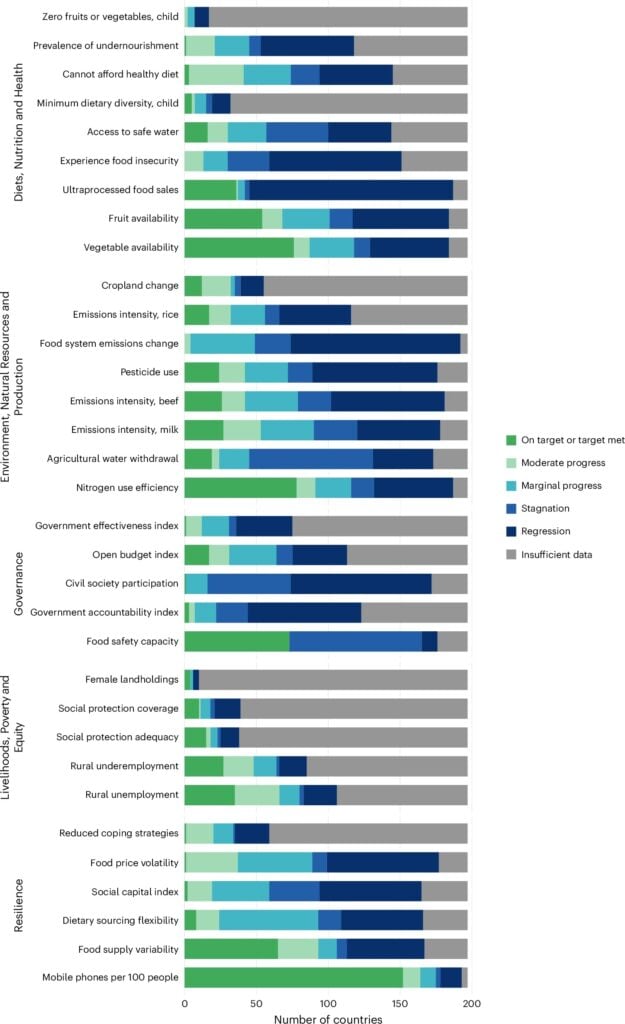
Evaluating 197 countries across 44 distinct metrics, the comprehensive performance assessment reveals that the vast majority of nations will fall short of internationally agreed-upon food systems goals for 2030. Most alarmingly, the reduction of greenhouse gas emissions generated by agrifood systems has emerged as one of the most severely neglected indicators. Along with child labor reduction and food insecurity mitigation, the global trajectory on agricultural emissions is so far off course that researchers have concluded the established 2030 targets are mathematically unattainable under current policy conditions.
The findings mark a critical pivot in how environmental and nutritional progress is measured. While prior studies primarily tracked broad directional trends, this third installment of the FSCI evaluation establishes firm performance benchmarks. By calculating the exact distance remaining between current state actors and achievable targets, the report transforms standard monitoring into an actionable framework for institutional accountability.
The Anatomy of a Global Slowdown
The scope of the FSCI report is unprecedented, organizing its evaluation across five thematic pillars: diets, nutrition, and health; environment, natural resources, and production; livelihoods, poverty, and equity; governance; and resilience. Within this matrix of 44 indicators, the data demonstrates widespread stagnation or active regression.
For 22 of the monitored indicators, fewer than one-third of the world’s countries are currently on track to hit their 2030 targets. Worse still, three indicators show a complete lack of global compliance, meaning not a single nation is projected to meet the objective. Among these is the crucial metric of food system emissions change.
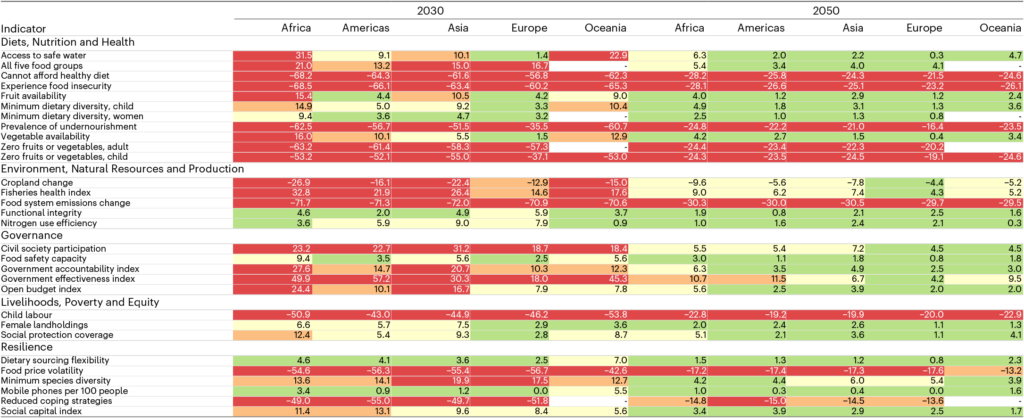
Globally, the agrifood sector is responsible for roughly one-third of all anthropogenic greenhouse gas emissions, placing it second only to the fossil fuel industry. Within this footprint, meat and dairy production alone account for approximately 20% of worldwide emissions. To bridge the gap and align with climate stabilization pathways, the report calculates that food system emissions must plummet by more than 60% annually—a reduction velocity that challenges even long-term 2050 projections.

Other critical indicators are actively moving in the wrong direction on a global scale. Metrics concerning civil society participation, governmental accountability, pesticide usage efficiency, and the financial accessibility of a healthy diet are deteriorating. These concerning trends have now been joined by the surging global sales of ultra-processed foods (UPFs) and expanding food system emissions, compounding the planetary and public health crises.
Regional Realities and Structural Disparities
The burdens of these systemic failures are not distributed evenly across the globe. Regional analyses within the report highlight the immense structural transformations required simply to catch up to baseline expectations by 2030.
In Africa, for example, nations face the daunting task of achieving a 15% to 20% annual improvement across 23 separate indicators to meet decade-end goals. Meanwhile, countries across Asia must accelerate efforts to slash food insecurity rates by more than 63% each year. In Europe, despite advanced industrial capacities and robust regulatory frameworks, 19 indicators remain structurally unattainable within the current timeline.
Despite these sobering figures, the report avoids total pessimism. For seven of the 33 evaluated indicators, at least one-third of countries are successfully on track to meet their 2030 benchmarks. Furthermore, approximately half of all monitored indicators are trending in a desirable direction globally, proving that progress is possible where targeted interventions are implemented.
To prevent ambitious global targets from breeding institutional inertia, the researchers introduced regional and income-group benchmarks. These localized targets provide realistic, attainable milestones that reflect the economic realities of specific areas. For instance, while African nations are, on average, 58.7% away from the global benchmark for healthy diet affordability, that gap shrinks to 32.2% when evaluated against a regional standard derived from the top-performing 20% of countries on the continent. By highlighting these regional exemplars, the framework offers a roadmap for neighboring nations.
The Evolution of the Food Systems Countdown Initiative
The publication of this comprehensive assessment represents years of methodological refinement within the international scientific community. The Food Systems Countdown Initiative was established to bridge a historically fragmented landscape of agricultural, environmental, and public health data.
In its inaugural tracking reports, the FSCI focused primarily on establishing baseline metrics and observing directional momentum—identifying whether indicators were improving or worsening over time. However, as international deadlines approached, researchers recognized that directional tracking lacked the teeth required to force policy shifts.
The latest Nature Food study represents a maturation of this methodology. By shifting from mere observation to performance benchmarking, the initiative provides governments with precise measurements of their velocity deficits. Lead author Bianca Carducci emphasized the practical utility of this shift, noting that distinguishing between trends and performance turns data collection into a direct tool for legal and political accountability.
By evaluating mobile phone subscriptions—the only indicator fully achieved globally, serving as a proxy for digital connectedness and societal resilience—the researchers established that systemic transformation is achievable when technological infrastructure and political will align. Unfortunately, this level of synchronization remains absent across agrifood and environmental metrics.
The Centrality of Governance and Institutional Accountability
At the heart of the FSCI’s recommendations lies a clear diagnosis: the primary bottleneck to food systems transformation is not a lack of technological innovation, but a deficit in governance, policy efficacy, and institutional accountability.
According to the study, improving regulatory frameworks and governmental accountability serve as the most critical leverage points, interacting directly with the highest number of secondary indicators. When governments fail to enforce sustainable agricultural practices, subsidize environmentally damaging production models, or neglect public health infrastructure, the negative externalities ripple across poverty, equity, and environmental stability.
Experts involved in the research stress that without a fundamental overhaul of political will, international summits and voluntary corporate pledges risk becoming performative rather than transformative. Mario Herrero, a professor at Cornell University’s Ashley School of Global Development and the Environment, underscored this sentiment, warning that the global community can no longer afford to maintain its current pace of implementation.
Similarly, Jessica Fanzo, a professor of food policy and climate at Johns Hopkins University’s School of Advanced International Studies Europe, noted that while global targets are essential for inspiring ambition, they must be paired with realistic, localized benchmarks to prevent despair and systemic abandonment among resource-constrained nations.
Implications and the Horizon Toward 2050
The release of the UN-backed report carries profound implications for international diplomacy, agricultural finance, and domestic policy design. As the international community confronts the reality of missing nearly all 2030 food system targets, attention is increasingly turning toward the horizon of 2050.
Extending the timeline for achieving core sustainability, nutrition, and poverty eradication goals makes absolute feasibility more likely, provided that structural investments begin immediately. The research indicates that while 2030 targets are largely out of reach for systemic indicators like agricultural emissions, child labor, and deep-seated food insecurity, a managed transition toward 2050 remains achievable across various regions under optimistic policy scenarios.
However, researchers caution that this extended runway is not an invitation to slow down. Maintaining feasibility past 2030 requires steady momentum, consistent policy enforcement, and synchronized financial investments starting today.
José Rosero Moncayo, chief statistician at the FAO, emphasized the indispensable value of the countdown study for guiding these investments. By pinpointing precisely where systems are failing—such as the escalating costs of healthy diets, stubborn food insecurity, and runaway agrifood emissions—governments, multilateral banks, and private sector actors can direct resources where they are most urgently needed.
As the international scientific community continues to refine its monitoring tools, the message from the FSCI remains unequivocal: the transformation of global food systems requires immediate, decisive, and accountable action from every sector of society. Without a dramatic acceleration in policy execution, the foundational systems that sustain human life will face mounting, irreversible strains in the decades to come.
