
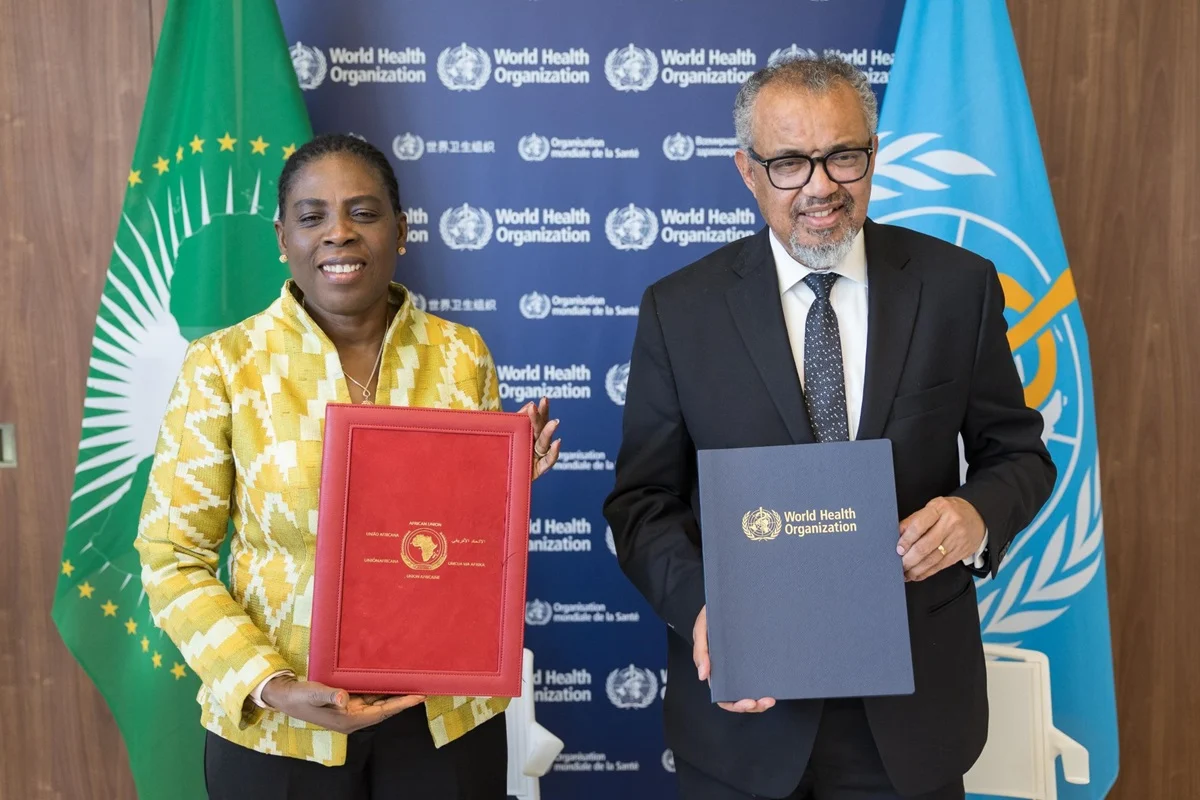
The World Health Organization (WHO) and the African Union (AU) Commission officially renewed their long-standing strategic partnership today, formalizing a new Memorandum of Understanding (MoU) on the sidelines of the 78th World Health Assembly in Geneva. This landmark agreement arrives at a pivotal juncture for the African continent, serving as a direct response to the mounting financial pressures and shifting geopolitical dynamics currently destabilizing global health funding. By reaffirming their commitment to universal health coverage (UHC), health security, and sustainable development, the two organizations are signaling a transition from traditional aid-dependent models toward a more robust framework of continental health sovereignty.
The signing ceremony, which featured Her Excellency Ambassador Amma Adomaa Twum-Amoah, Commissioner for Health, Humanitarian Affairs and Social Development at the AU, and Dr. Tedros Adhanom Ghebreyesus, WHO Director-General, serves as a blueprint for the next phase of cooperation between the two bodies. It is intended to bridge the implementation gap between high-level policy commitments and the operational realities faced by individual African nations.
A Chronology of Collaboration: Building on the 2019 Foundation
The current agreement is the latest iteration in a deepening relationship that has evolved significantly over the past decade. The 2019 MoU served as the original bedrock for this structural alignment, providing a framework that helped coordinate the response to the COVID-19 pandemic and subsequent health crises.
- 2019: The inaugural high-level MoU was signed, establishing the AU-WHO Joint Task Force to streamline technical assistance and policy alignment.
- 2020-2022: The partnership was stress-tested by the COVID-19 pandemic, leading to the establishment of the Africa Centres for Disease Control and Prevention (Africa CDC) as a primary operational arm for continental health surveillance.
- 2023: Increased focus was placed on local manufacturing of medical products, including vaccines and diagnostics, to reduce reliance on external supply chains.
- 2024: The 78th World Health Assembly in Geneva marks the formal renewal of the partnership, reflecting the AU’s elevated status as a permanent G20 member and a critical voice in global governance.
This progression demonstrates a clear trajectory: from an era of reactive crisis management to a proactive strategy focused on institutional strengthening and internal capacity building.
The Financial Landscape: Addressing the Aid Deficit
The urgency of this renewal is underscored by a sobering economic reality. According to data from the WHO and World Bank, bilateral aid for health in Africa has faced significant volatility in recent years. As major donor nations recalibrate their domestic budgets, countries across the African continent are experiencing a contraction in essential funding for public health programs.
Recent analysis from the AU’s health department suggests that the funding gap for achieving the Sustainable Development Goal (SDG) 3—which focuses on ensuring healthy lives and promoting well-being for all—has widened by nearly 15% since 2022. The reliance on external, short-term grants has proven insufficient to address long-term health infrastructure needs.
Dr. Tedros Adhanom Ghebreyesus emphasized this point during the signing, noting that the partnership aims to help countries move away from "budgeting for survival" and toward "planning for health sovereignty." This shift implies a move toward domestic resource mobilization, private-public partnerships, and the maturation of regional medical manufacturing hubs that can serve local demand without being susceptible to the whims of international market fluctuations.
Strengthening Institutional Governance
The MoU formally positions the AU’s Department of Health, Humanitarian Affairs, and Social Development at the center of the continent’s health architecture. This move is designed to ensure that WHO’s technical and normative guidance is not merely distributed to member states but is effectively integrated into the African Union’s policy implementation mechanisms.
The partnership focuses on five core pillars, designed to address systemic weaknesses in the continent’s health ecosystem:
- Health Security and Pandemic Preparedness: Establishing rapid-response protocols and strengthening the Africa CDC’s mandate.
- Universal Health Coverage (UHC): Expanding primary health care networks to reach rural and underserved populations.
- Local Production of Health Products: Investing in the regional manufacturing of pharmaceuticals, vaccines, and diagnostic tools.
- Digital Health and Data Infrastructure: Enhancing the ability of member states to collect, store, and utilize health data for evidence-based decision-making.
- Humanitarian Response: Strengthening the capacity of regional bodies to deliver health services in conflict-affected or climate-vulnerable zones.
Perspectives from Leadership
Commissioner Amma Adomaa Twum-Amoah highlighted the strategic necessity of this alliance. "This Agreement marks a new chapter in AU-WHO cooperation," she stated. "By working together more closely, we can better respond to the health needs of our populations and ensure that no one is left behind. The African Union values WHO’s central and leading role in global health and looks forward to deepening this strategic partnership in support of our shared goals."
From the WHO’s perspective, the agreement is an acknowledgment that technical expertise cannot be divorced from political will. Dr. Tedros remarked, "This renewed agreement comes at a critical time, as cuts to bilateral aid imperil the health of millions in Africa. It reflects our determination to translate our partnership into tangible results for the people of Africa, and support countries to leave behind the era of aid dependency and transition to sustainable self-reliance."
Broader Implications and Future Outlook
The political weight of the African Union has grown substantially, particularly following its inclusion as a permanent member of the G20. This gives the continent a stronger platform to advocate for systemic reforms in the global health financial architecture. The renewed MoU is, in many ways, an alignment of WHO’s global normative reach with the AU’s growing political influence.
Analysts suggest that if this partnership is successfully executed, the impact could be transformative for health outcomes. By streamlining administrative processes and eliminating redundant efforts between WHO regional offices and AU bodies, resources can be directed more efficiently to frontline health workers and infrastructure projects.
However, the path forward is not without challenges. The success of this MoU will depend on the ability of individual African nations to integrate these regional agreements into their national health budgets. Historically, the "implementation gap"—the distance between regional policy and local action—has been the primary barrier to health progress in Africa. The commitment to "health sovereignty" will require sustained political capital from AU heads of state and a continued focus on transparency and accountability in health spending.
Conclusion
As the 78th World Health Assembly continues in Geneva, the renewal of the AU-WHO partnership stands as one of the most significant developments regarding global health governance. By prioritizing self-reliance and aligning institutional capacities, the AU and WHO are attempting to insulate the continent’s most vulnerable populations from the volatility of global finance. The coming years will reveal whether this strategic alignment can successfully translate into reduced mortality rates, increased access to essential medicines, and a stronger, more resilient health system across the African continent.
Contact Information for Further Inquiries:
- Professor Julio Rakotonirina | Director, Department of Health, Humanitarian Affairs and Social Development, African Union Commission | [email protected]
- Ms. Stéphanie Seydoux | Director, DG Envoy for Multilateral Affairs, World Health Organization | [email protected]
Media and Press Relations:
- WHO Media Team, World Health Organization
- Mr. King David Cartey, African Union Commission
