
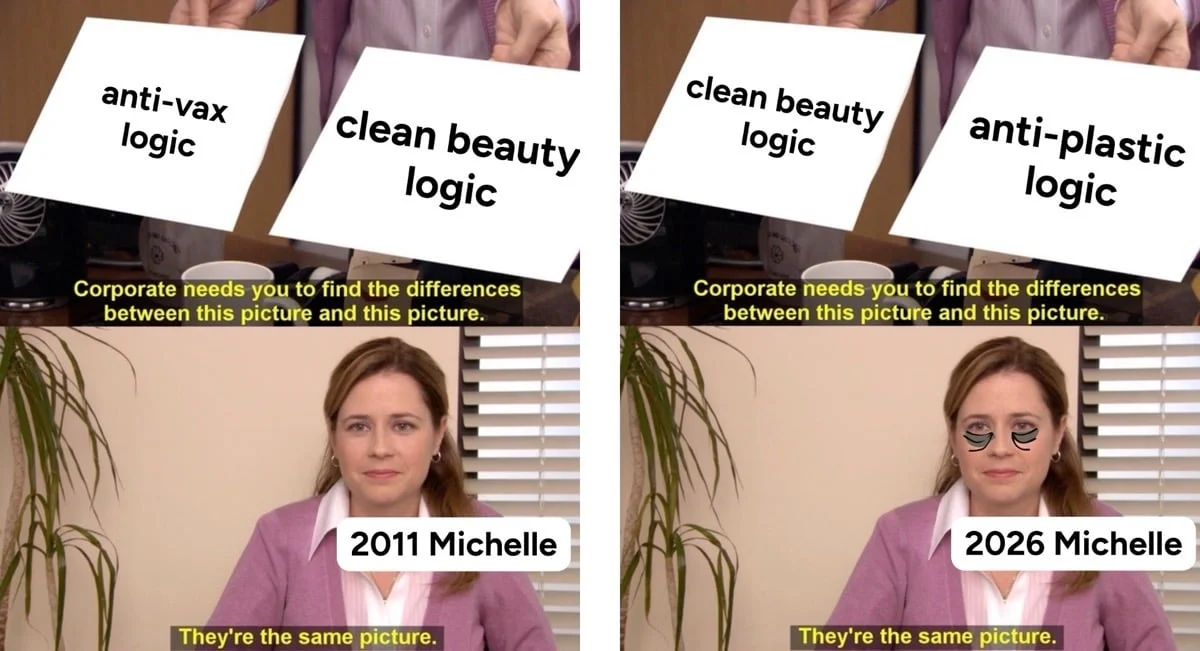
A thought-provoking observation recently shared on Threads by user @idea.soup posited a speculative link between the burgeoning anti-polyester movement and a potential pipeline to right-wing ideologies. This sentiment resonated deeply with Dr. Michelle Wong of Lab Muffin Beauty Science, a prominent voice in science communication, who immediately drew parallels to her decade-long engagement with the "non-toxic" clean beauty movement. Dr. Wong, whose scientific outreach began in 2011, initially aimed to counter the pseudoscientific claims of clean beauty, which she observed could lead consumers down a path towards anti-vaccination beliefs due to shared logical fallacies and the demonization of common substances like aluminium and formaldehyde.
Now, a similar pattern appears to be emerging with the pervasive anti-plastic trend. Dr. Wong notes the striking similarities in rhetoric between the anti-vax/clean beauty narratives and the current messaging from beauty brands and influencers advocating for "plastic-free" solutions. These include sweeping claims of plastic’s inherent negativity and pervasive fearmongering about microplastics, often devoid of nuanced scientific context. This development is particularly concerning as many proponents of the "plastic-free" movement are themselves aware of the pseudoscientific underpinnings of clean beauty, yet seemingly fail to apply the same critical thinking to their anti-plastic stance. Even reputable scientific communication platforms, which have sometimes faltered in their coverage of clean beauty, are struggling to navigate the complexities of plastic discourse.
The Clean Beauty Precedent: A Foundation of Misinformation
To understand the current "plastic-free" phenomenon, it’s crucial to revisit the trajectory of the "clean beauty" movement. Originating from a desire for safer, more transparent cosmetic products, clean beauty quickly evolved into a broad, often ill-defined concept centered on "free-from" lists that demonized a range of ingredients, many of which are perfectly safe and beneficial at typical usage concentrations. Ingredients like parabens, phthalates, and sulfates became targets, despite extensive scientific research affirming their safety and efficacy.
The clean beauty narrative frequently leveraged an "appeal to nature" fallacy, suggesting that anything "natural" is inherently good and anything "chemical" or synthetic is inherently bad. This oversimplification ignored the fact that many natural substances are toxic, while countless synthetic compounds are benign or even life-saving. The movement also often disregarded fundamental principles of toxicology, such as the crucial concept that "the dose makes the poison." Instead, the mere presence of an ingredient, regardless of its concentration or exposure level, was often presented as evidence of harm. This created an environment ripe for misinformation, where anecdotal evidence and alarmist claims often overshadowed rigorous scientific data.
The Rise of "Plastic-Free": A New Frontier for Misguided Activism
The public’s growing awareness of environmental issues, particularly plastic pollution, has fueled a legitimate and necessary conversation about waste reduction. However, much like clean beauty, the "plastic-free" movement has quickly adopted a similar set of problematic arguments and fear-based tactics. Brands are increasingly marketing products with "plastic-free" labels, often without a comprehensive understanding of the environmental implications of their alternatives. This mirrors the "non-toxic" claims of clean beauty, where marketing often outpaces scientific validation.
The current discourse frequently focuses almost exclusively on the end-of-life stage of plastic products – visible pollution, landfills, and the slow degradation of materials. While these are critical concerns, this narrow focus often obscures the broader environmental picture, leading to potentially counterproductive solutions.
Core Parallels: Shared Flaws in Logic and Science
Dr. Wong highlights several key parallels between the anti-plastic and clean beauty movements, underscoring the consistent nature of scientific misinformation:
-
Appeal to Nature Fallacy: Both movements heavily rely on the idea that "natural equals good, synthetic equals bad." For plastics, this translates to "plastic = bad, natural alternatives (e.g., bioplastics, glass, paper) = good." This ignores the fundamental scientific principle that a substance’s origin provides no inherent information about its safety or environmental impact. Many natural substances are highly toxic, and bioplastics, while derived from natural sources, often present their own complex environmental challenges, including land use, water consumption, and processing energy.
-
Ignoring Basics of Relevant Science – The Case of Life Cycle Assessment (LCA): Just as clean beauty often ignores toxicology, the blanket "plastic-free = better for the environment" claims often disregard the foundational principles of sustainability science, particularly Life Cycle Assessment (LCA). LCA is the internationally recognized standard for quantifying a product’s environmental impact across its entire lifespan, from raw material extraction and manufacturing to transport, consumer use, and end-of-life disposal or recycling.
Crucially, for many products, the end-of-life stage is not the most impactful phase. Public perception, however, often disproportionately focuses on visible waste and disposal, leading to incorrect judgments about which materials are truly the least environmentally damaging. Most discussions surrounding plastics are almost entirely dominated by end-of-life issues like microplastics, recycling rates, landfill accumulation, and ocean waste. This narrow perspective often overlooks climate change, which is widely considered by scientists to be the most pressing environmental threat.
Paradoxically, plastic packaging often outperforms alternatives when considering climate impact. For instance, a comprehensive analysis revealed that switching from plastic to glass, paper, or aluminium packaging could, on average, require 3.6 times more material, 2.2 times more energy, and result in 2.7 times higher carbon emissions. Plastics are lightweight, reducing transportation fuel consumption; they offer superior barrier properties, extending product shelf life and minimizing spoilage; and their efficient use of resources in production can often result in a lower overall carbon footprint compared to heavier, more energy-intensive alternatives. While these benefits are not universal, and each case demands individual LCA, blanket anti-plastic statements are often emotionally driven rather than evidence-based.
The emphasis on consuming less remains the most sustainable option. However, if reducing plastic consumption merely shifts demand to other materials like aluminium, glass, or paper, the overall environmental burden can paradoxically increase. Many beauty brands, unfortunately, promote "plastic-free" alternatives while sidestepping the broader issue of overconsumption. Examples like Dieux Skin’s aluminum samples or nylon/polyester tote bags, marketed as eco-friendly, illustrate how perceived "plastic-free" initiatives can inadvertently contribute to greenwashing if not thoroughly vetted by sustainability experts.
-
Citing Studies with Serious Methodology Issues: A significant concern mirrors the clean beauty movement’s reliance on flawed or misinterpreted studies. Many microplastic studies, particularly those claiming widespread human exposure or severe health impacts, suffer from significant methodological limitations. The challenges of accurately measuring minute quantities of substances are compounded for microplastics, often leading to false positives or exaggerated findings that generate sensational headlines.
For example, pyrolysis-gas chromatography-mass spectrometry (Py-GCMS), a common quantification method, can misidentify natural fats as polyethylene unless meticulously corrected through additional experiments. This can lead researchers to report higher microplastic concentrations than actually present, as seen in studies claiming a "spoon’s worth of microplastics in our brains." Furthermore, ubiquitous contamination is a major issue; microplastics are so prevalent in the environment that studies often inadvertently count microplastics originating from lab equipment, clothing, or even researchers’ gloves as part of the sample. These esoteric methodological flaws are difficult for the public to discern, creating fertile ground for misinformation.
-
Assuming Presence Means Harm (Correlation is Not Causation): Finding microplastics in diseased tissues, such as artery plaque or brains of dementia patients, does not automatically imply causation. This crucial distinction, often overlooked in both anti-plastic and clean beauty narratives, is fundamental to scientific inquiry. The presence could be coincidental, a result of the disease process itself altering tissue properties, or simply a reflection of plastics’ ubiquity in the environment. This echoes the infamous "parabens in breast tumors" study, which gained significant traction despite failing to measure paraben levels in healthy tissues, thus making any causal link impossible to establish.
-
Ignoring Other Reasons for Using the Material: Both movements frequently overlook the practical and functional benefits of the materials they demonize. Beyond environmental considerations, plastics offer a multitude of advantages: they are lightweight, durable, cost-effective, and provide excellent barrier protection, crucial for product stability and safety. In medical applications, plastics are indispensable for sterile packaging and single-use devices, preventing contamination and disease spread. For beauty products, plastic packaging can be more accessible, reduce breakage, and ensure the integrity of sensitive formulations.
This mirrors the clean beauty movement’s dismissal of preservatives like parabens. While demonized, parabens are highly effective, broad-spectrum preservatives that are well-tolerated by most individuals, including those with sensitive skin, often requiring lower concentrations than alternative preservatives to ensure product safety and prevent microbial contamination. Removing them without scientific justification often leads to less effective or potentially more allergenic formulations.
-
Science-Washing Using Convenient Myths and Convenient Experts: A pervasive issue across both clean beauty and anti-plastic discourse is "science-washing." Brands and influencers often selectively employ scientific language, cherry-pick data, and promote "experts" who validate their preconceived notions, rather than adhering to rigorous scientific methodology. Claiming to be "science-backed" is not synonymous with actually following scientific principles.
Regulators worldwide, including the US FTC, UK CMA, and Australian ACCC, are increasingly cracking down on misleading and deceptive sustainability claims. Brands are expected to engage genuine sustainability experts and adhere to evidence-based practices rather than relying on buzzwords. A significant problem arises from the public, and even some brands, misinterpreting expertise; a toxicologist might be an expert on chemical safety, but not necessarily on life cycle assessment or environmental policy. This creates a vacuum filled by self-proclaimed experts whose credentials may not align with the complex issues they address.
The Broader Challenge: Motivated Reasoning and Public Discourse
One of the most insidious aspects of these movements is the prevalence of identity-based motivated reasoning and confirmation bias. Individuals are often more receptive to evidence that aligns with their existing political, social, or personal beliefs. This phenomenon is increasingly evident in the anti-plastic discourse.
For example, when mainstream outlets like The Guardian recently published an article critically examining methodological issues in microplastic research, some reactions were dismissive. Despite the article quoting multiple independent scientists from public institutions, the inclusion of a former Dow chemist led to accusations of the publication being "bought by Big Plastic." This reaction exemplifies motivated reasoning, where the perceived affiliation of one source trumps the substantive arguments presented by multiple credible experts. As cosmetic scientist Jen Novakovich aptly states, "Discounting something solely based on funding source or affiliation is actually the opposite of critical thinking." Evaluating the arguments themselves, rather than merely their origin, is paramount for informed public discourse.
Official and Expert Reactions: A Call for Evidence-Based Action
The scientific community, including experts like Jen Novakovich of The Eco Well, has consistently advocated for a nuanced, evidence-based approach to environmental challenges. Novakovich, who is pursuing a PhD on the impacts of environmental misinformation, emphasizes the need for comprehensive Life Cycle Assessments and critical evaluation of microplastic research methodologies. Regulatory bodies are also becoming more proactive. The proliferation of greenwashing has prompted authorities to issue stricter guidelines for environmental claims, pushing brands towards greater transparency and scientific rigor.
A Chronology of Emerging Concerns
The evolution of these trends can be traced chronologically:
- Early 2010s: The "clean beauty" movement gains significant traction, fueled by consumer desires for "non-toxic" and "natural" products, often driven by fear of synthetic ingredients like parabens and phthalates, sometimes with tenuous links to health concerns.
- Mid-2010s: Concerns about plastic pollution, particularly ocean plastics, escalate globally, capturing public attention through viral images and documentaries. This sets the stage for the "plastic-free" movement.
- Late 2010s – Early 2020s: The "plastic-free" trend rapidly expands, with brands adopting it as a core marketing strategy. Simultaneously, research into microplastics proliferates, leading to numerous studies, some of which gain significant media attention for alarming findings.
- Mid-2020s: Science communicators and critical thinkers, observing the patterns from clean beauty, begin to raise alarms about the pseudoscientific elements emerging within the anti-plastic discourse. Methodological flaws in some microplastic studies come under increasing scrutiny by the wider scientific community, prompting calls for more robust research and cautious interpretation of findings. Regulators start to intensify efforts to combat greenwashing.
Broader Impact and Implications
The parallels between the "plastic-free" movement and clean beauty carry significant implications. Firstly, they threaten to erode public trust in science and environmental advocacy. When well-intentioned movements are built on flawed premises or exaggerated claims, they can inadvertently undermine the credibility of genuine scientific concerns. Secondly, they risk misdirecting resources and policy efforts. If consumer demand and regulatory pressure are focused on "plastic-free" solutions that are ultimately more environmentally damaging (e.g., higher carbon footprint alternatives), the overarching goals of human and environmental health are jeopardized.
Ultimately, while the desire to reduce plastic waste and mitigate its long-term impacts is a valid and important objective, the path forward must be guided by robust scientific evidence. Blanket demonization of plastic, without a holistic assessment of its benefits and the comparative impacts of alternatives, leads to misplaced conservation efforts that can, ironically, exacerbate environmental problems. The lessons from the clean beauty movement serve as a potent reminder: genuine progress in sustainability and public health demands critical thinking, scientific literacy, and a commitment to evidence over ideology.
