
The global alternative protein sector has long faced a stubborn economic bottleneck: the high cost of scaling production while maintaining structural integrity and nutritional density. Addressing this structural hurdle, Israeli food technology firm Ever After Foods and Scottish cellular agriculture pioneer Roslin Technologies have announced a landmark technological breakthrough. By combining their respective proprietary platforms, the two companies successfully produced structured cultivated meat tissue boasting unprecedented yields, higher cell densities, and a dramatic surge in protein concentration.
This collaborative milestone merges Ever After Foods’ advanced tissue-production environment with Roslin Technologies’ robust, versatile cell platforms. Industry experts note that the achievement carries significant implications for the commercial viability of cultivated meat, potentially offering a streamlined pathway toward cost parity with conventional animal agriculture.
A Paradigm Shift in Cellular Agriculture
For over a decade, the cultivated meat industry has primarily focused on maximizing cell density within suspension bioreactors. While scaling the sheer volume of cells is vital, researchers increasingly recognize that high-density suspensions alone do not translate directly into commercial success. The ultimate goal remains the efficient conversion of these cells into edible, structured tissue with high nutritional profiles, mimicking the texture and composition of traditional meat.
Ever After Foods and Roslin Technologies recognized that integrating upstream cell propagation with downstream tissue structuring could solve this dilemma. Ever After Foods, operating as a joint venture between cellular agriculture firm Pluri and Israel’s largest food enterprise, the Tnuva Group, specializes in a species-agnostic platform. Its system hinges on PlantriX, a proprietary edible scaffold technology, and the Edible Packed-Bed (EPB) production system, a patented three-dimensional environment designed to replicate natural physiological conditions for cells.
Conversely, Roslin Technologies, a spinout from the prestigious University of Edinburgh, excels in upstream innovations. The company develops advanced pluripotent stem cells capable of indefinite replication, rapid growth, and natural differentiation into any tissue type while maintaining strict genetic stability. By feeding Roslin’s robust porcine cells into Ever After Foods’ specialized bioreactor environment, the two firms established an end-to-end processing pipeline that bypassed traditional limitations.
Methodology and Chronology of the Breakthrough
The successful collaboration followed a meticulously timed, multi-stage protocol designed to transition cells smoothly from fluid suspension into structured tissue matrices.
Initially, Roslin’s porcine pluripotent stem cells were expanded in suspension as multicellular aggregates using serum-free and animal-component-free media. This phase underscored the ability of the cells to multiply rapidly and efficiently in low-cost, food-safe environments.
Following this propagation phase, the cell aggregates underwent mechanical dissociation. They were then directly inoculated into Ever After Foods’ EPB bioreactor. Within this chamber, the cells encountered the PlantriX edible scaffold, utilizing animal-free attachment materials, coatings, and microcarriers to bind and organize.
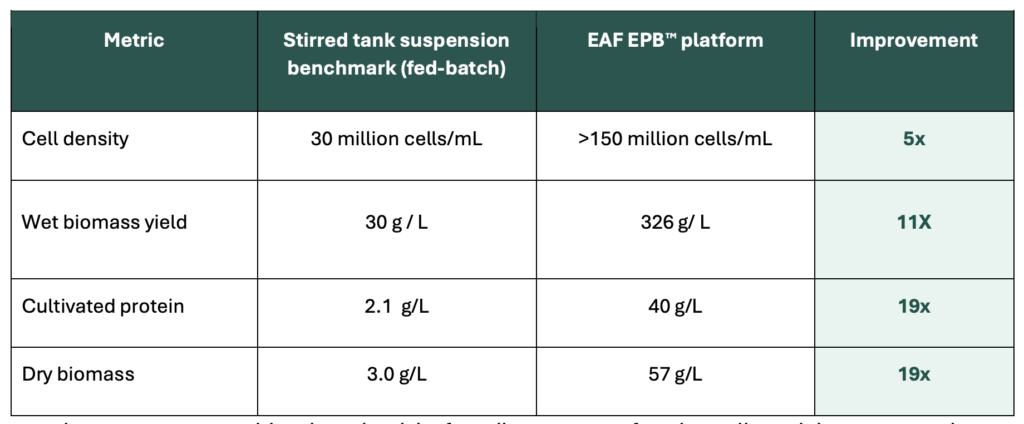
The results of this integration were striking. Within a nine-day cultivation period, the platform achieved a cell density of 150 million cells per milliliter—representing a staggering 62-fold increase from baseline metrics. Furthermore, the collaborative platform yielded volumetric productivities of 326 grams of wet biomass, 57 grams of dry biomass, and 40 grams of cultivated protein per liter.
Compared against a conventional stirred-tank suspension benchmark, the joint technology achieved a cell density five times higher, while simultaneously boosting per-cell protein and dry biomass yields fourfold. Crucially, these metrics were calculated independently of the scaffold and media contributions, with the edible scaffold comprising less than two percent of the final product by weight.
Detailed Data and Comparative Productivity Metrics
To understand the magnitude of this technical achievement, industry analysts look closely at the comparative productivity ratios. The partnership’s combined approach delivered a 19-fold increase in cultivated protein and dry biomass productivity when measured against standard stirred-tank suspension benchmarks. Simultaneously, wet biomass productivity experienced an 11-fold increase.
These numbers address the core economic challenges of cellular agriculture. In traditional bioprocessing, downstream steps such as cell harvesting, washing, and separation require extensive infrastructural investments and add significant time and financial costs to production. Ever After Foods’ technology produces structured biomass directly on an edible scaffold, effectively bypassing separate downstream processing steps.
By eliminating these extra manufacturing stages and packing higher output into identical cultivation volumes, producers can theoretically scale back capital expenditures. Less equipment, lower facility footprints, and reduced operating costs per kilogram of finished product begin to transform the financial calculus of lab-grown meat.
Leadership Perspectives and Economic Projections
Executives from both companies have emphasized that these technical gains are merely the foundation for broader commercial restructuring.
"Manufacturing productivity is one of the biggest factors determining whether cultivated meat can become economically viable," stated Eyal Rosenthal, Chief Executive Officer of Ever After Foods. "This has significant implications for production economics. Higher output from the same cultivation volume means potentially less equipment, infrastructure, and operating cost per kilogram of product."
Rosenthal noted that Ever After Foods positions itself primarily as a manufacturing technology provider. Rather than focusing exclusively on consumer-facing brands, the company intends to supply its EPB platform to industry partners worldwide, helping them scale industrial operations efficiently.
Echoing these sentiments, Ernst van Orsouw, CEO of Roslin Technologies, highlighted the synergy between the two firms. "These results demonstrate the versatility of our porcine pluripotent stem cells across suspension expansion and Ever After Foods’ tissue-production environment, while achieving substantial gains in productivity," van Orsouw remarked. "The collaboration provides an encouraging example of how complementary technologies can be integrated to address key scale-up challenges."
Economic modeling conducted by Ever After Foods indicates the potential for substantial reductions in capital and production costs relative to conventional methods. While these projections still require rigorous validation at commercial scale, the productivity data offers strong empirical evidence supporting a viable path forward.
Strategic Expansion and Commercial Roadmap
Following this technological milestone, both companies are pressing ahead with scale-up initiatives. Ever After Foods is expanding its infrastructural capabilities through strategic partnerships. Notably, the firm has collaborated with global industrial engineering leader Bühler to develop a 200-liter modular production system, marking a critical stepping stone toward industrial validation.
Beyond pork production, Ever After Foods is diversifying its portfolio. The company recently acquired Fishway, a strategic move designed to expand its capabilities into aquatic cell biology and cultivated seafood. While pet food remains an attractive and potentially faster avenue for early commercialization due to lighter regulatory friction, company leadership maintains that human consumption remains the ultimate frontier.
Regulatory Landscape and Target Markets
As the technology advances toward industrial scale, the question of regulatory clearance remains paramount. Ever After Foods operates as a B2B technology supplier, meaning regulatory requirements vary depending on the end product, specific cell lines, and target markets of its partners.
Currently, the company is actively advancing regulatory preparations in key pioneering jurisdictions, including Singapore, Israel, and the United States. These markets have established regulatory frameworks for cultivated foods, though official greenlights will depend on exhaustive dossier reviews and the specific development timelines of Ever After Foods’ commercial partners.
Broader Industry Implications
The collaboration between Ever After Foods and Roslin Technologies arrives at a critical juncture for the alternative protein sector. Amid shifting venture capital flows and mounting pressure to demonstrate clear paths to profitability, technological innovations that directly attack unit economics are vital.
By proving that high-density cell platforms can be seamlessly paired with advanced edible scaffolds to exponentially increase protein output, the partnership challenges traditional manufacturing paradigms. If these laboratory successes can be successfully replicated in commercial-scale facilities, the cultivated meat industry may finally cross the threshold from an experimental scientific endeavor into a competitive, mainstream global food category.
