
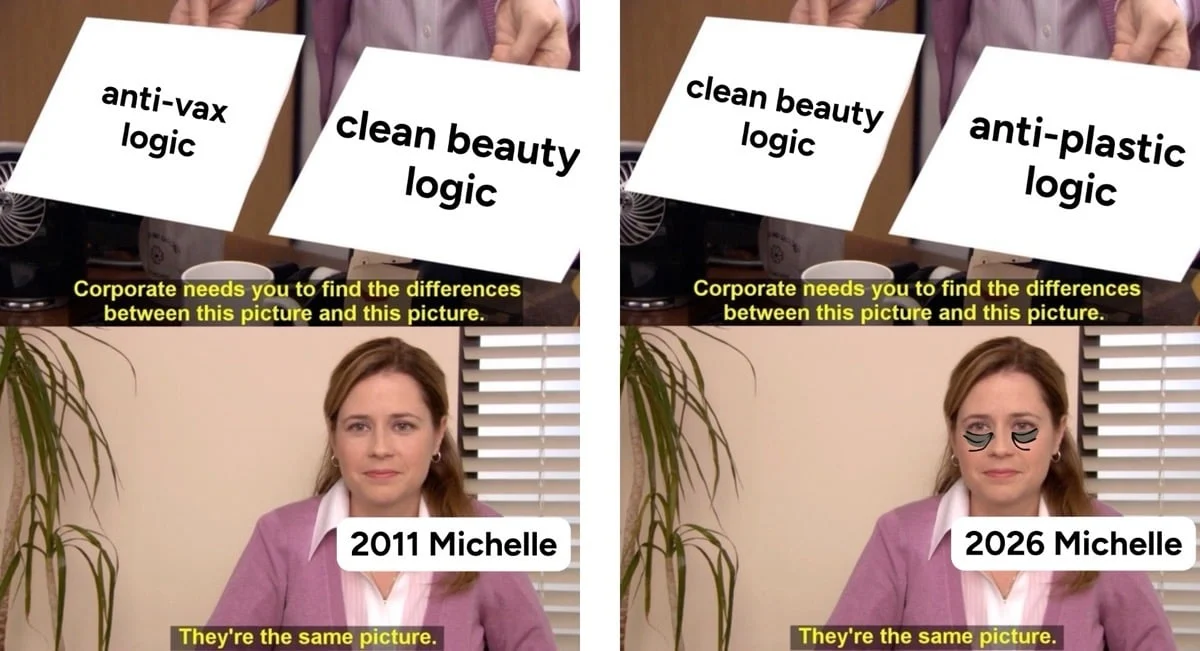
The fervent drive towards "plastic-free" products and lifestyles, particularly within the beauty industry, is increasingly drawing parallels to the "clean beauty" movement, sparking concerns among science communicators about the potential for misinformation and misaligned environmental efforts. Originally identified by Dr. Michelle Wong of Lab Muffin Beauty Science, this emerging trend exhibits a striking resemblance to the "non-toxic" clean beauty narrative that gained prominence in the early 2010s, both in its underlying logic and its propensity to demonize substances without robust scientific backing. This critique suggests that while the intention to reduce plastic waste is laudable, the current approach risks substituting genuine environmental solutions with performative greenwashing and pseudoscientific claims.
The Precedent: "Clean Beauty" and the Anti-Vax Pipeline
The "clean beauty" movement, which advocates for products free from a list of "toxic" ingredients (often including common preservatives like parabens and formaldehyde-releasing agents, as well as aluminum), emerged as a significant force in the beauty industry around 2010-2011. Driven by consumer fears and aggressive marketing, it capitalized on a distrust of synthetic chemicals and a romanticized view of "natural" ingredients. Dr. Wong, a cosmetic chemist and science communicator, noted at the time that the rhetorical strategies employed by clean beauty advocates shared significant commonalities with anti-vaccination narratives, particularly in their demonization of specific chemicals and their disregard for fundamental toxicological principles such as "the dose makes the poison." Both movements, she observed, often cited flawed studies, ignored scientific consensus, and fostered an environment of fear around substances deemed "unnatural" or "chemical." The economic impact was substantial, with the global clean beauty market projected to reach over $50 billion by 2027, indicating a strong consumer appetite for products perceived as safer and more ethical, even if those perceptions were not always scientifically grounded.
The Rise of "Plastic-Free": A New Paradigm or Echo?
Fast forward to the mid-2020s, and a similar wave of rhetoric is accompanying the "plastic-free" movement. Fueled by growing public awareness of plastic pollution, particularly the visible accumulation of waste in oceans and landfills, and concerns about microplastics, brands and influencers are increasingly adopting "plastic-free" as a core marketing tenet. While the urgency to address plastic waste is undeniable, the current discourse, much like clean beauty, often simplifies complex environmental issues into a binary of "plastic = bad, alternative = good." This simplification, critics argue, frequently overlooks the holistic environmental impact of alternative materials and processes, potentially leading to unintended consequences that may exacerbate other environmental problems, such as climate change.
Scientific Scrutiny: Deconstructing the "Plastic-Free" Narrative
Several key parallels underscore the argument that "plastic-free" is mirroring the "clean beauty" playbook, often at the expense of sound scientific reasoning:
1. Appeal to Nature Fallacy:
At the core of many "plastic-free" claims is the appeal to nature fallacy – the belief that anything "natural" is inherently good or superior, while anything synthetic (like plastic) is inherently bad. This extends to materials like bioplastics, which, despite being derived from natural sources, often present their own set of environmental challenges, including land use, water consumption, and complex end-of-life considerations. The fundamental flaw in this logic is that a substance’s origin reveals little about its safety or environmental impact; many natural substances are toxic, and many synthetic ones are benign or even beneficial. For instance, some of the most potent poisons known to humanity, such as botulinum toxin or ricin, are entirely natural. Conversely, plastics have revolutionized medicine, hygiene, and countless industries due to their versatility, durability, and safety profile.
2. Misunderstanding Environmental Science: The Role of Life Cycle Assessments (LCAs):
Just as clean beauty ignored basic toxicology, the blanket assertion that "plastic-free equals better for the environment" often disregards the fundamentals of sustainability science, particularly Life Cycle Assessments (LCAs). LCAs are the gold standard for quantifying a product’s environmental impact across its entire lifespan, from raw material extraction, manufacturing, transportation, use, and ultimately, disposal or recycling. This comprehensive approach often reveals that the end-of-life stage, while visually impactful, may not be the most significant contributor to a product’s overall environmental footprint.
Consumer perception, however, frequently overemphasizes end-of-life issues like landfill waste and microplastics, leading to an underappreciation of upstream impacts such as energy consumption and carbon emissions during manufacturing and transport. For many products, plastic packaging, being lightweight and durable, often results in a lower carbon footprint during transport compared to heavier alternatives like glass or aluminum. A 2011 Denkstatt report, for example, found that switching from plastic to glass, paper, or aluminum would, on average, require 3.6 times more material, 2.2 times more energy, and result in 2.7 times more carbon emissions. This is largely due to plastic’s superior strength-to-weight ratio and its efficiency in production. Ignoring these holistic impacts can lead to "solutions" that inadvertently worsen the climate crisis, which is widely recognized by scientists as the paramount environmental threat.
3. Methodological Flaws in Microplastic Research:
The scientific understanding of microplastics and their health impacts is still evolving. However, a significant concern highlighted by experts is the prevalence of methodological issues in some microplastic studies, leading to potentially exaggerated or false positive results. The inherent difficulty in accurately measuring minute quantities of substances, coupled with the ubiquity of microplastics in the environment, makes contamination a pervasive challenge. For instance, techniques like pyrolysis-GCMS (Py-GCMS), commonly used to quantify microplastics, can misinterpret fatty acids as polyethylene unless rigorous controls are in place, potentially leading to overestimations, as seen in studies claiming significant microplastic accumulation in human brains. Reports in outlets like The Guardian in early 2026 began to critically examine these methodological shortcomings, suggesting that some widely reported findings may have been overstated.
4. Correlation vs. Causation: Interpreting Health Impacts:
A recurring theme from clean beauty, which often linked parabens to breast cancer based on correlative studies, is now emerging in microplastic discourse. The detection of microplastics in diseased tissues, such as arterial plaque or brains of individuals with dementia, is frequently presented as evidence of causation. However, as with clean beauty’s "parabens in tumors" narrative, correlation does not equate to causation. Such findings could be attributed to reverse causation (e.g., diseased tissue is more susceptible to microplastic accumulation), confounding factors, or simply the pervasive presence of microplastics in the environment, making their detection in any tissue unsurprising without clear evidence of a pathogenic role.
5. Overlooking Functional Benefits of Plastics:
The singular focus on "plastic-free" often eclipses the numerous, often critical, benefits that plastics provide beyond environmental impact. These include:
- Product Protection and Preservation: Plastics are highly effective at protecting products from contamination, spoilage, and damage, extending shelf life and reducing waste.
- Safety and Hygiene: In healthcare, packaging, and personal care, plastics ensure sterility and prevent cross-contamination.
- Accessibility and Affordability: The low cost and widespread availability of plastics make many products accessible to a broader population, a crucial factor in developing economies.
- Durability and Lightweighting: Plastics enable lighter transport loads, reducing fuel consumption and emissions, and contribute to the longevity of goods.
Just as parabens are highly effective preservatives requiring lower concentrations than many alternatives (thus potentially causing fewer allergic reactions), plastics often offer unparalleled functional advantages that, when removed without careful consideration, can lead to inferior products, increased waste, or higher overall environmental costs.
The Role of Brands and Influencers: "Science-Washing" and Greenwashing
A significant driver of both clean beauty and the "plastic-free" movement is "science-washing" – the appropriation of scientific language and imagery to lend credibility to marketing claims that lack genuine scientific basis. Many brands and influencers, despite proclaiming adherence to science, propagate anti-plastic myths supported by cherry-picked evidence or "convenient experts." This phenomenon is not unique to beauty but mirrors trends in wellness and fitness, where perceived scientific authority is leveraged to sell products.
Regulatory bodies globally are beginning to crack down on unsubstantiated "eco-friendly" claims. The US Federal Trade Commission (FTC), the UK Competition and Markets Authority (CMA), and the Australian Competition and Consumer Commission (ACCC) have issued guidelines to prevent misleading "green" marketing. Brands that genuinely aim to be sustainable are advised to engage qualified sustainability experts and conduct rigorous LCAs rather than relying on superficial buzzwords.
Motivated Reasoning and Media Scrutiny
The critical examination of the "plastic-free" narrative often encounters resistance, particularly due to identity-based motivated reasoning and confirmation bias. When mainstream media outlets, such as The Guardian, published articles in early 2026 questioning the methodology of certain microplastic studies and correcting previous reporting, they faced accusations of being "bought by Big Plastic." This response occurred despite the articles quoting multiple independent scientists from public institutions alongside former industry chemists, demonstrating a nuanced, evidence-based approach. As cosmetic scientist Jen Novakovich, whose work heavily informs this discussion, aptly states, "Discounting something solely based on funding source or affiliation is actually the opposite of critical thinking." Evaluating the arguments themselves, rather than merely their source, is essential for critical thinking.
Broader Implications: Environmental Effectiveness and Consumer Trust
The parallels between the "plastic-free" and "clean beauty" movements highlight a broader challenge in environmental discourse: the risk of misdirecting well-intentioned efforts due to a lack of scientific literacy and critical thinking. While reducing plastic waste is an imperative, a blanket demonization of plastic, without a comprehensive assessment of its lifecycle impacts and functional benefits, risks:
- Increased Environmental Footprint: Substituting plastic with heavier or more energy-intensive materials (like glass or aluminum) without proper LCA can lead to higher carbon emissions, increased water usage, and greater resource depletion.
- Economic Burden: Consumers often pay a premium for "plastic-free" alternatives that may not offer genuine environmental advantages, creating a perception of sustainability without real impact.
- Erosion of Trust: When brands and influencers promote unscientific or misleading environmental claims, it ultimately erodes consumer trust in genuine sustainability efforts and expert advice.
- Diversion of Resources: Focusing on superficial "plastic-free" goals can divert attention and resources from more impactful solutions, such as improving recycling infrastructure, developing truly sustainable new materials, or reducing overall consumption.
Conclusion
The "plastic-free" movement, while born from legitimate concerns about environmental degradation, stands at a critical juncture. It can either evolve into a scientifically grounded pursuit of holistic sustainability or risk becoming another iteration of the "clean beauty" phenomenon—a movement characterized by fearmongering, pseudoscientific claims, and ultimately, ineffective or even counterproductive outcomes. Moving forward, a rigorous, evidence-based approach, prioritizing life cycle assessments, accurate scientific communication, and a holistic understanding of environmental impacts, is essential to ensure that efforts to reduce plastic waste genuinely contribute to better human and environmental health, rather than simply replacing one set of problems with another. The goal should be informed conservation, not misplaced activism.
