
The concept of "hair porosity" has become a cornerstone of modern haircare advice, guiding countless individuals toward products and routines tailored to what is believed to be their hair’s unique ability to absorb and retain moisture. This term, however, is far more complex and multifaceted than commonly understood, encompassing various definitions within different scientific and cosmetic contexts. While many users report positive outcomes from following porosity-based recommendations, scientific scrutiny reveals that the popular at-home diagnostic tests – such as the float test and the drop test – often relied upon to determine one’s hair porosity are fundamentally flawed, offering misleading insights into hair’s true internal structure and hydration capabilities. These widely circulated tests, rather than measuring actual internal porosity, predominantly assess the surface characteristics of hair, specifically its interaction with liquid water, which is governed by principles of surface tension and hydrophobicity, not its inherent capacity for internal absorption.
The Pervasive Influence of Hair Porosity in Modern Haircare
The rise of "hair porosity" as a diagnostic tool gained significant traction with the burgeoning interest in personalized beauty routines, particularly within the natural hair community. For many, these simple, accessible tests offered a seemingly scientific method to understand their hair type better and select products more effectively. The promise was empowerment: by knowing your hair’s porosity, you could unlock the secrets to optimal hydration, styling, and overall hair health. This narrative fostered a widespread belief in the diagnostic power of the float and drop tests, making them a staple in online beauty forums, blogs, and even some professional consultations. However, the scientific principles underlying these tests are often oversimplified or entirely misunderstood, leading to a disconnect between the observed phenomena and their actual implications for hair biology.
Challenging the "Waterproof" Hair Myth
A pervasive misconception underpinning many of these porosity myths is the idea that healthy, undamaged hair is inherently waterproof. This belief posits that the hair cuticle, when intact, forms an impenetrable barrier against water, and that conditioners function primarily by mimicking this sealing action on damaged hair. Scientific evidence, however, unequivocally contradicts this notion. Human hair, even in its most pristine and undamaged state, is far from waterproof. Research demonstrates that undamaged hair possesses a remarkable capacity to absorb a significant amount of water, often up to 30% – nearly one-third – of its own dry weight, within mere minutes of exposure. This absorption is not a slow, gradual process, but rather a rapid exchange influenced by ambient humidity, indicating that hair’s water content is dynamic and constantly adjusting to environmental conditions.
The Science of Hair Hydration: Beyond the Cuticle
Consider the detailed data from scientific studies, such as those compiled by C.R. Robbins in Chemical and Physical Behavior of Human Hair. This research illustrates the direct relationship between relative humidity and the weight of water absorbed by hair, showcasing its inherent hygroscopic nature:
| Relative humidity (%) | Weight of water absorbed (%) |
|---|---|
| 0 | 0 |
| 8 | 3.9 |
| 40 | 10.2 |
| 63 | 14.8 |
| 86 | 22.6 |
| 100 | 31.2 |
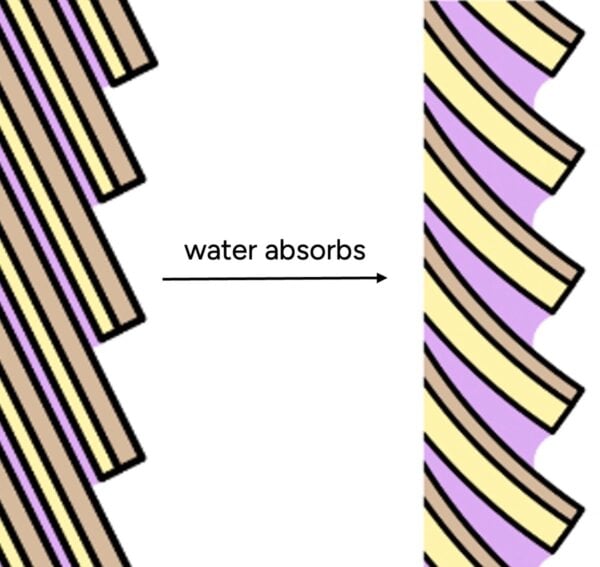
This table underscores that hair is a highly hygroscopic material, meaning it readily absorbs moisture from the air. Even at moderate humidity levels (e.g., 40%), hair can absorb over 10% of its weight in water, a clear indicator that its structure is designed for moisture exchange, not impermeability. This phenomenon occurs because hair’s intricate structure, often likened to a pinecone, is not a seamless, sealed tube. The natural protective F-layer, a thin lipid coating, is present only on the uppermost surface of each cuticle scale. Between these overlapping scales exist microscopic gaps and fissures, providing numerous pathways through which water molecules, particularly in their gaseous state, can penetrate the hair shaft. This allows for constant equilibrium with environmental moisture, maintaining hair’s flexibility and strength.
Conditioners: Smoothing Agents, Not Impermeable Seals
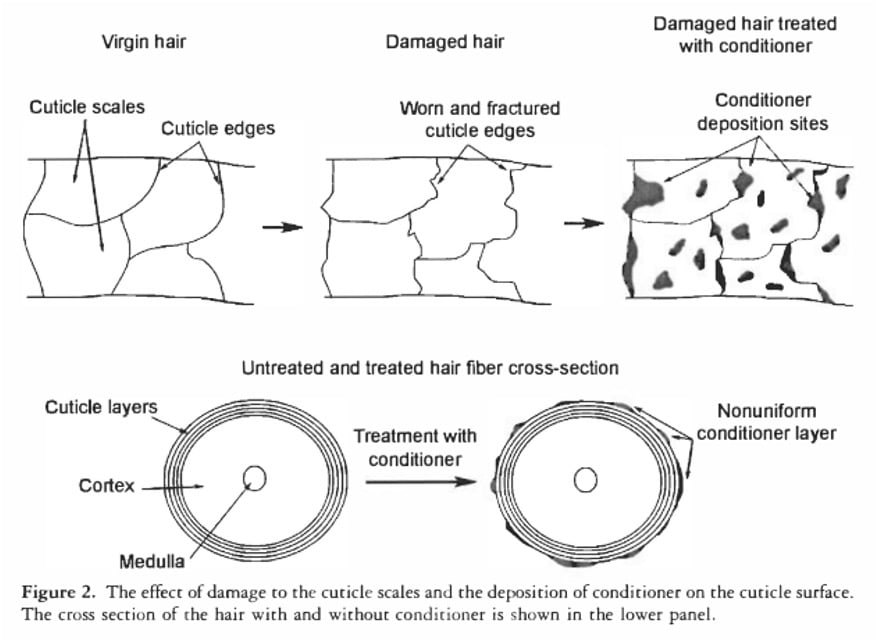
Furthermore, the role of hair conditioners is frequently misunderstood in the context of waterproofing. Conditioners are designed to smooth the hair’s surface, reduce friction, and impart softness and shine. They achieve this by depositing conditioning agents, typically silicones or cationic surfactants, onto the hair shaft. However, these deposits do not form a continuous, impermeable film that seals off the hair from water. Instead, as electron microscopy images, such as those presented by La Torre and Bhushan in their 2006 Journal of Cosmetic Science study, reveal, conditioners adhere to the hair surface in discrete "blobs" or patches. While these microscopic deposits are sufficient to create a smooth tactile sensation and reduce tangling, their discontinuous nature means they are ineffective at preventing the ingress of tiny water molecules. Water molecules are significantly smaller than the gaps between these conditioner deposits, allowing them to bypass the "sealed" surface and enter the hair’s cortex.
Deconstructing the At-Home Porosity Tests: Float and Drop
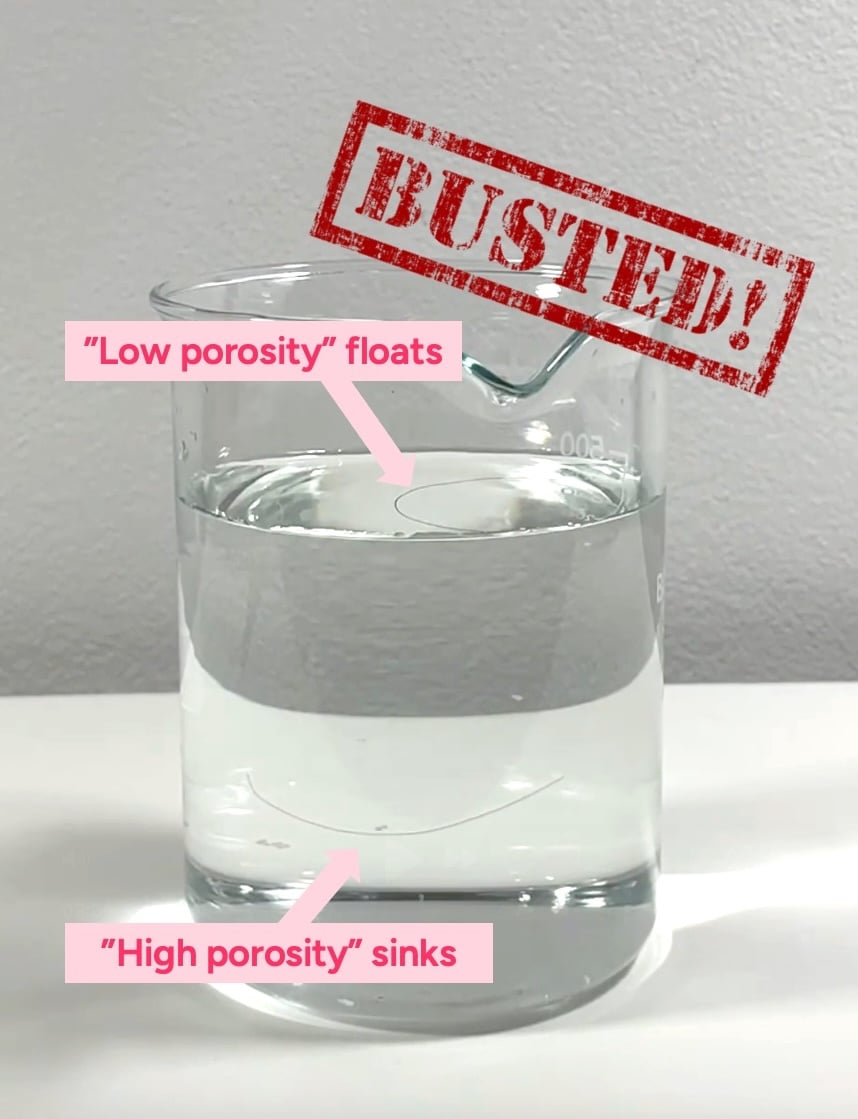
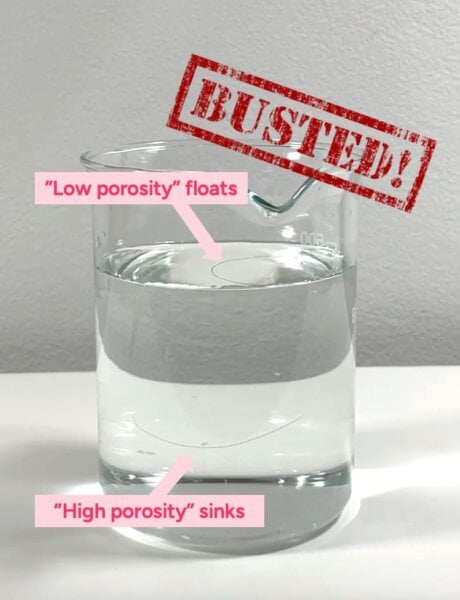
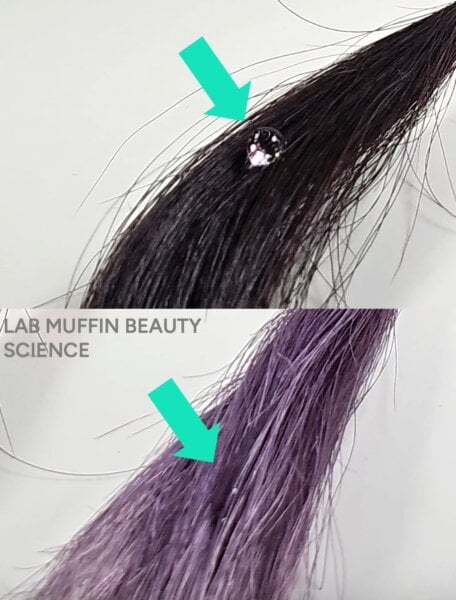
These scientific realities directly challenge the premises of popular at-home porosity tests. The Float Test, for instance, instructs individuals to place a single strand of hair into a glass of water. The common interpretation suggests that hair that sinks rapidly is "high porosity" (damaged and absorbent), while hair that floats indicates "low porosity" (undamaged and resistant to water). Similarly, the Drop Test involves placing a droplet of water onto a section of hair. If the water bead remains round and sits on the surface, it’s deemed "low porosity," whereas a droplet that quickly flattens and spreads is labeled "high porosity." Both tests are presented as direct measures of how readily hair absorbs water into its core.
The Critical Role of Surface Tension in Water Interactions
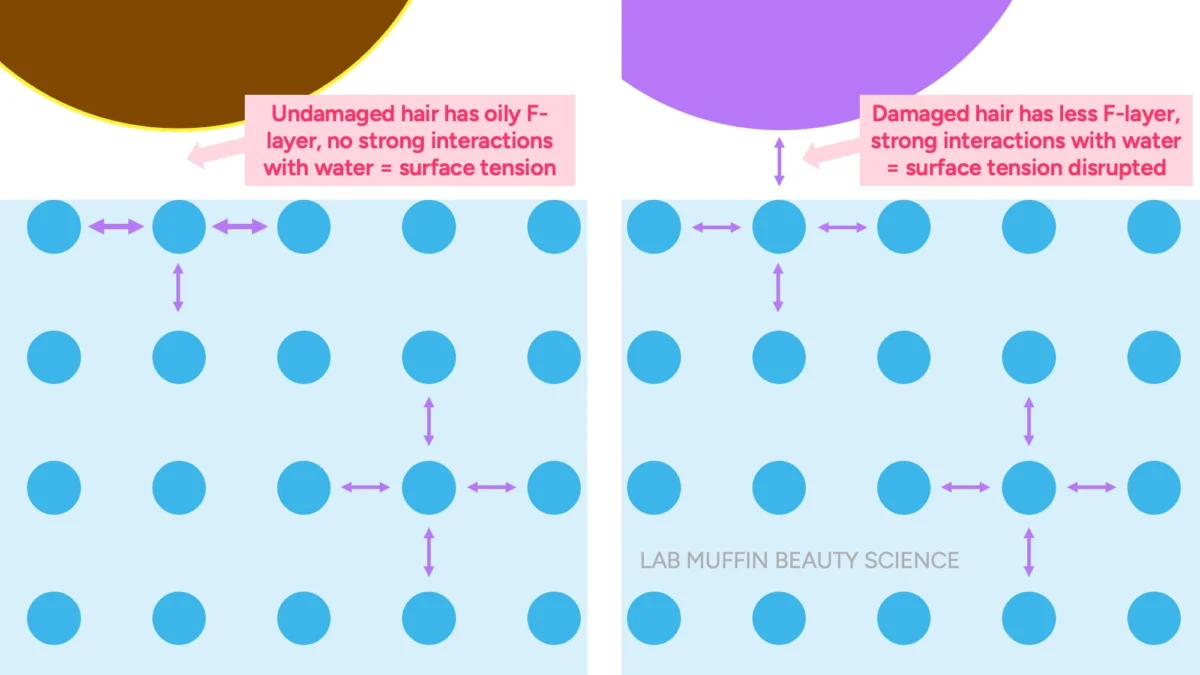
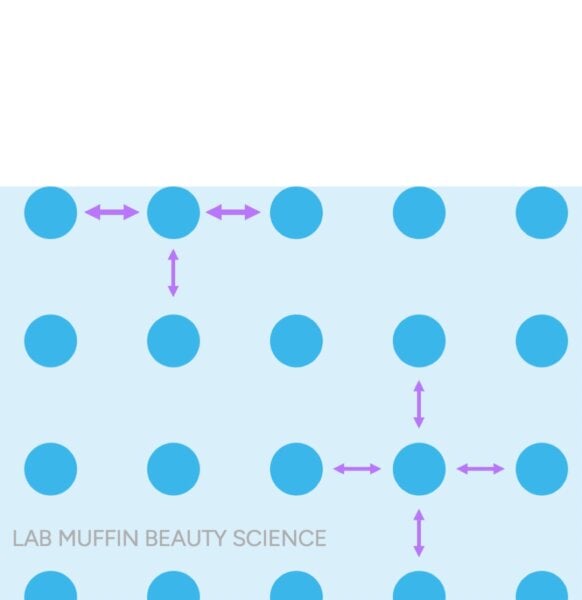
However, the observations made during these tests are not primarily about water absorption into the hair’s interior, but rather about the interaction between the water’s surface tension and the hair’s outer surface. Surface tension is a critical physical property of liquids, particularly water, where the cohesive forces between water molecules at the liquid-air interface are stronger than those in the bulk of the liquid. This creates a resilient, elastic "skin" on the water’s surface, capable of supporting objects denser than water itself. A classic example is a paperclip or an insect floating on water; despite being significantly denser than water (steel is approximately eight times denser), they remain afloat because the surface tension of the water prevents them from breaking through its "skin." This fragile equilibrium is easily disrupted – a gentle poke or the addition of a surfactant (like detergent) will cause the paperclip to sink immediately, not because it suddenly absorbed water, but because the surface tension has been compromised.
Understanding the Mechanics of the Float Test
Applying this principle to the Float Test, undamaged hair typically possesses an intact F-layer, which is a hydrophobic (water-repelling) lipid layer. When such hair is gently placed on water, the strong surface tension of the water, combined with the hair’s hydrophobic surface, allows the strand to rest on the water’s "skin" without immediately breaking through. The hair floats, not because it cannot absorb water, but because it repels the liquid water at its surface, preserving the water’s surface tension. Conversely, damaged hair often has a compromised or absent F-layer, exposing a more hydrophilic (water-attracting) protein surface. When this damaged, hydrophilic hair encounters water, it readily forms hydrogen bonds with the water molecules at the surface. This interaction disrupts the cohesive forces that maintain water’s surface tension, effectively "poking" the water’s skin and causing the hair to sink. Therefore, the Float Test is primarily a gauge of the integrity of the hair’s outer hydrophobic layer and its capacity to interact with liquid water’s surface tension, rather than a measure of its internal porosity or water absorption rate.
Analyzing the Drop Test Through a Scientific Lens
The Drop Test operates on a similar principle of surface interaction. On undamaged hair with its intact F-layer, a water droplet maintains a high contact angle, appearing as a round bead, because the hydrophobic surface repels the water, minimizing contact and preserving the droplet’s spherical shape due to its own internal cohesive forces. On damaged hair, where the F-layer is compromised, the exposed hydrophilic surface readily "wets" and bonds with the water molecules. This reduces the contact angle, causing the droplet to spread out and flatten, appearing to "absorb" more quickly. Again, this is a surface phenomenon – the water is spreading along the hair shaft and between individual strands, not necessarily being rapidly absorbed into the hair’s core in liquid form. While damaged hair can absorb slightly more water (around 45% of its weight) compared to undamaged hair’s 30%, this difference is not significant enough to explain the immediate and dramatic spreading observed in the drop test solely through internal absorption of liquid water.
Water Absorption: Liquid vs. Vapor
So, if these tests aren’t measuring how quickly liquid water soaks into the hair, how does undamaged hair manage to absorb up to 30% of its weight in water? The key distinction lies between liquid water and water vapor. The significant water absorption observed in undamaged hair, as detailed in the humidity table, occurs when hair is exposed to humid air, not necessarily when submerged in liquid water. In a gaseous state, individual water molecules are much smaller and less cohesive than in liquid form. They float freely and can easily "wiggle" their way through the microscopic gaps between the cuticle scales and into the hair’s cortex, unimpeded by the surface tension effects that govern liquid-solid interactions. This gaseous absorption is a continuous process, allowing hair to maintain a moisture equilibrium with its environment.
The Coincidental Efficacy: Why "Porosity" Advice Sometimes Works
Despite their scientific inaccuracies, the widespread popularity of "porosity" advice and the corresponding at-home tests is undeniable. This phenomenon can be traced to the desire for personalized haircare solutions, especially within communities focused on natural hair care, where understanding hair characteristics is paramount. The simplicity of these tests offered an accessible, seemingly scientific method for individuals to categorize their hair and choose products. Often, the advice derived from these tests does lead people to products that coincidentally suit their hair better. This is because what the float and drop tests do effectively diagnose is the degree of surface damage to the hair. Hair diagnosed as "high porosity" by these tests typically has a compromised F-layer and damaged cuticles, which is indeed a sign of structural damage. Haircare recommendations for "high porosity" hair often involve rich, moisturizing ingredients, protein treatments, and techniques to seal the cuticle – all of which are beneficial for genuinely damaged hair. Conversely, "low porosity" hair, characterized by an intact F-layer and smooth cuticle, benefits from lighter products that don’t cause buildup, advice that also aligns with the needs of less damaged hair.
Critical Implications for Consumers and Hair Professionals
However, relying solely on these tests for a comprehensive understanding of hair health can lead to significant misinterpretations and suboptimal haircare decisions. For example, chemical treatments such as coloring, perming, or relaxing penetrate the hair shaft to alter its internal structure. The rate at which these chemicals penetrate is influenced by factors like the hair’s internal structure, density, and prior chemical treatments, not solely by the surface characteristics that these "porosity" tests measure. A person with significant surface damage (leading to a "high porosity" test result) might still have tightly packed internal structures that resist chemical penetration, requiring longer processing times. Conversely, someone with seemingly "low porosity" hair might have internal characteristics that allow for rapid chemical uptake. Misjudging this based on a float or drop test could lead to under-processing, over-processing, or inconsistent results, posing potential risks to hair integrity.
Furthermore, external factors can heavily influence test outcomes. Regular use of heavy oils or waxes, for instance, can coat the hair shaft, temporarily enhancing its hydrophobicity and causing it to float or repel water droplets, leading to a "low porosity" diagnosis, even if the underlying hair structure is damaged. This demonstrates that the tests are highly susceptible to superficial coatings rather than reflecting intrinsic hair properties.
For professional hairstylists and colorists, this distinction is particularly crucial. Relying on such rudimentary tests for chemical services is strongly cautioned against. The optimal approach remains direct strand testing with the actual product to be used. This involves applying a small amount of the chemical treatment to a hidden strand of hair to observe its processing time and reaction, ensuring precise and safe application for the client’s entire head of hair. This practical, empirical method provides far more accurate information than any at-home "porosity" test.
Moving Forward: Towards Science-Backed Haircare
In conclusion, while the concept of hair porosity has brought valuable attention to personalized haircare, the popular at-home tests designed to diagnose it are scientifically misleading. They provide information primarily about the surface integrity and hydrophobicity of hair, not its internal absorption capacity. Understanding that even healthy hair readily absorbs water vapor, and that conditioners smooth rather than seal, is vital for a truly informed approach to haircare. Consumers and professionals alike should move towards a more nuanced, science-backed understanding of hair biology, prioritizing direct observation and professional assessment over simplified, often misinterpreted, diagnostic tools. This shift will foster more effective haircare practices and ensure that treatments are truly tailored to the hair’s actual needs, rather than its perceived "porosity" based on flawed tests.
References
Robbins CR. Chemical and Physical Behavior of Human Hair. 5th ed. Springer Berlin Heidelberg 2012.
La Torre C, Bhushan B. Nanotribological effects of silicone type, silicone deposition level, and surfactant type on human hair using atomic force microscopy. J Cosmet Sci. 2006;57(1):37-56.
Affiliate Disclosure: I receive a small commission for purchases made via affiliate links. How to cite: Wong M. Hair porosity tests are a lie. Lab Muffin Beauty Science. January 28, 2026. Accessed July 15, 2026. https://labmuffin.com/hair-porosity-tests-are-a-lie/
