
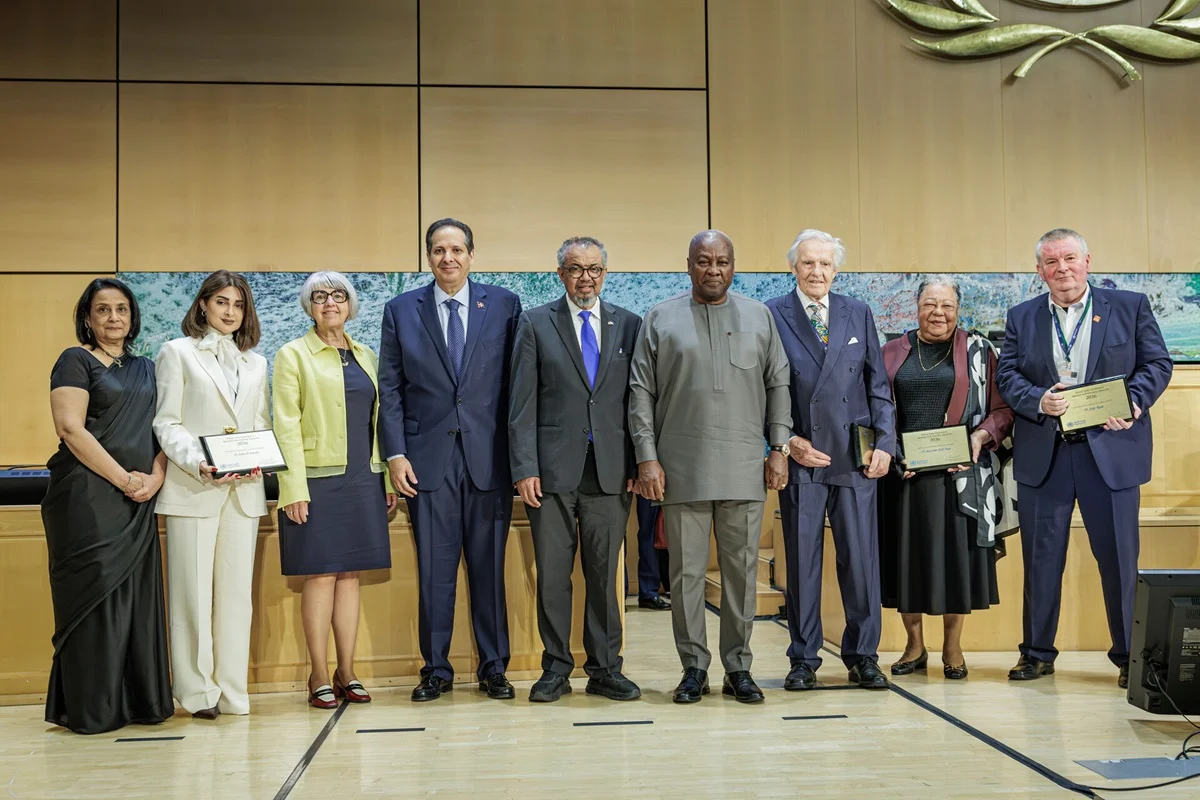
In a ceremony marked by a call for international solidarity and renewed commitment to public health equity, World Health Organization (WHO) Director-General Dr. Tedros Adhanom Ghebreyesus presented the Global Health Leaders Award to four distinguished individuals during the Seventy-ninth World Health Assembly (WHA) in Geneva. The awards, which recognize lifetime achievements and exceptional contributions to global health, were bestowed upon Dr. Tore Godal, Dr. Merceline Dahl-Regis, Dr. Mike Ryan, and Dr. Heba El Sewedy. This year’s assembly, convened under the theme "Reshaping global health: a shared responsibility," highlights the necessity of collaborative leadership in an era defined by emerging pathogens, climate-driven health crises, and the persistent burden of infectious and non-communicable diseases.
The Director-General’s Awards for Global Health were established in 2019 to honor those whose leadership has resulted in tangible, life-saving improvements in health outcomes. During his opening remarks at the High-Level Welcome, Dr. Tedros emphasized that the work of the four laureates transcends national borders, embodying the spirit of the WHO’s mission to promote health, keep the world safe, and serve the vulnerable. The 2026 honors come at a critical juncture as the international community seeks to finalize pandemic preparedness treaties and address the widening health disparities between the Global North and South.
Dr. Tore Godal: Architect of Global Immunization Infrastructure
Dr. Tore Godal was recognized for his transformative leadership in the fields of immunization and infectious disease control. Often described as one of the most influential figures in global health over the last half-century, Dr. Godal’s career has been defined by his ability to bridge the gap between scientific research and large-scale public health implementation.
His recognition at the 79th WHA stems largely from his role in establishing Gavi, the Vaccine Alliance. Launched at the turn of the millennium, Gavi was a revolutionary public-private partnership designed to improve access to new and underused vaccines for children living in the world’s poorest countries. Since its inception, Gavi has helped vaccinate more than 1 billion children, preventing more than 17.3 million future deaths. Dr. Godal’s vision for Gavi laid the groundwork for modern health financing, ensuring that market forces were leveraged to lower vaccine prices for developing nations.
Beyond Gavi, Dr. Godal played a pivotal role in the creation of the Coalition for Epidemic Preparedness Innovations (CEPI) and the Roll Back Malaria partnership. During his tenure leading the WHO’s Tropical Diseases Programme, he spearheaded efforts to combat neglected tropical diseases (NTDs). His advocacy for community-based ivermectin distribution was a cornerstone in the fight against onchocerciasis, or river blindness. This initiative transformed the lives of millions in sub-Saharan Africa, where the disease had previously rendered vast tracts of fertile land uninhabitable due to the risk of blindness. By empowering local communities to manage their own health interventions, Dr. Godal pioneered a model of sustainable development that remains a gold standard in public health today.
Dr. Merceline Dahl-Regis: A Pioneer of Regional Disease Elimination
The award presented to Dr. Merceline Dahl-Regis celebrates her lifelong dedication to expanding immunization and achieving historic milestones in disease elimination within the Region of the Americas. A Bahamian physician and public health expert, Dr. Dahl-Regis has been a driving force behind the Pan American Health Organization’s (PAHO) most significant successes.
One of her most notable achievements was leading the effort to eliminate measles and rubella in the Americas. In 2016, the region became the first in the world to be declared free of endemic measles, a feat that required rigorous surveillance, high vaccination coverage, and unprecedented political will across diverse nations. This milestone served as a proof-of-concept for the rest of the world, demonstrating that with coordinated regional action, even highly contagious viral diseases could be eradicated.
Dr. Dahl-Regis also championed the Dual Elimination Initiative, which sought to end mother-to-child transmission (MTCT) of syphilis and HIV. Her holistic approach integrated maternal and child health services with infectious disease protocols, ensuring that the most vulnerable members of society received comprehensive care. Her work has not only saved countless lives but has also strengthened the primary healthcare systems of Caribbean and Latin American nations. In the context of the 79th WHA, her award serves as a reminder of the power of regional collaboration in achieving global health targets.
Dr. Mike Ryan: Leading the Frontlines of Health Emergencies
Dr. Mike Ryan, currently the Executive Director of the WHO Health Emergencies Programme, was honored for his decades of leadership in preparing for and responding to global health crises. Dr. Ryan’s career has been synonymous with the WHO’s operational evolution, shifting the organization from a purely technical advisory body to a frontline responder in humanitarian emergencies.
As a founder of the Global Outbreak Alert and Response Network (GOARN), Dr. Ryan helped create a mechanism that allows the international community to deploy experts and resources rapidly to the site of an outbreak. His leadership has been tested in some of the most challenging environments on earth, including conflict zones and areas with collapsed infrastructure. He has led responses to a spectrum of threats, including SARS, cholera, Ebola, and polio.
Perhaps most notably, Dr. Ryan became a global household name during the COVID-19 pandemic. His direct, science-based communication and his insistence on equity in the distribution of medical countermeasures were vital during the height of the crisis. Analysts point out that Dr. Ryan’s work has been instrumental in shaping the International Health Regulations (IHR), the legal framework that governs how countries report and respond to public health events of international concern. His recognition at the WHA underscores the importance of resilient emergency systems and the need for courageous leadership when facing "Disease X"—the placeholder for the next unknown pathogen that could trigger a pandemic.
Dr. Heba El Sewedy: Humanitarian Action and Social Justice
Dr. Heba El Sewedy received the Global Health Leaders Award for her profound dedication to humanitarian action, specifically through her work with the Ahl Masr Foundation. Founded in 2013, the foundation was established to address a critical but often overlooked gap in the Egyptian healthcare system: the treatment and reintegration of burn victims.
In many developing nations, burn injuries are a major cause of mortality and lifelong disability, yet specialized care is often prohibitively expensive or non-existent. Dr. El Sewedy’s foundation pioneered a comprehensive model of care that includes not only advanced surgical intervention and skin grafting but also psychological support and social reintegration. By focusing on the dignity of survivors, she has challenged the stigma associated with disfigurement and trauma.
Furthermore, Dr. El Sewedy has extended her humanitarian reach to provide medical aid to those affected by the conflict in Gaza. Her work represents the intersection of public health and social justice, emphasizing that healthcare is a fundamental human right that must be upheld even in the midst of war and displacement. Her foundation stands as a model of how non-governmental organizations (NGOs) can partner with public sectors to provide high-quality, people-centered care.
Context and Chronology of the Global Health Leaders Awards
The Seventy-ninth World Health Assembly takes place against a backdrop of significant institutional change for the WHO. Since the establishment of the Director-General’s Awards in 2019, the honors have served to highlight the "human element" of public health. While global health is often discussed in terms of data, budgets, and policies, these awards refocus attention on the individuals who navigate political and logistical hurdles to implement change.
The timeline of global health achievements represented by this year’s laureates spans from the late 20th century to the present. In the 1980s and 90s, the focus was on establishing basic immunization and tackling NTDs (Dr. Godal). The early 2000s saw the rise of regional elimination goals (Dr. Dahl-Regis) and the formalization of outbreak response (Dr. Ryan). The last decade has seen an increased emphasis on social justice, trauma care, and the role of private philanthropy in humanitarian crises (Dr. El Sewedy).
Supporting Data and Global Health Milestones
The impact of the work led by these four individuals can be quantified through several key metrics:
- Vaccine Impact: According to WHO and Gavi data, immunization currently prevents 3.5 to 5 million deaths every year from diseases like diphtheria, tetanus, pertussis, influenza, and measles.
- Disease Elimination: The Americas were declared free of endemic rubella in 2015 and measles in 2016, a direct result of the strategies championed by leaders like Dr. Dahl-Regis.
- Emergency Response: Since its inception, GOARN (co-founded by Dr. Ryan) has conducted over 3,000 deployments to respond to outbreaks in more than 115 countries.
- Burn Care: The Ahl Masr Foundation estimates that nearly 250,000 people in Egypt suffer from burn accidents annually, with a high mortality rate among children. The foundation’s specialized hospital is the first of its kind in the Middle East and Africa to provide free treatment at this scale.
Official Responses and Implications for the Future
The presentation of the awards elicited widespread praise from international delegates and health ministers present in Geneva. In a statement following the ceremony, a representative from the Pan American Health Organization noted that the recognition of Dr. Dahl-Regis serves as an "inspiration for all regional offices to pursue the highest standards of disease surveillance and elimination."
Health policy analysts suggest that the selection of these four laureates reflects the WHO’s current strategic priorities. By honoring Dr. Godal and Dr. Dahl-Regis, the WHO reaffirms the central role of immunization in the "triple billion" targets (one billion more people benefiting from universal health coverage, one billion more protected from health emergencies, and one billion more enjoying better health and well-being). The recognition of Dr. Ryan emphasizes the ongoing need for a robust, well-funded Health Emergencies Programme, while the award for Dr. El Sewedy signals a shift toward recognizing the importance of specialized humanitarian care and social equity.
As the Seventy-ninth World Health Assembly continues, the achievements of these leaders provide a roadmap for the "shared responsibility" mentioned in the assembly’s theme. Their careers demonstrate that while global health challenges are increasingly complex, they are not insurmountable. The integration of scientific innovation, regional cooperation, operational readiness, and compassionate humanitarianism remains the most effective strategy for building a healthier and more equitable world.
The laureates’ work will likely influence the discussions at the WHA regarding the Sustainable Development Goals (SDGs), particularly Goal 3, which aims to ensure healthy lives and promote well-being for all at all ages. As member states deliberate on budget allocations and policy frameworks for the coming years, the examples set by Godal, Dahl-Regis, Ryan, and El Sewedy serve as a powerful testament to the impact of dedicated leadership in the pursuit of global health security.
