
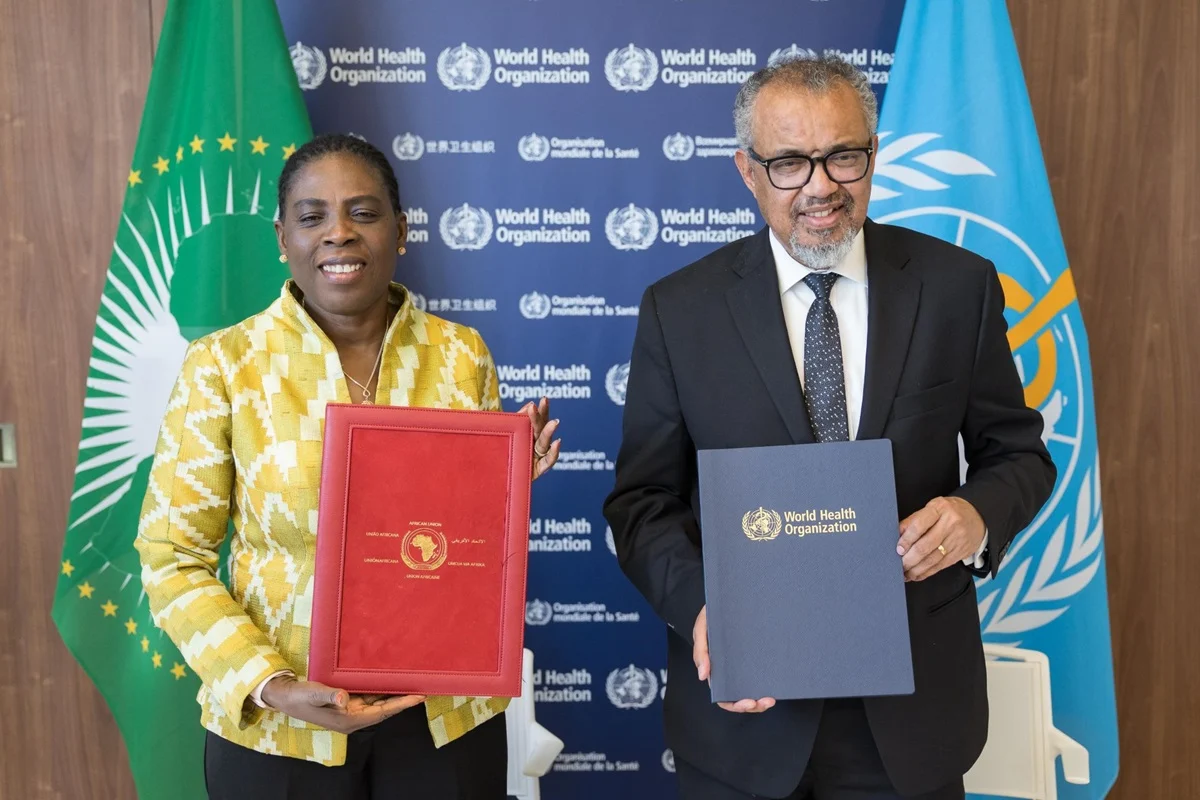
The World Health Organization (WHO) and the African Union (AU) Commission have officially renewed their strategic partnership through an updated Memorandum of Understanding (MoU), signed on the sidelines of the 78th World Health Assembly in Geneva. This landmark agreement serves as a formal commitment to fortify health security, accelerate the path toward universal health coverage (UHC), and foster sustainable development across the African continent. In a global landscape marked by tightening fiscal constraints and shifting geopolitical priorities, this renewed alliance represents a pivotal effort to transition African nations from a state of aid-dependency toward a framework of health sovereignty.
The signing ceremony featured Her Excellency Ambassador Amma Adomaa Twum-Amoah, Commissioner for Health, Humanitarian Affairs and Social Development, representing the AU Commission, and Dr. Tedros Adhanom Ghebreyesus, Director-General of the WHO. The agreement solidifies the AU’s role as the primary architect of regional health policy, while reaffirming the WHO’s position as the leading normative and technical authority in global health.
A Chronology of Collaboration: From 2019 to the Present
The partnership between the WHO and the AU is not a nascent development but the evolution of a long-standing institutional relationship. The original framework for this cooperation was established in 2019, providing a structured approach to managing infectious disease outbreaks, coordinating responses to humanitarian crises, and harmonizing health standards across the 55 member states of the African Union.
Since 2019, the partnership has navigated significant turbulence, most notably the COVID-19 pandemic. The lessons learned during the pandemic—specifically the vulnerabilities exposed by inequitable vaccine distribution and fragmented regional supply chains—have served as the catalyst for this updated MoU. The 2024 agreement builds upon the structural foundations of the 2019 document but introduces more robust mechanisms for accountability, data sharing, and resource mobilization. By streamlining the interaction between WHO technical experts and the AU’s Department of Health, Humanitarian Affairs, and Social Development, the agreement seeks to eliminate bureaucratic redundancies that have historically hampered the rapid deployment of medical interventions.
The Macroeconomic Landscape: Addressing the Funding Gap
The renewal of this partnership arrives at a juncture where the financial stability of global health initiatives is under significant pressure. Recent years have seen a marked shift in bilateral aid strategies among major donor nations, many of whom are redirecting funds toward domestic economic concerns or emerging geopolitical conflicts. For the African continent, where health infrastructure remains heavily reliant on external financing, this trend poses an existential threat to progress on Sustainable Development Goal (SDG) 3: ensuring healthy lives and promoting well-being for all.
According to World Bank and WHO data, the gap between the health financing required to achieve the UHC targets in Africa and the actual expenditure is widening. Many African nations currently allocate less than 5% of their GDP to health, a figure that falls short of the Abuja Declaration target of 15%. The new MoU explicitly addresses this by emphasizing the need for "health sovereignty"—a paradigm shift that encourages African governments to prioritize domestic resource mobilization, improve tax-to-GDP ratios, and invest in sustainable, locally-owned primary health care systems.
Strategic Priorities and Functional Domains
The renewed Memorandum of Understanding identifies five key pillars of collaboration designed to address the most pressing health burdens facing the continent:
- Strengthening Health Security: Enhancing regional surveillance, early warning systems, and laboratory capacities to detect and mitigate cross-border health threats, including emerging zoonotic diseases.
- Universal Health Coverage (UHC): Providing technical assistance to member states to expand access to essential medical services, focusing on rural and marginalized populations who are frequently excluded from traditional healthcare models.
- Humanitarian Response and Resilience: Coordinating rapid, multi-sectoral responses to humanitarian crises driven by climate change, conflict, and displacement, which currently affect millions across the Sahel, the Horn of Africa, and the Great Lakes region.
- Health Policy Harmonization: Aligning national health policies with regional standards to facilitate the cross-border movement of medical supplies, health workers, and research data.
- Sustainable Health Financing: Building capacity for institutional investment and reducing reliance on external donors by fostering local pharmaceutical production and strengthening the African Medicines Agency (AMA).
Official Perspectives on the Partnership
During the signing ceremony, Commissioner Amma Adomaa Twum-Amoah underscored the shift in the African Union’s posture. "This agreement marks a new chapter in our cooperation," she stated. "By working together more closely, we can better respond to the health needs of our populations and ensure that no one is left behind. We need to move from budgeting for survival to planning for health sovereignty."
Dr. Tedros Adhanom Ghebreyesus, WHO Director-General, echoed these sentiments, noting that the agreement is as much about political empowerment as it is about clinical outcomes. "This renewed agreement comes at a critical time, as cuts to bilateral aid imperil the health of millions in Africa," he noted. "It reflects our determination to translate our partnership into tangible results, helping countries transition to sustainable self-reliance. The WHO is proud to stand with the African Union in driving forward the health priorities of the continent."
Implications for Global Health Governance
The significance of this agreement extends beyond the African continent; it reflects a broader realignment in global health governance. The African Union’s recent admission to the G20 as a permanent member has fundamentally altered its influence on the world stage. As the AU increasingly occupies a seat at the table where global fiscal and developmental policies are decided, its partnership with the WHO provides the necessary technical credibility to advocate for a more equitable global health architecture.
Analysts observe that this agreement is a strategic move to insulate African health systems from the volatility of global markets. By positioning the AU at the center of implementation, the agreement empowers regional institutions like the Africa Centres for Disease Control and Prevention (Africa CDC) to lead the response to health crises, rather than relying on external actors to initiate and manage interventions.
Future Outlook and Operational Challenges
While the MoU provides a robust framework, the true measure of its success will lie in its implementation. Challenges such as political instability in several regions, the impact of climate change on health infrastructure, and the persistent shortage of trained health professionals remain formidable hurdles.
The success of the partnership will depend on the ability of the WHO to translate its normative guidance into actionable technical support, and the capacity of the AU to enforce accountability mechanisms across its member states. Furthermore, the ability to leverage the private sector for sustainable health investment will be a critical determinant of long-term viability.
As the international community watches, the AU-WHO alliance serves as a test case for whether multilateral organizations can successfully pivot from being top-down aid providers to becoming partners in regional empowerment. By prioritizing local capacity, data-driven decision-making, and long-term financial planning, the signatories hope to ensure that the next decade of health progress in Africa is defined not by external charity, but by internal strength and collective regional action.
For further information regarding the implementation of this partnership, stakeholders and the public may contact the relevant offices:
- Professor Julio Rakotonirina, Director, Department of Health, Humanitarian Affairs and Social Development, African Union Commission ([email protected]).
- Ms. Stéphanie Seydoux, Director, DG Envoy for Multilateral Affairs, World Health Organization ([email protected]).
Additional inquiries may be directed to the WHO Media Team or the African Union Commission’s media liaison, Mr. King David Cartey, as both organizations continue to coordinate their communication strategies to reflect this deepened institutional alignment.
