
The scientific debate surrounding hair bond-building treatments has intensified following the publication of a peer-reviewed study examining the chemical interactions of commercial hair repair products. The research, titled Bleached Hair as Standard Template to Insight the Performance of Commercial Hair Repair Products and published in the open-access journal Cosmetics, evaluated popular treatments including Olaplex and K18. While the study suggested that Olaplex reacts with sulfur bonds in a manner consistent with its original patent claims, a detailed chemical re-evaluation indicates that the methodologies and analytical techniques employed in the paper may contain significant flaws.
This development brings renewed scrutiny to how cosmetic science is conducted, peer-reviewed, and interpreted by consumers and industry professionals alike. As the beauty industry continues to market advanced molecular repair technologies, independent analyses highlight the persistent challenges of accurately measuring chemical changes within complex biological structures like human hair.
Background and Context of Hair Bond Builders
Over the last decade, bond-building treatments have transformed the hair care market. Products such as Olaplex—which utilizes the active ingredient bis-aminopropyl diglycol dimaleate—were introduced with the premise of actively repairing broken disulfide bonds inside the hair shaft caused by chemical bleaching, coloring, and thermal styling. Traditional hair conditioning treatments primarily coat the exterior cuticle of the hair to smooth frizz and improve manageability, whereas bond builders claim to work on an internal, molecular level.
However, independent cosmetic chemists and polymer scientists have frequently debated the exact mechanism by which these products operate. Previous analyses by researchers in the field have suggested that while bond builders undoubtedly improve the tactile and mechanical properties of damaged hair, they may not necessarily reform broken disulfide (S-S) bonds in the manner originally proposed. Instead, alternative mechanisms have been hypothesized, such as the introduction of supplemental hydrogen and ionic bonds or the creation of protective networks that alter how hair interacts with ambient moisture.
The publication of the Cosmetics study in late 2024 appeared to offer a counter-narrative, presenting experimental data that seemingly supported the formation of sulfur-based bonds following Olaplex treatment. This prompted a deeper examination of the study’s underlying methodology, revealing a complex intersection of analytical chemistry, assay limitations, and the interpretation of spectroscopic data.
Chronology of the Study and Experimental Methodology
The research team behind the Cosmetics paper structured their investigation around a standardized testing template using bleached human hair samples. The general chronology and methodology of their experiment proceeded through several distinct stages:
- Sample Preparation: Human hair tresses were subjected to a standardized bleaching process to induce severe damage and break existing disulfide bonds.
- Treatment Phase: Twenty-four hours post-bleaching, the damaged hair samples were treated with either a control substance (no treatment), Olaplex (specifically utilizing Olaplex No. 0, a minimalist formulation containing the active ingredient dissolved in water and preservatives), or K18.
- Analytical Testing: The treated samples were subsequently evaluated using a variety of instrumental analysis techniques, including Raman spectroscopy, Scanning Electron Microscopy (SEM), Atomic Force Microscopy (AFM), and Ellman’s chemical assay.
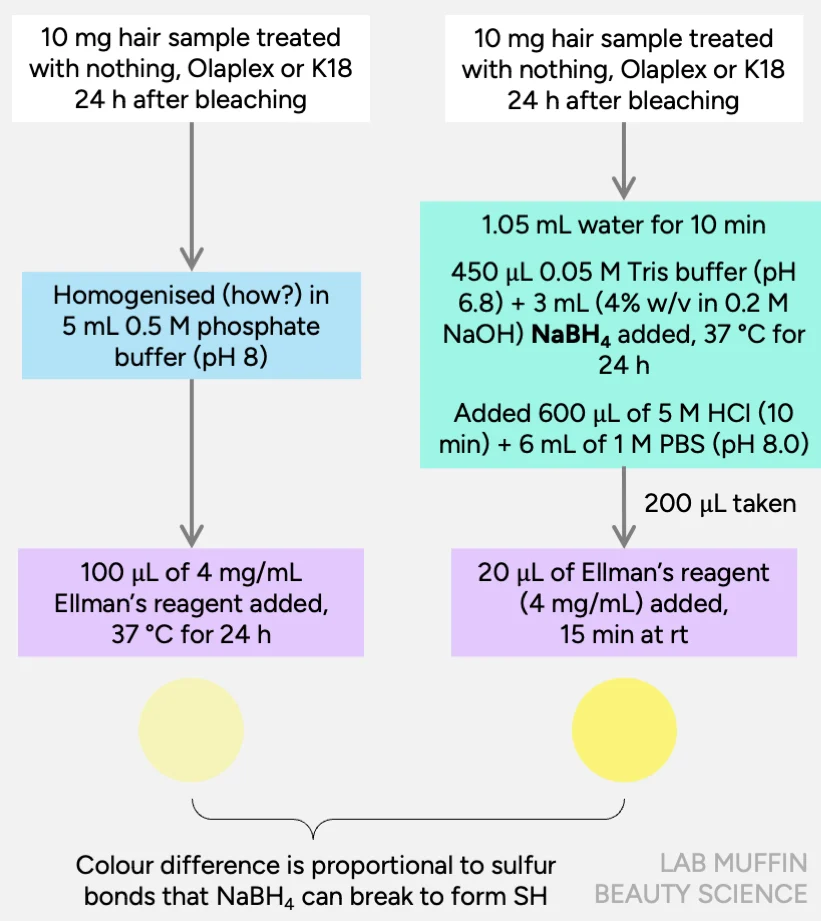
The core of the study’s conclusions rested on a comparison between Raman spectroscopy—which measures specific molecular vibrations, including disulfide (S-S) bonds—and Ellman’s test, a chemical procedure traditionally used to quantify accessible thiol (-SH) groups or sulfur-containing bonds.
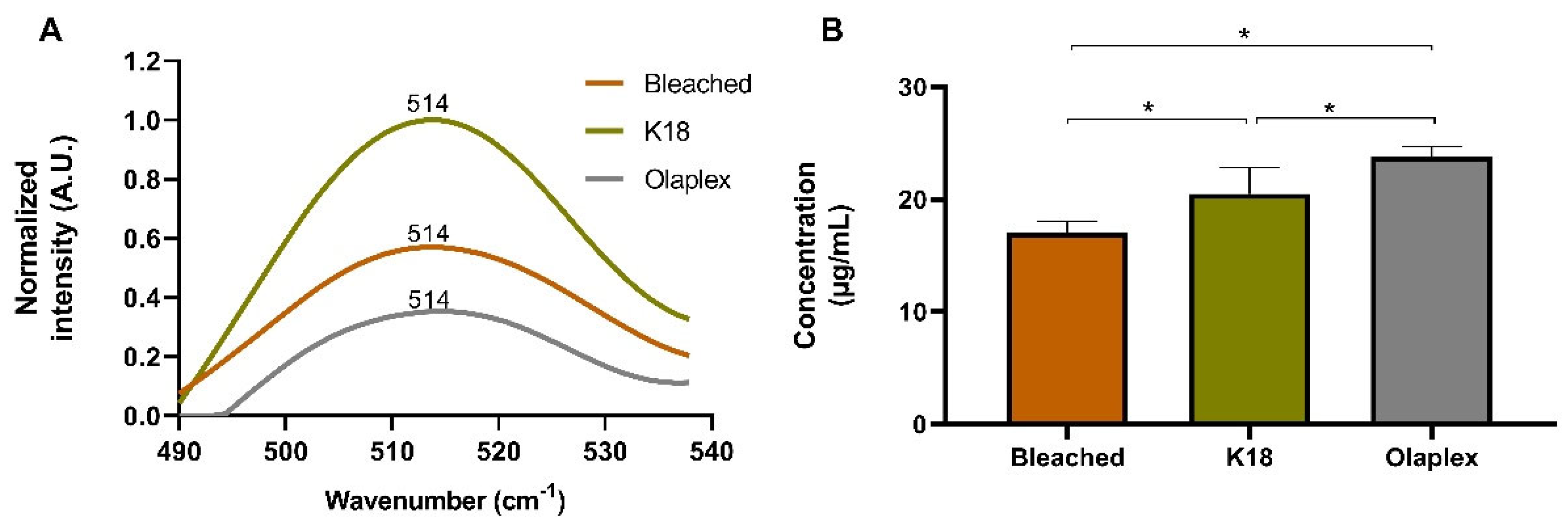
According to the published paper, the researchers observed that Olaplex treatment resulted in a higher signal in Ellman’s test while showing a lower signal in the specific S-S Raman band. The authors interpreted this divergence as evidence that Olaplex creates new, non-specific sulfur-carbon (S-R) bonds via a Michael addition reaction, aligning with the chemical pathway described in the original 2015 Olaplex patent.
Critical Analysis of Analytical Discrepancies
Despite publication in a peer-reviewed journal, the study’s conclusions have faced rigorous critique from cosmetic chemists specializing in organosulfur chemistry. The primary point of contention centers on the suitability and application of Ellman’s test for measuring the specific types of bonds claimed by the product manufacturer.
Chemical principles dictate that Ellman’s reagent reacts with specific accessible thiol groups, while standard reducing agents like sodium borohydride (NaBH4) primarily cleave disulfide (S-S) bonds. Sulfur-carbon (S-R) bonds, such as those theoretically formed via the Michael addition mechanism of bis-aminopropyl diglycol dimaleate, are exceptionally stable when exposed to borohydride and typically require transition metals or radical reactions to break.
Furthermore, a close reading of the study reveals inconsistencies in terminology between sections, shifting between the quantification of disulfide bonds (S-S) and S-R bonds without accounting for the chemical limitations of the assay.
Independent evaluations of the experimental design point to several potential factors that could explain the mismatched results between Raman spectroscopy and Ellman’s test:
- Protein Accessibility and Hair Swelling: Hair proteins are tightly folded structures. Reagents like Ellman’s solution cannot penetrate deeply into untreated or hydrophobic hair fibers unless the structure is sufficiently denatured or swollen. The extreme alkalinity (pH ~13) used in certain preparation conditions may have drastically altered hair permeability compared to gentler handling steps.
- Moisture and Product Barriers: Both Olaplex and K18 formulations have been shown to impact the water-holding capacity of hair. By altering how aqueous solutions penetrate the fiber, these treatments may physically restrict access to internal disulfide bonds during testing phases.
- Assay Concentration and Sampling Inconsistencies: Standard spectroscopic and chemical assays require rigorous control of variables, particularly when subtracting baseline values. Variations in sample volumes, reagent concentrations, and the physical homogeneity of hair suspensions can introduce significant noise into the final data calculations, challenging the validity of direct numerical subtraction.
Comparative Findings on K18 and Penetration Depth
The study also evaluated K18, a peptide-based hair treatment that commercial marketing claims work by reconnecting broken polypeptide chains and disulfide bonds. The researchers utilized surface-probing techniques—specifically SEM and AFM—to conclude that K18 operates primarily at a superficial level on the cuticle, whereas Olaplex allegedly penetrates deeper into the core of the hair fiber.
Specialists in hair science have noted that this interpretation relies on the assumption that a formulation can only function in a single compartment of the hair fiber. In practice, multi-functional cosmetic formulations often deposit conditioning agents on the exterior cuticle while delivering active ingredients internally. Furthermore, because the study utilized Olaplex No. 0 (a water-heavy, minimalist formula) alongside a K18 retail formulation containing richer, lipophilic conditioning ingredients like cetearyl alcohol, surface-level microscopy naturally reflected the differing surface depositions rather than absolute penetration limits of the active molecules themselves.
Broader Implications for Cosmetic Science and Peer Review
The discourse surrounding the Cosmetics study highlights systemic challenges within cosmetic science research, offering several key takeaways for researchers, industry analysts, and consumers:
The Limitations of Peer Review
Peer review serves as an initial quality control mechanism, confirming that a manuscript meets basic academic standards, formatting requirements, and logical coherence. However, peer review does not guarantee absolute scientific infallibility. Reviewers are often assigned based on general expertise and may lack niche specialization in specific sub-disciplines—such as organosulfur polymer chemistry—leaving interdisciplinary nuances unflagged prior to publication.
The State of Independent Research Funding
Unlike pharmaceutical or biomedical research, which benefits from extensive public and governmental grants, cosmetic science receives relatively little public funding. Consequently, independent academic studies are frequently underfunded, rely on smaller sample sizes, or are conducted by researchers venturing outside their primary domains of analytical specialization. This structural limitation can occasionally lead to methodological oversights or over-reliance on manufacturer patent literature to interpret complex biochemical interactions.
The Necessity of Critical Source Appraisal
Industry-funded studies carry inherent financial conflicts of interest that require cautious interpretation, but independent studies are similarly susceptible to analytical errors. Experts emphasize that single studies rarely establish definitive scientific consensus. True scientific validation emerges during post-publication review, where the broader scientific community engages in critical appraisal, replication, and contextualization.
As consumer demand for scientifically validated hair care continues to rise, the debate over the Cosmetics study underscores the importance of rigorous, multi-disciplinary methodology in evaluating complex chemical interactions within consumer goods.
