
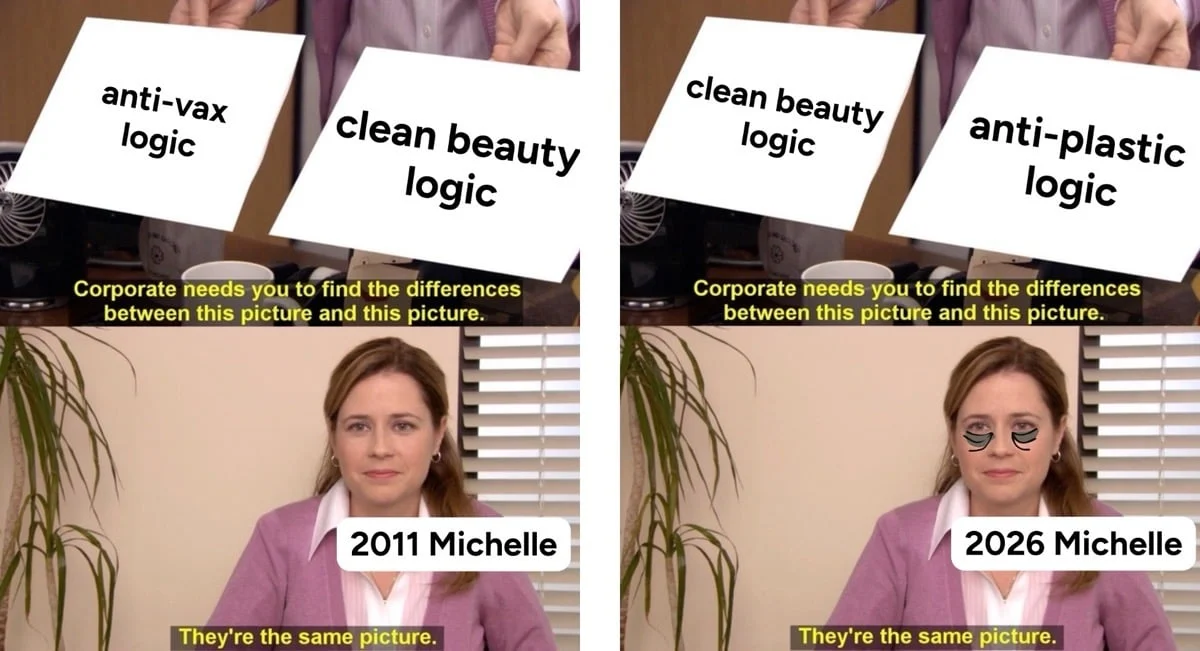
The burgeoning "plastic-free" movement, championed by numerous beauty brands and influencers, is exhibiting concerning parallels with the scientifically dubious "clean beauty" trend, according to science communicator Michelle Wong of Lab Muffin Beauty Science. Wong, who has been engaging in science communication since 2011, observes that the underlying logic, fearmongering tactics, and potential for misinformation in the anti-plastic narrative strongly echo those that characterized the "non-toxic" clean beauty movement, which she initially feared could serve as a pipeline to anti-vaccination beliefs.
Wong’s analysis, published in January 2026, was catalyzed by a social media post from @idea.soup speculating that the "anti-polyester movement is about to become a right-wing pipeline." This observation resonated with Wong, who noted that both clean beauty and the anti-plastic trend frequently demonize similar substances (e.g., aluminum, formaldehyde in the past, microplastics now) and share a common disregard for fundamental scientific principles. The core concern is that while reducing plastic waste is a laudable goal, an uncritical, evidence-poor approach to eliminating plastics could lead to unintended negative consequences for both human and environmental health.
The Rise of "Clean Beauty" and Its Criticisms
The "clean beauty" movement gained significant traction in the 2010s, advocating for products free from a list of "toxic" or "dirty" ingredients, often including parabens, phthalates, sulfates, and synthetic fragrances. Proponents frequently argued that these ingredients were harmful, carcinogenic, or endocrine disruptors, despite a lack of robust scientific consensus or regulatory action to support such blanket claims at typical exposure levels. This movement was criticized for its reliance on an "appeal to nature" fallacy, suggesting natural ingredients were inherently safer, and for ignoring basic toxicology principles like "the dose makes the poison."
Michelle Wong, through her platform Lab Muffin Beauty Science, has consistently debunked many clean beauty myths, highlighting how the movement often promotes pseudoscientific beliefs. She pointed out that the rhetoric used—fearmongering about chemicals, focusing on presence rather than concentration or exposure, and misinterpreting scientific studies—shared disturbing similarities with anti-vaccination narratives. This pattern of misinformed alarmism, Wong argues, is now resurfacing within the anti-plastic discourse.
Echoes in the Anti-Plastic Trend
The current anti-plastic trend, particularly within the beauty industry, is characterized by broad "plastic-free" claims and intense fearmongering about microplastics. Brands are increasingly marketing products in alternative packaging materials like glass, aluminum, or paper, often without a comprehensive understanding of the environmental impact across the entire product lifecycle. This approach, Wong contends, mirrors the clean beauty movement’s failings in several key areas:
-
Appeal to Nature Fallacy: Just as clean beauty posited "natural equals good," the anti-plastic movement often operates under the simplistic premise that "plastic equals bad, natural alternatives equals good." This extends even to bioplastics, which are derived from natural starting materials but are not inherently superior environmentally. The fallacy lies in judging a material’s effects solely by its origin, disregarding that many natural substances are highly toxic, and conversely, many synthetic materials are safe and beneficial. This oversimplification often overlooks the complex realities of material science and environmental impact.
-
Ignoring Fundamentals of Sustainability Science: A significant critique leveled against the blanket "plastic-free" claims is their disregard for Life Cycle Assessment (LCA). LCA is the internationally recognized scientific method for quantifying the environmental impacts of a product across its entire lifespan, from raw material extraction, manufacturing, transportation, use, and ultimately, its end-of-life disposal or recycling.
Many anti-plastic discussions disproportionately focus on the "end-of-life" stage—concerns about microplastics, landfill accumulation, slow degradation, and oceanic "trash islands." However, LCA studies frequently reveal that for many products, the greatest environmental impacts occur during the raw material extraction and manufacturing phases, or due to transportation. By fixating on end-of-life, consumers and brands often incorrectly assess which options are genuinely more environmentally friendly.
Crucially, climate change is widely acknowledged by scientists as the paramount environmental threat. Here, plastic packaging often demonstrates significant advantages. For instance, a 2011 Denkstatt report, cited by the Biodegradable Plastics Association, found that switching from plastic to glass, paper, or aluminum alternatives would, on average, necessitate 3.6 times more material, consume 2.2 times more energy, and generate 2.7 times more carbon emissions. These benefits of plastic stem from its lightweight nature, which reduces transport fuel consumption, and its superior barrier properties, which extend product shelf life and reduce waste. While these are not blanket statements, and each case requires a holistic LCA, they underscore the complexity often ignored by simplistic anti-plastic narratives.
Wong points out that many beauty brands, while promoting plastic-free alternatives, often ignore the critical aspect of reducing consumption. Instead, they encourage switching to different materials, sometimes with higher overall environmental footprints, without addressing the broader consumption issue. She cites Dieux Skin’s aluminum samples and limited-edition nylon/polyester tote bags as examples of "performative greenwashing" that can mislead even informed consumers.
-
Citing Studies with Serious Methodological Issues: A major concern in the microplastics discussion is the reliance on studies with significant methodological flaws, which often lead to exaggerated or false positive results. Measuring trace amounts of any substance accurately is challenging, but microplastic research faces unique hurdles. For example, pyrolysis-GCMS (Py-GCMS), a common quantification method, can mistake fats for polyethylene unless rigorous corrections are applied. This can inflate reported microplastic levels, as seen in studies claiming a "spoon’s worth of microplastics" in the brain. Furthermore, widespread environmental contamination means many studies inadvertently count microplastics from lab equipment or personnel as originating from the sample itself. These esoteric issues create fertile ground for misinformation to spread rapidly through media headlines and social media.
-
Assuming Presence Means Harm: A recurring fallacy is the assumption that the mere presence of microplastics in human tissues, such as artery plaque or the brains of individuals with dementia, automatically implies causation of disease. This overlooks the fundamental principle that correlation does not equal causation. Such findings could be attributed to background environmental exposure, the fact that microplastics are ubiquitous, or that the presence is a coincidental finding rather than a causal factor. The "parabens in breast tumors" study, a cornerstone of clean beauty fearmongering, similarly failed to establish causation or even measure paraben levels in normal tissue for comparison.
-
Ignoring Other Reasons for Material Use: The anti-plastic narrative frequently overlooks the diverse functional benefits of plastics beyond just their environmental footprint. Plastics offer crucial advantages in terms of durability, safety (e.g., preventing breakage in bathrooms), cost-effectiveness, hygiene (especially important for medical and food applications), and accessibility. Removing plastic without considering these factors can lead to products that are less effective, more expensive, or even less safe. This mirrors the clean beauty movement’s demonization of effective preservatives like parabens, which are often safer for sensitive skin due to their potency, requiring lower concentrations than many alternatives.
-
Science-Washing and Convenient Experts: Many brands and influencers, while claiming to be "science-backed," engage in "science-washing" – selectively presenting information or experts to support predetermined anti-plastic narratives. This involves cherry-picking evidence and promoting "convenient myths." As in the fitness or wellness industries, the beauty sector frequently leverages scientific language without genuine scientific rigor to sell products.
Regulators in major regions, including the US FTC, UK CMA, and Australian ACCC, have issued guidelines against misleading and deceptive sustainability claims. Brands genuinely committed to transparency are advised to consult qualified sustainability experts to vet their claims, rather than relying on unqualified internal assessments or marketing hype. A persistent issue is the misunderstanding of relevant expertise; for instance, dermatologists, while experts in skin, are not necessarily authorities on environmental science or material lifecycle assessments. This mirrors how clean beauty often relied on health gurus or celebrity endorsements rather than toxicologists or formulation chemists.
Broader Implications and Motivated Reasoning
Wong highlights a concerning trend of "identity-based motivated reasoning" and confirmation bias, where individuals accept evidence only if it aligns with their existing beliefs or political stances. This phenomenon is evident in the backlash against reputable media outlets, such as The Guardian, when they publish nuanced reporting on microplastics. For example, when The Guardian reported on methodological issues in microplastic measurement and corrected earlier misinformation about microplastics in the brain, they faced accusations of being "bought by Big Plastic" simply for quoting a former Dow chemist. This occurred despite the article also citing two independent scientists from public institutions and a letter from nine European scientists who expressed similar concerns.
As cosmetic scientist Jen Novakovich of The Eco Well, whose work significantly informs Wong’s analysis, aptly states: "Discounting something solely based on funding source or affiliation is actually the opposite of critical thinking." Evaluating the arguments presented, rather than merely dismissing sources based on perceived conflicts of interest, is essential for critical engagement with complex scientific issues.
The core implication of this parallel between clean beauty and the anti-plastic movement is the risk of misdirected efforts. While the goal of reducing plastic waste is critical, a fear-based, scientifically uncritical approach can lead to suboptimal environmental outcomes, potentially replacing plastics with alternatives that have a higher overall environmental footprint. It also fosters a culture of distrust in science and expertise, which can have broader societal consequences, including the propagation of anti-science sentiments.
Ultimately, addressing complex environmental challenges requires nuanced, evidence-based solutions rooted in comprehensive scientific understanding, rather than simplistic demonization or appeals to nature. True progress in sustainability will depend on critical thinking, rigorous scientific assessment, and a willingness to engage with the full scope of environmental impacts, not just the most emotionally resonant aspects.
