

The European Food Safety Authority has underscored the pressing need to sustain scientific expertise and ensure regulatory clarity to avoid costly approval delays for novel foods like cultivated meat. As the global food technology sector accelerates toward sustainable alternatives, the European Union finds itself at a critical crossroads. In a comprehensive strategic paper published in the EFSA Journal, the bloc’s primary food safety regulator has issued a candid assessment of its current operational limitations, warning that the existing regulatory framework risks lagging dangerously behind private-sector innovation.
The report marks a significant moment of introspection for the agency. It highlights systemic bottlenecks that have historically plagued the authorization of alternative proteins, precision-fermented dairy, and cellular agriculture. By outlining a proactive strategy that embraces modern technological tools and structured foresight, the European Food Safety Authority (EFSA) hopes to transition from a reactive posture—where experts merely review dossiers as they arrive—to an anticipatory model capable of evaluating cutting-edge food innovations with both speed and scientific rigor.
Anatomy of Regulatory Delay: The High Cost of Bureaucracy
The European Union maintains some of the most stringent and meticulous food safety regulations in the world. While this rigorous standard has historically engendered high consumer trust, the practical implementation of the Novel Foods Regulation has earned a reputation for being excessively complex, lengthy, and expensive. For early-stage biotech startups operating on tight venture capital runways, the financial and temporal toll of navigating the EU approval process can prove fatal.
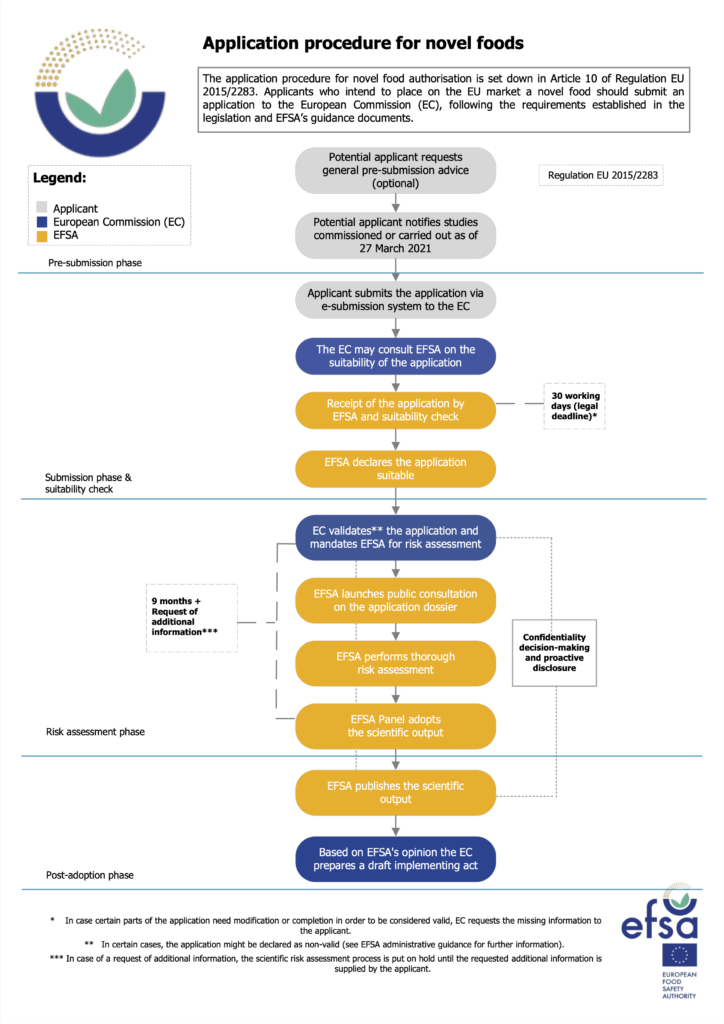
Under the current statutory framework, the journey of a novel food product begins when an applicant compiles extensive scientific data and dossiers. Once submitted, the European Commission validates the application before passing it to the EFSA for a preliminary suitability check, which carries a 30-day legal window. Following this, the agency undertakes a thorough scientific risk assessment, a process legally mandated to take nine months, though frequently extended when experts demand additional toxicological, nutritional, or compositional data.
Once the EFSA issues its scientific opinion, the ball returns to the European Commission, which drafts an implementing regulation. This draft must then win the approval of at least 55% of member states represented in the Standing Committee on Plants, Animals, Food and Feed. The formal legal timeline stipulates a total duration of roughly 18 months from submission to final market authorization.
However, empirical reality paints a vastly different picture. Data indicates that the average clearance time for a novel food product within the European Union stretches to an onerous 30 months, with complex cases routinely exceeding five years. This starkly contrasts with international competitors. In jurisdictions such as Singapore, Australia, and New Zealand, regulatory frameworks have adapted to the pace of alternative protein development, compressing average approval timelines to a predictable 12 to 24 months. Consequently, European entrepreneurs, venture capitalists, and multinational food corporations have increasingly redirected their capital and research endeavors toward more accommodating foreign markets.

The Limitations of Legacy Risk Assessment
In its forward-looking paper, the EFSA attributes much of its structural lag to outdated methodologies rooted in 20th-century paradigms. Traditional risk assessment models were predominantly animal-based, resource-intensive, and slow. These legacy approaches often struggled with reproducibility, raised valid ethical concerns regarding animal welfare, and occasionally faced skepticism regarding their direct human relevance.
Furthermore, the agency’s internal architecture has historically relied on a document-centred operational framework. Scientific opinions, raw datasets, evidence reviews, methodological assumptions, uncertainty assessments, and computational models are frequently produced and stored as isolated digital artifacts. According to the regulator, this fragmented storage model severely restricts data reuse, compounds manual administrative burdens, slows down evaluation cycles, and inhibits cross-domain scientific synthesis.
To break free from these administrative and technical constraints, the EFSA has proposed the implementation of an advanced, human-led, and AI-enabled regulatory model. Rather than treating artificial intelligence as a superficial tech upgrade, the agency envisions a complete overhaul of its core operating environment. The proposed end-to-end AI-supported risk assessment infrastructure aims to automatically ingest incoming mandates, terms of reference, dossier materials, and stakeholder queries, converting them into structured digital data objects. This integration of advanced computing, robust cybersecurity, and rigorous legal compliance is designed to streamline evidence gathering while keeping human scientific accountability at the helm.
Elevating Priority Areas: Cultivated Meat and Precision Fermentation
Within its strategic blueprint, the EFSA explicitly identifies cultivated meat and precision fermentation as critical priority areas for sustainable food and feed innovation. Precision fermentation—a technology that utilizes microflora such as yeast and fungi to produce complex animal proteins like dairy caseins or egg albumin without the animal—alongside cultivated meat derived directly from animal cells, represent the vanguard of the future food economy.
To prepare for these complex matrices, the agency’s strategy emphasizes the creation of faster, fit-for-purpose risk assessments. This involves investing proactively in New Approach Methodologies (NAMs), employing social science insights to understand consumer risk perceptions earlier in the developmental cycle, and fostering structured cooperation through a cross-sectoral One Health approach that links human, animal, and environmental health data.
Industry Reactions: Welcoming Reform While Demanding Greater Ambition
The release of the EFSA’s strategic paper has drawn widespread praise and cautious optimism from alternative protein advocates, industry trade groups, and agricultural stakeholders alike.
Leading alternative protein think tank the Good Food Institute (GFI) Europe was quick to welcome the agency’s candor. Lea Seyfarth, policy manager at GFI Europe, commended the regulator for recognizing the necessity of modernizing its systems.
"EFSA’s food safety assessment processes are among the most robust in the world, and it’s positive to see the agency acknowledge the need to keep pace with innovation and develop a more proactive system that avoids unnecessary delays," Seyfarth stated.
However, industry leaders argue that administrative reform within the EFSA must be matched by legislative flexibility at the European Commission and member state levels. Specifically, stakeholders have renewed their calls for novel foods to be integrated into the European Union’s emerging regulatory sandbox schemes.
Regulatory sandboxes are controlled, real-world testing environments designed to allow businesses and researchers to collaborate closely with regulators. These frameworks enable the co-design of safety standards, monitoring protocols, and compliance guidelines for emerging technologies before they hit broader commercial markets, fostering innovation without compromising public safety.
The Battle Over the EU Biotech Act and Regulatory Sandboxes
The debate over regulatory sandboxes has become a key flashpoint in European technology and agricultural policy. Last year, the European Commission introduced provisions for regulatory sandboxes under its flagship Biotech Act. Controversially, however, the Commission proposed explicitly excluding novel foods from these controlled testing environments.
This proposed exclusion provoked immediate and forceful pushback from a broad coalition of food and biotechnology trade groups representing some of the largest multinational food companies in the world, including Nestlé, Coca-Cola, Danone, and Mars. Industry heavyweights argued that sidelining novel foods from the sandbox framework lacked any sound legal, scientific, or innovation-based justification.

Political resistance has also mounted within European legislative bodies. Members of the European Parliament (MEPs) serving on the Committee on Environment, Public Health and Food Safety (ENVI) have formally asserted that the blanket exclusion of novel foods must be struck from the final legislation. Simultaneously, influential member states destined to play major roles in future food production, notably Germany and the Netherlands, have formally urged the Council of the European Union to reconsider the Commission’s restrictive stance.
Proponents of reform argue that denying alternative protein startups access to regulatory sandboxes contradicts the EU’s stated goals of achieving strategic autonomy, bolstering food security, and meeting ambitious European Green Deal targets for sustainable agriculture.
Broader Economic and Geopolitical Implications
The stakes of the ongoing regulatory debate extend far beyond food industry profit margins. As nations worldwide race to secure leadership in the bio-economy, the European Union risks falling behind in a sector projected to reshape global food production over the coming decades.
Cultivated meat and precision-fermented foods offer substantial environmental benefits, including dramatically reduced greenhouse gas emissions, significantly lower land and water footprints, and enhanced resilience against supply chain disruptions caused by geopolitical instability and climate change. However, without a predictable, transparent, and efficient regulatory pathway, European innovators will continue to face an uphill battle to commercialize domestic discoveries.
By signaling its intent to modernize risk assessments and adopt advanced digital tools, the European Food Safety Authority has demonstrated a willingness to adapt to the realities of 21st-century food science. Whether EU policymakers will match this scientific pragmatism by opening regulatory sandboxes and streamlining legislative bottlenecks remains the critical question. For now, the future of Europe’s alternative protein industry hangs in the balance, resting on the capacity of its regulators and lawmakers to harmonize rigorous safety standards with the urgent demands of global innovation.
