
The global cellular agriculture sector faces a complex matrix of scientific, regulatory, and financial bottlenecks that have long hindered the rapid scaling of laboratory-grown proteins. Addressing these structural inefficiencies, UK-based venture Cultigen Group has officially launched its unified Research Layer. This innovative digital architecture connects three of the company’s foundational platforms—Cellbase, Cellag Bio, and Assay Markets—into a single, live, interoperable data system. Designed to assist scientists, researchers, and innovators in the cultivated meat industry, the new infrastructure bridges the gap between empirical research, raw material sourcing, and live market pricing. By integrating these critical nodes, Cultigen Group aims to drastically reduce research and development (R&D) timelines and capital expenditure for companies striving to bring sustainable alternative proteins to market.
The Architectural Evolution of Cultigen Group
The debut of the Research Layer marks a major milestone in Cultigen Group’s methodical, multi-phased strategy to build the commercial backbone of the cellular agriculture industry. The company’s ecosystem development began in mid-2025 with the launch of the Cultivated Meat Shop, a consumer-facing e-store designed to familiarise the public with cell-cultured proteins. Recognizing that stringent regulatory landscapes—particularly in Europe, where human consumption approval remains pending—would delay mass-market retail, Cultigen quickly pivoted toward the B2B supply chain infrastructure.
Months after the initial consumer rollout, the startup introduced Cellbase, a specialized B2B marketplace linking suppliers of bioreactors, growth media, scaffolds, cell lines, sensors, and processing equipment directly with cultivated meat researchers and startups. Early industry partners included key players such as Multus, Sallea, Quest Meat, and Cellcraft. Cellbase has since expanded rapidly, now hosting over 500 products supplied by more than 50 distinct vendors. The platform features advanced data filtering, structured metadata parsing, complete e-commerce functionality, and automated order management.
Following the success of Cellbase, Cultigen introduced Cellag Bio earlier this year. Leveraging artificial intelligence, Cellag Bio systematically extracts structured data from fragmented scientific literature. The extracted data undergoes rigorous editorial review before publication, resulting in comprehensive, decision-ready experiment records that outline specific species, cell types, media formulations, components, results, and critical failure modes. This intelligence tool was designed specifically to prevent alternative protein startups from burning vital capital on previously documented experimental dead ends.
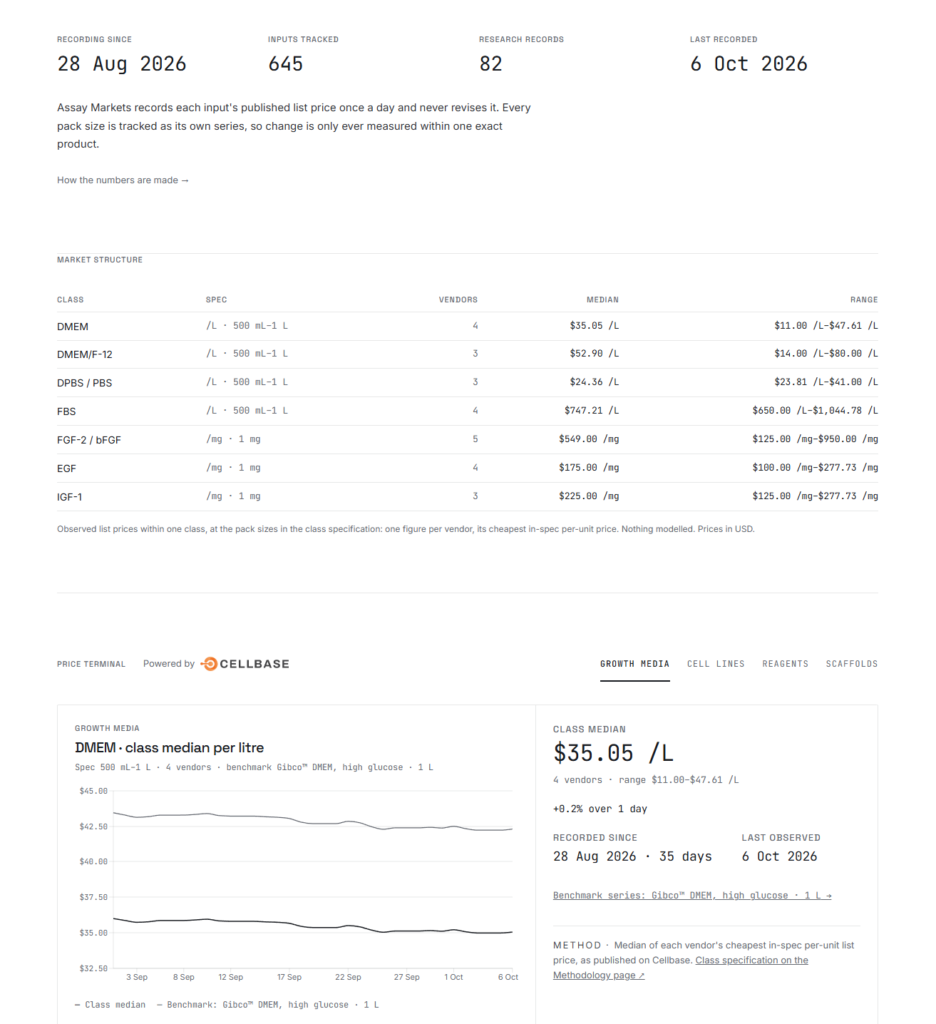
In August, the ecosystem expanded further with the rollout of Assay Markets, a neutral price-reporting mechanism that tracks and records timestamped price series for essential production inputs. By combining these distinct tools, Cultigen Group has systematically mapped out the three fundamental questions every biotechnology lab faces during development: procurement, empirical validity, and cost.
Anatomy of the Unified Research Layer
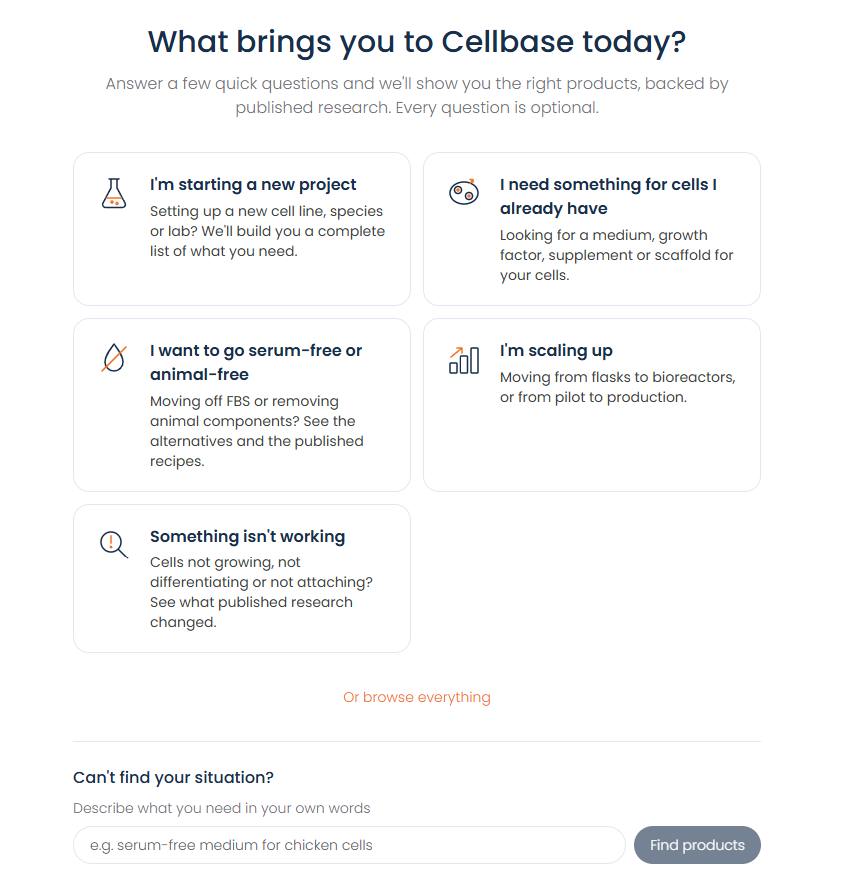
At the core of the newly launched Research Layer is the Cellbase Product Finder, an intelligent query tool that harmonizes the data streams of Cellbase, Cellag Bio, and Assay Markets. When researchers encounter technical roadblocks or initiate new workflows, the Product Finder allows them to navigate via five distinct starting points: launching a new project, sourcing inputs for existing cell lines, transitioning to animal-component- or serum-free media, scaling up production, or troubleshooting current failures.
Once a parameter is selected, the platform synthesizes data across all three integrated datasets. It evaluates published scientific literature to determine which experimental methodologies succeeded, cross-references current market prices for necessary inputs via Assay Markets, and generates an evidence-backed shopping list directly from the Cellbase inventory.
To achieve this level of seamless cross-platform functionality, Cultigen Group engineered a shared vocabulary and component dictionary. This standardized framework ensures that hundreds of distinct data fields, product matches, and automated integrity checks communicate fluidly.
"People often ask me why I keep building separate businesses instead of one," said Cultigen Group founder David Bell. "This is the answer. Each one was built to stand on its own, and each was also built to plug into the others. This is the first time you can see them working as one system."
Bell further elaborated on the philosophical division of labor among the platforms: "Cellbase is what you can buy. Cellag Bio is what has actually worked. Assay Markets is what it costs. On their own, they’re useful. Joined up, they answer the question scientists actually ask, which is: what should I use, and why?"
Strategic Partnerships and Industry Integration
The launch of the Research Layer arrives on the heels of critical institutional developments for Cultigen Group. Earlier this year, the company forged a strategic partnership with the Association for Meat, Poultry and Seafood Innovation (AMPS Innovation), a prominent United States-based trade association representing the cultivated protein sector. This collaboration is designed to bolster domestic and international R&D capabilities, facilitating smoother commercialization pathways for member companies navigating complex regulatory frameworks.
Industry observers note that fragmented data has historically been one of the primary hurdles for cellular agriculture. Academic literature regarding cell lines and media optimization is frequently siloed, proprietary, or obscured by varying terminology. By establishing a neutral, standardized data layer, Cultigen Group provides emerging biotechnology firms with the empirical clarity typically reserved for legacy pharmaceutical giants with massive internal R&D budgets.
Roadmap Ahead: Intelligence, Production, and Market Layers
Cultigen Group’s ambitions extend far beyond the newly launched Research Layer. The company has confirmed that deeper integrations between Cellbase, Cellag Bio, and Assay Markets will roll out over the coming weeks. More importantly, the startup has outlined a comprehensive timeline for three additional macro-layers designed to govern the entire commercial lifecycle of cultivated meat.
Scheduled for release by the end of the year is the Intelligence Layer. This upcoming infrastructure will encompass Cultideck—an intelligence directory tracking global regulatory progress, venture investments, and supplier capabilities—alongside The Growth Medium, a searchable repository of corporate announcements, funding milestones, and industry news. A third, unannounced venture will complete the Intelligence Layer triad. Like the Research Layer, these platforms will operate on a shared registry of corporate financing and regulatory data, ensuring that Cellbase suppliers and Assay Markets pricing feeds continue to provide holistic visibility.
Following the deployment of the Intelligence Layer, Cultigen Group plans to introduce a dedicated Production Layer and a subsequent Market Layer. These future phases aim to address large-scale manufacturing logistics and consumer-facing market distribution, respectively.
"The Research Layer is the proof of concept. The Intelligence Layer is being built the same way, on shared data from day one. Each layer we add makes the ones before it more valuable," Bell emphasized. "Right now, the job is getting scientists what they need, faster. The consumer side of cultivated meat comes later and needs a different set of tools. But it’s all one plan, and this is the first layer of it."
Broader Implications for Cellular Agriculture
The commercial implications of Cultigen Group’s unified architecture are significant. As the cellular agriculture industry matures, venture capital funding has grown increasingly discerning, demanding higher operational efficiency and clearer pathways to cost parity with conventional livestock meat. High input costs—particularly regarding growth media and specialized biochemical reagents—remain among the most formidable barriers to commercial viability.
By integrating real-time price monitoring through Assay Markets with empirically validated methodologies via Cellag Bio and transactional procurement through Cellbase, Cultigen Group is effectively building a digital operating system for alternative protein R&D. If successful, this ecosystem could drastically shorten development cycles, reduce capital waste, and accelerate the timeline for cultivated meat products to achieve cost-competitive scale in global markets.
