
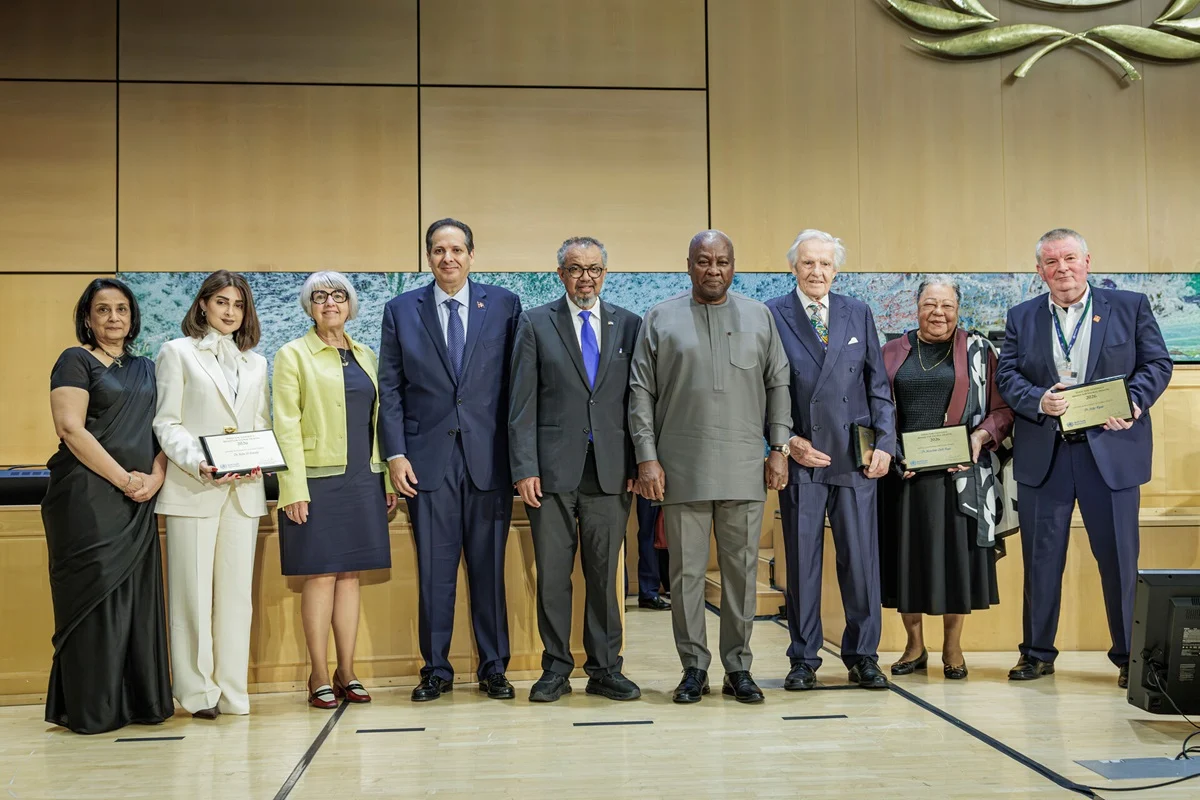
At the Seventy-ninth World Health Assembly in Geneva, WHO Director-General Dr Tedros Adhanom Ghebreyesus has presented four distinguished leaders with the Award for Global Health, recognizing their lifetime achievements and exceptional contributions to improving the health and well-being of communities worldwide. This year’s laureates—Dr Tore Godal, Dr Merceline Dahl-Regis, Dr Mike Ryan, and Dr Heba El Sewedy—were celebrated during the High-Level Welcome of the World Health Assembly (WHA), an event that serves as the cornerstone of international health policy and governance. Held under the evocative theme “Reshaping global health: a shared responsibility,” the 2026 assembly emphasizes the necessity of collaborative action in an era marked by complex humanitarian crises, emerging pathogens, and the persistent burden of non-communicable diseases.
The Director-General’s Global Health Leaders Awards, established in 2019, are designed to recognize individuals who have demonstrated extraordinary leadership and a commitment to delivering tangible improvements in health outcomes. In his address to the delegates of the 194 Member States, Dr Tedros underscored the importance of individual agency within the massive machinery of global health. “I am honoured to present the Global Health Leaders Awards to four individuals who have made outstanding lifetime contributions to global health,” Dr Tedros remarked, highlighting that their work reflects the diverse strategies required to ensure health as a fundamental human right.
Dr Tore Godal: A Legacy of Immunization and Strategic Innovation
Dr Tore Godal was recognized for his transformative leadership in the fields of immunization and infectious diseases. Often described as one of the most influential figures in global health over the last half-century, Dr Godal’s career is defined by his ability to translate high-level scientific research into actionable public health programs. Throughout his distinguished tenure, he played a pivotal role in elevating vaccines as a global development priority.
During the 1990s, when global immunization rates were stagnating, Dr Godal was instrumental in the conceptualization and establishment of Gavi, the Vaccine Alliance. Since its inception in 2000, Gavi has helped vaccinate more than 1 billion children, preventing more than 17 million future deaths. Dr Godal’s vision also extended to the creation of the Roll Back Malaria partnership and the Coalition for Epidemic Preparedness Innovations (CEPI), the latter of which has become a cornerstone of the global response to emerging pandemic threats by accelerating the development of vaccines for "Disease X."
Furthermore, Dr Godal’s leadership of the WHO’s Special Programme for Research and Training in Tropical Diseases (TDR) led to significant breakthroughs in the fight against neglected tropical diseases (NTDs). He was a key proponent of expanding community-based ivermectin distribution to combat onchocerciasis, commonly known as river blindness. This strategy moved away from clinical-only models to empower local communities, a shift that has since protected tens of millions of people from permanent disability. His recognition at the 79th WHA serves as a testament to the "Godal Factor"—a term often used by colleagues to describe his unique ability to forge partnerships between the public and private sectors to achieve massive health gains.
Dr Merceline Dahl-Regis: Pioneering Disease Elimination in the Americas
The second laureate, Dr Merceline Dahl-Regis, was honored for her lifelong commitment to expanding immunization and achieving disease elimination, particularly within the Region of the Americas. A public health physician from the Bahamas, Dr Dahl-Regis has been a trailblazer in regional health policy, serving as the first woman to lead the Pan American Health Organization’s (PAHO) Technical Advisory Group on Immunization.
Her leadership was instrumental in a historic milestone: the elimination of measles and rubella in the Americas. This achievement made the Americas the first region in the world to be certified free of these diseases, providing a blueprint for other WHO regions to follow. Dr Dahl-Regis’s work was not limited to viral elimination; she was also a driving force behind the Dual Elimination Initiative, which sought to end mother-to-child transmission (MTCT) of both syphilis and HIV.
Data from PAHO indicates that the success of these programs has drastically reduced infant mortality rates and improved maternal health outcomes across the Caribbean and Latin America. By integrating research with community engagement, Dr Dahl-Regis proved that even in resource-constrained settings, rigorous public health standards and regional collaboration can lead to the eradication of endemic threats. Her award recognizes the profound impact of her "holistic approach," which views health not merely as the absence of disease but as a vital component of sustainable development.
Dr Mike Ryan: Architect of Global Emergency Response
Dr Mike Ryan, the Executive Director of the WHO Health Emergencies Programme, was honored for his leadership in strengthening global preparedness and operational responses to health crises. A veteran of the front lines, Dr Ryan’s career has spanned over three decades, during which he has become one of the most recognizable figures in international crisis management.
As a founder of the Global Outbreak Alert and Response Network (GOARN) in 2000, Dr Ryan helped create the infrastructure that allows the international community to pool resources and expertise during outbreaks. His operational leadership has been critical during some of the most challenging health events of the 21st century, including the SARS outbreak, the 2014-2016 West Africa Ebola epidemic, and the global COVID-19 pandemic.
In his role at the WHO, Dr Ryan has often worked in conflict zones and areas with fragile health systems, advocating for the protection of health workers and vulnerable populations. His philosophy centers on the idea that "speed trumps perfection" in the early stages of an emergency—a mantra that has influenced emergency response protocols worldwide. The award recognizes his unwavering commitment to global health security and his ability to navigate the complex intersection of science, politics, and humanitarian logistics.
Dr Heba El Sewedy: Humanitarian Action and the Treatment of Trauma
Dr Heba El Sewedy received the award for her dedication to humanitarian action and social justice, specifically her work with survivors of burn injuries and trauma. In 2013, she founded the Ahl Masr Foundation in Egypt, which has since become a leading institution in the Middle East and North Africa for the prevention and treatment of burn injuries.
Burn injuries are often referred to as a "forgotten crisis," primarily affecting those in low- and middle-income countries where safety regulations may be lacking and access to specialized care is limited. Dr El Sewedy’s foundation pioneered a comprehensive care model that includes not only state-of-the-art medical treatment but also psychological support and social reintegration programs. Her work has been vital in reducing the stigma associated with disfigurement and ensuring that survivors can lead dignified lives.
Beyond her work with burn victims, Dr El Sewedy has been a prominent figure in providing humanitarian aid to those affected by the Gaza conflict. The Ahl Masr Foundation has facilitated the delivery of medical supplies and supported the treatment of injured civilians, demonstrating a people-centered approach to care in the midst of geopolitical instability. Her recognition at the WHA highlights the growing importance of non-governmental leadership in addressing specialized health needs and humanitarian gaps.
Chronology and Context of the Director-General’s Awards
The presentation of these awards at the 79th WHA follows a tradition of honoring those who work outside the traditional limelight. Since 2019, the awards have evolved to reflect the changing landscape of global health.
- 2019: The inaugural awards focused on polio eradicators and primary healthcare advocates.
- 2021-2022: During the height of the COVID-19 pandemic, the awards recognized frontline health workers and scientists who contributed to vaccine development.
- 2024-2025: Emphasis shifted toward climate change and health equity.
- 2026: The current year’s selection highlights "Lifetime Achievement," focusing on leaders who have built the systems that the world relies on today.
The 2026 awards come at a time when the WHO is undergoing significant structural reforms aimed at improving the International Health Regulations (IHR) and finalizing the Pandemic Accord. The achievements of the four laureates provide a historical context for these modern efforts, reminding Member States that progress is often the result of decades of persistent advocacy and scientific rigor.
Supporting Data and Global Impact Analysis
The impact of the work performed by these four leaders can be quantified through various health metrics:
- Vaccine Efficacy: Under initiatives championed by Dr Godal, global coverage for the DTP3 (diphtheria-tetanus-pertussis) vaccine reached 84% globally before the pandemic disruptions, a significant increase from the 1990s.
- Disease Elimination: Due to the frameworks supported by Dr Dahl-Regis, over 40 countries and territories in the Americas have been certified for the elimination of MTCT of HIV and syphilis.
- Emergency Response: The GOARN network, co-founded by Dr Ryan, now includes over 250 technical institutions, allowing for the deployment of hundreds of experts within 48 to 72 hours of an outbreak notification.
- Trauma Care: The Ahl Masr Foundation has treated thousands of patients who otherwise would not have had access to specialized burn care, in a region where burn injuries are among the leading causes of long-term disability.
Analysts suggest that the recognition of these specific leaders serves a dual purpose: it validates the traditional multilateral approach to health (represented by Ryan and Dahl-Regis) while also acknowledging the vital role of innovative financing and NGOs (represented by Godal and El Sewedy).
Broader Implications for the Future of Global Health
The 79th World Health Assembly’s theme of "shared responsibility" is mirrored in the careers of the awardees. Their work demonstrates that global health is no longer the sole province of doctors and nurses but requires the involvement of diplomats, logistics experts, social workers, and philanthropists.
As the WHA continues its sessions in Geneva, the stories of these four laureates are expected to inform discussions on the "Health for All" agenda. Their achievements serve as a source of inspiration for the next generation of public health professionals, particularly those in the Global South who are seeking to build resilient, localized health systems.
The 2026 Global Health Leaders Awards underscore a critical reality: while the challenges facing global health are evolving—from the threats of antimicrobial resistance to the health impacts of environmental degradation—the fundamental requirements for success remain the same. These requirements include visionary leadership, a commitment to equity, and the courage to act in the face of uncertainty. By honoring Dr Godal, Dr Dahl-Regis, Dr Ryan, and Dr El Sewedy, the WHO has not only celebrated past successes but has also set a high standard for the future of international public health.
