
A Legacy of Strategic Partnership
The history of the WHO-Switzerland cooperation is unique within the international health landscape. When the initial cooperation strategy was piloted in 2013, Switzerland made history by becoming the first high-income country in the WHO European Region to adopt such a structured, collaborative framework. Traditionally, country cooperation strategies were designed primarily for low- and middle-income nations to assist in strengthening health systems. By applying this model to Switzerland, both the WHO and the Swiss Federal Office of Public Health (FOPH) acknowledged that even advanced economies require a formalized, strategic approach to address the shifting burden of disease, aging populations, and the need for robust pandemic preparedness.
This initiative was not merely a diplomatic gesture; it was a pragmatic response to the increasing interconnectedness of global health. Over the past decade, the partnership has evolved from a pilot program into a cornerstone of European health policy. The decision to renew this agreement in 2022 and finalize it in early 2025 demonstrates a commitment to continuity despite the volatility of the global political and health climate.
Chronology of Cooperation
The timeline of the WHO-Switzerland relationship reflects a steady progression toward deeper integration:
- 2013: Switzerland becomes the first high-income country in the WHO European Region to implement a formal Country Cooperation Strategy.
- 2013–2022: The initial phase focuses on knowledge exchange, shared health data, and leveraging Switzerland’s expertise in medical research and public health infrastructure to benefit the broader European region.
- 2022: Following the global disruption caused by COVID-19, both parties agree to modernize the CCS to address lessons learned during the pandemic, including supply chain resilience and global health security.
- June 2024: A major milestone is reached with the strengthening of the partnership for the global BioHub system, a network designed to facilitate the rapid sharing of pathogens and biological samples to accelerate the development of countermeasures.
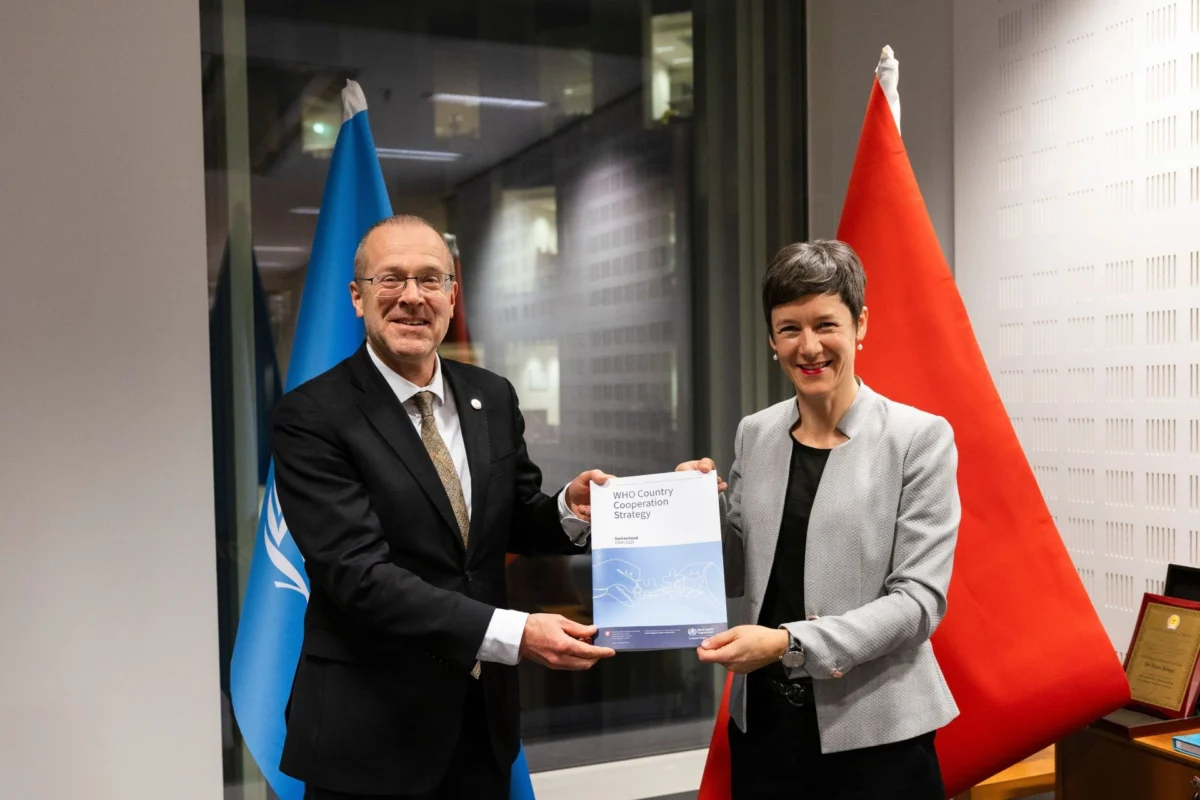
- March 4, 2025: The 2024–2028 CCS is officially signed in Copenhagen by the WHO Regional Director for Europe and the Swiss Ambassador for Global Health, signaling the start of a new, high-intensity collaborative phase.
Strategic Objectives for 2024–2028
The newly signed 2024–2028 strategy is built upon several pillars that address the most pressing health challenges of the coming years. Central to this plan is the reinforcement of health system resilience. Given the strain placed on healthcare providers during the pandemic, the strategy emphasizes the digitization of health records, the optimization of human resources for health, and the promotion of universal health coverage as a mechanism for stability.
Furthermore, the strategy integrates a "One Health" approach, acknowledging the intricate link between human, animal, and environmental health. This is particularly relevant to Switzerland, where alpine ecosystems and diverse agricultural sectors are increasingly susceptible to climate-related health risks. By aligning with the WHO’s European Program of Work, Switzerland aims to serve as a laboratory for policy innovation, testing solutions that could eventually be scaled to other European nations.
Data-Driven Health Policy
Switzerland remains one of the world’s leaders in healthcare spending, with health expenditure as a percentage of GDP consistently ranking among the highest in the OECD. This fiscal capacity allows Switzerland to act as a significant donor and technical partner to the WHO. According to recent WHO data, the collaboration is not just about policy; it is about leveraging Switzerland’s technical excellence.

The BioHub initiative, for instance, relies heavily on Swiss infrastructure and legal frameworks to ensure that the global community can respond to future outbreaks without the delays that hampered early COVID-19 testing efforts. By formalizing this, the 2024–2028 strategy ensures that the legal and operational pathways for such sharing remain clear and unimpeded by bureaucratic friction.
Perspectives from Leadership
The signing ceremony in Copenhagen was attended by key figures who emphasized the symbiotic nature of the agreement. Dr. Hans Henri P. Kluge, WHO Regional Director for Europe, highlighted that the partnership is a two-way street. "Switzerland is not only a host to the WHO but an active participant in shaping the future of global health," he noted.
Barbara Schedler, Ambassador for Global Health at the Swiss Federal Office of Public Health, underscored that for Switzerland, the strategy provides a "clearer, more objective mechanism for contributing to the WHO European Region’s goals." She remarked that the renewal reflects Switzerland’s long-term commitment to multilateralism, an essential component of the nation’s foreign policy. The sentiment among the diplomatic community in Geneva—the global hub of health governance—is that this agreement provides a model for how host countries can contribute more meaningfully to the organizations they house.
Broader Impact and Global Implications
The implications of the WHO-Switzerland cooperation extend well beyond the borders of both entities. In an era of geopolitical fragmentation, the ability of a major international health agency and a sovereign nation to maintain a stable, long-term strategic partnership serves as a stabilizing force for the international system.
- Standardization of Health Metrics: By aligning its reporting and data-collection methods with WHO standards, Switzerland provides high-quality, reliable data that strengthens the evidence base for regional health policies.
- Leadership in Health Diplomacy: Switzerland’s role as a neutral, high-capacity nation allows it to act as a mediator in health policy negotiations, facilitating consensus among disparate member states within the WHO.
- Crisis Readiness: The emphasis on the BioHub and similar technological frameworks ensures that when the next health emergency occurs, the infrastructure for a global response is already functional and tested.
- Innovation in Health Systems: Through this strategy, Switzerland shares its experience with integrated care models, particularly for its aging population, providing a template for other European nations facing similar demographic shifts.
Challenges and Future Considerations
While the agreement is robust, its success will depend on its implementation. Critics of international health strategies often point to the gap between policy documents and actual outcomes on the ground. For the 2024–2028 period, the primary challenge will be maintaining political momentum. As domestic priorities shift due to economic fluctuations or internal political changes, sustaining the necessary funding and personnel for these international collaborative projects can be difficult.
However, the fact that this is a renewal of an existing strategy suggests that the mechanisms for cooperation are already well-established. The bureaucratic hurdles that usually delay such partnerships have been minimized by over a decade of operational history.
Conclusion
The renewal of the WHO-Switzerland Country Cooperation Strategy represents a maturation of the relationship between a global health authority and a leading European nation. By anchoring their collaboration in a multi-year framework, both parties have signaled that they are prepared for the uncertainties of the future. Whether it is through the acceleration of medical research, the strengthening of regional health security, or the implementation of universal health policies, the partnership is set to play a decisive role in the health trajectory of the European region. As the world continues to navigate the complexities of global health, the model established by Switzerland and the WHO stands as a testament to the power of structured, long-term cooperation in achieving collective well-being. The road toward 2028 is now clearly defined, with both the WHO and Switzerland moving in lockstep toward a more secure and resilient global health architecture.
