
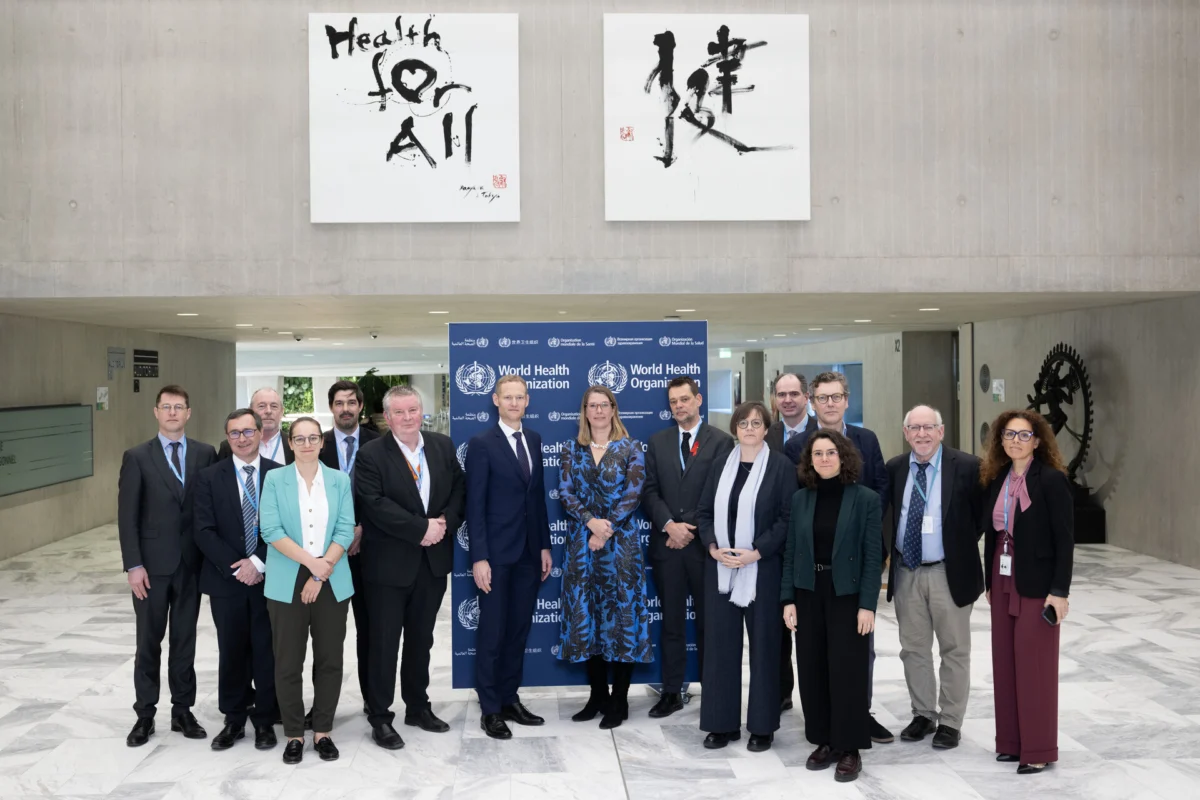
The Kingdom of Belgium and the World Health Organization (WHO) have concluded a pivotal three-day strategic dialogue in Geneva, reaffirming their long-standing partnership and committing to an intensified roadmap for global health cooperation. Held from March 2 to 5, 2025, the consultations brought together high-level representatives from the Belgian Federal government, the Flemish and Walloon regional governments, and WHO leadership to harmonize Belgium’s international development priorities with the WHO’s 14th General Programme of Work (GPW14).
The dialogue served as a critical platform to address the mounting pressures on global health infrastructure, specifically focusing on universal health coverage (UHC), the mitigation of biological risks, and the equitable distribution of life-saving medical technologies. This meeting arrives at a time when the global health landscape is characterized by increasing geopolitical volatility, the lingering effects of the COVID-19 pandemic, and a renewed urgency for sustainable, locally-led health interventions.
A Chronology of Strategic Alignment
The partnership between Belgium and the WHO is rooted in decades of collaboration, but recent years have seen a marked increase in the scope and ambition of this relationship. Following Belgium’s influential presidency of the Council of the European Union in 2024, where global health was elevated to a top-tier policy concern, this week’s dialogue sought to translate those policy aspirations into granular, country-level actions.
The three-day engagement followed a structured agenda:
- Day 1: Strategic Vision and Policy Alignment. The delegation, headed by H.E. Christophe Payot, Ambassador of Belgium to the United Nations in Geneva, opened the sessions by evaluating how Belgium’s development cooperation strategy can best support the WHO’s evolving institutional priorities. Discussions focused on ensuring that multilateral support remains agile enough to respond to emerging crises.
- Day 2: Technical Deep-Dives. The second day was dedicated to thematic deep-dives into the "Access to Medicines" programme and the "UHC-Partnership." Experts from WHO’s Regional Offices for Africa and Europe presented data-driven insights into how Belgian-funded initiatives are functioning in the field, specifically highlighting successes in Senegal and the Democratic Republic of Congo.
- Day 3: Future-Proofing and Resilience. The final day addressed the "One Health" approach, pandemic prevention, and the long-term sustainability of health systems. The sessions concluded with a framework for a renewed WHO-Belgium Country Cooperation Strategy, ensuring that both parties are prepared for the implementation of the GPW14.
Advancing Equitable Access to Medical Innovation
A centerpiece of the discussions was the review of the Belgium-funded Access to Medicines programme. For years, the disparity in vaccine and drug availability between the Global North and South has been a primary concern for the WHO. The dialogue highlighted that market-shaping—the process of creating stable, predictable demand for essential health products—is the most effective way to drive long-term sustainability.
Data presented during the session emphasized that without local production capabilities, developing nations remain perpetually vulnerable to supply chain shocks. The WHO illustrated this through the lens of its work in Senegal, where targeted investments have begun to shift the focus from mere importation to localized manufacturing capacity. Both partners reached a consensus that future funding cycles must prioritize "local-for-local" production models to reduce reliance on fragile international supply chains.
Navigating Health Emergencies and Biological Risks
The dialogue took place against the backdrop of ongoing negotiations for a global pandemic agreement, a treaty intended to ensure the world is better prepared for future health threats. The participants held an in-depth session on the "One Health" approach, which recognizes the interconnectedness of human, animal, and environmental health.
The WHO provided a sobering account of its field operations in Gaza, using the crisis as a case study for the difficulties of delivering health services in conflict-affected zones. This demonstration underscored the necessity of robust emergency response frameworks. Beyond conflict, the dialogue addressed the acceleration of biological risks and zoonotic diseases—illnesses that jump from animals to humans. The delegation expressed a firm commitment to supporting the WHO’s risk mitigation strategies, noting that the threat of future pandemics is a non-negotiable factor in modern national security.
Universal Health Coverage and Institutional Synergy
Universal Health Coverage (UHC) remains the cornerstone of the WHO’s mission, and the partnership with Belgium has been instrumental in the UHC-Partnership’s expansion since 2021. The dialogue reviewed the progress made in partner countries, where Belgian support has helped governments integrate mental health services into primary healthcare systems.

By aligning WHO country office programs with Belgium’s bilateral development initiatives, the two parties aim to eliminate redundancies. This "coherence" approach is designed to ensure that every euro invested in a specific nation has a measurable impact on the ground. In the Democratic Republic of Congo, for example, the focus has shifted toward building resilient primary care networks that can withstand both endemic disease burdens and sudden health emergencies.
Official Statements and Institutional Perspectives
The atmosphere of the dialogue was characterized by mutual recognition of the "uncharted territories" currently faced by international health agencies.
"After listening to the leaders and experts of WHO, we now better understand how they are navigating these challenging times," remarked Mr. Koen Van Acoleyen, Minister Counselor at the Permanent Representation of Belgium to the UN. "We are honoured that we can walk this road together."
Dr. Catharina Boehme, WHO Assistant Director-General for External Relations and Governing Bodies, acknowledged the unique nature of the Belgian contribution. "We thank you for your support, honesty, and strong engagement for global health," she noted. "Your efforts in supporting our work in Mozambique and Senegal are clear examples of the crucial work we accomplish together."
Mr. Dirk Brems, Director of Thematic and Multilateral Cooperation at Belgium’s Directorate-General for Development Cooperation and Humanitarian Aid, emphasized the importance of sustained multilateralism. "We recognize WHO as a trustworthy partner in global health. We felt proud hearing how crucial our support is to the Organization and how it is having a positive impact at country, regional, and global levels," he said.
Broader Impact and Global Health Implications
The results of this strategic dialogue have significant implications for the international health order. As the WHO transitions into the implementation phase of the 14th General Programme of Work (GPW14), the influence of donor nations like Belgium is paramount.
- Refinement of Multilateralism: The commitment to align Belgian bilateral aid with WHO programs represents a move toward "streamlined multilateralism." This reduces the administrative burden on recipient countries and allows for a more unified international response.
- Focus on Evidence-Based Outcomes: By tying funding to specific, evidence-based metrics—such as those seen in Neglected Tropical Diseases (NTD) and Sexual and Reproductive Health and Rights (SRHR) programs—Belgium is helping set a standard for accountability in global development.
- Sustainability in Market Shaping: The recognition that market-shaping is essential for the long-term success of the Access to Medicines program signals a shift away from short-term humanitarian aid toward structural, market-based development.
Looking Toward the Future
The concluding sessions of the dialogue focused on the long-term trajectory of the partnership. With the development of a renewed WHO-Belgium Country Cooperation Strategy, the two entities have established a clear mechanism for oversight and adjustment.
The shared vision for the coming years is one where UHC and health system strengthening are not merely abstract goals, but the primary filters through which all WHO and Belgian health cooperation is viewed. As global threats such as zoonoses and the, as yet, unpredictable climate-health nexus continue to emerge, this deepened partnership provides a blueprint for how mid-sized nations and global health institutions can pool resources and expertise to protect the most vulnerable populations.
The dialogue was not merely an administrative review; it was a proactive effort to secure the future of global public health through high-level coordination, technical rigor, and a shared commitment to equity. As the delegation departed Geneva, the consensus was clear: the Belgium-WHO partnership remains a vital, resilient anchor in a world that is increasingly defined by its health dependencies.
