
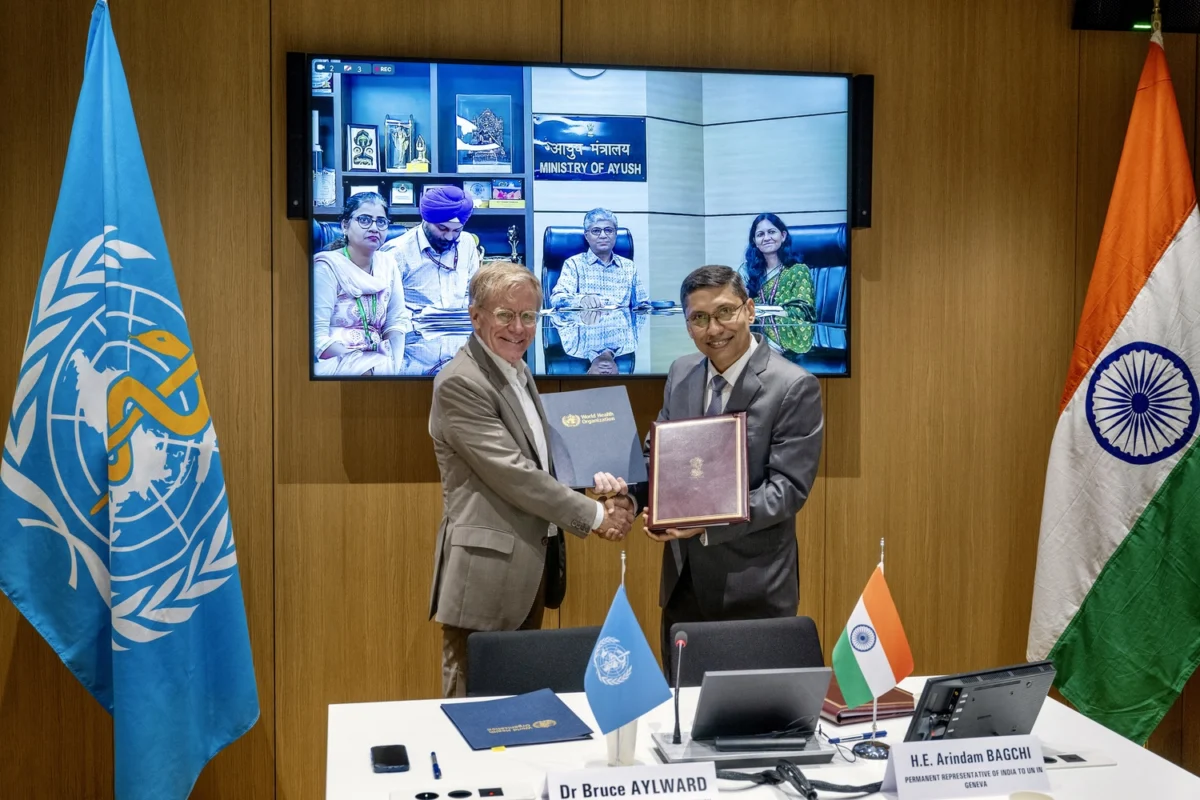
In a landmark development for global public health, the Government of India has formalized a commitment of US$ 85 million over the next decade, spanning 2022 to 2032, to support the strategic programming of the World Health Organization (WHO) Global Traditional Medicine Centre. This substantial financial infusion, announced at a high-level signing ceremony in Geneva, marks a pivotal shift in how international health bodies approach the synthesis of ancient medical wisdom and modern scientific rigor. The funding is specifically earmarked to strengthen the evidence base for traditional medicine, providing a robust framework for policies, clinical practices, and public health products that billions of people worldwide rely upon for their daily health and well-being.
This contribution is a significant component of a broader, US$ 250 million investment by India, which facilitated the establishment of the Jamnagar-based Centre in 2022. By integrating this financial support into the WHO’s broader investment round for 2025–2028, the initiative ensures that traditional medicine remains a central pillar of the organization’s core operations, transcending regional boundaries and technical divisions.
A Chronology of Strategic Integration
The partnership between India and the WHO regarding traditional medicine is not a sudden emergence but the result of a deliberate, multi-year strategic alignment. The timeline of this collaboration highlights the transition from conceptualization to global implementation:
- 2022: The WHO Global Centre for Traditional Medicine is inaugurated in Jamnagar, Gujarat, with a foundational investment of US$ 250 million from the Government of India to cover infrastructure, interim premises, and initial workplans.
- August 2023: The inaugural WHO Traditional Medicine Global Summit is held in Gujarat, bringing together international stakeholders to formalize the "Gujarat Declaration." This document established a multilateral action agenda for integrating traditional practices into national health systems.
- 2023: India signs a five-year agreement to provide ongoing technical support to the WHO’s Traditional, Complementary, and Integrative Medicine (TCI) unit.
- May 2025 (Anticipated): The 78th World Health Assembly is expected to witness the official launch of the 2025–2034 Global Strategy for Traditional Medicine.
- November 2025: A follow-up WHO Global Summit is scheduled to assess progress and align member states with the new decade-long strategy.
The Scope of the WHO Global Traditional Medicine Centre
The Centre, currently under the leadership of Director a.i. Dr. Shyama Kuruvilla, functions as a sophisticated knowledge hub. Its operations are divided into five inter-connected pillars designed to bring scientific clarity to traditional practices:
- Research and Evidence: Systematic evaluation of traditional remedies through clinical trials and observational studies.
- Primary Health Care and Universal Health Coverage: Ensuring that traditional practitioners are effectively incorporated into formal primary health networks.
- Indigenous Knowledge and Biodiversity: Protecting the cultural heritage and medicinal plants that underpin traditional systems while ensuring sustainable sourcing.
- Digital Health Applications: Utilizing big data, AI, and digital databases to track the efficacy and safety of traditional products.
- Global Collaborations: Facilitating the biennial Summits and maintaining a Technical Expert Network that promotes a "One WHO" approach across headquarters and regional offices.
Official Responses and Diplomatic Significance
The signing of the donor agreement reflects a high degree of diplomatic consensus between the Indian government and international health authorities. Dr. Bruce Aylward, Assistant Director-General of the Universal Health Coverage and Life Course division at the WHO, emphasized that the timing of this investment is critical. "India’s commitment and leadership in expanding the evidence-based contribution of traditional medicine to the health and well-being of all people and the planet comes at an opportune moment," Dr. Aylward stated. He noted that traditional medicine, when properly integrated into national systems, acts as a bridge to reach marginalized populations who have been historically left behind by conventional medical infrastructure.
Vaidya Rajesh Kotecha, Secretary of the Ministry of Ayush, highlighted that the agreement is a "major milestone" in the shared vision of Prime Minister Narendra Modi and WHO Director-General Tedros Adhanom Ghebreyesus. Similarly, Ambassador Arindam Bagchi, Permanent Representative of India to the UN in Geneva, underscored India’s enduring dedication to the project. "India remains committed to supporting WHO in its work to strengthen traditional medicine systems globally for achieving universal health coverage and serving the entire humanity," he noted, emphasizing that the Jamnagar facility is intended to provide long-term, equitable benefits to all WHO Member States.
Analytical Perspectives: Implications for Global Health
The infusion of $85 million represents more than just a financial transaction; it signifies a validation of traditional medicine as a legitimate scientific and clinical discipline. For decades, the divide between "Western" allopathic medicine and traditional systems was marked by a lack of standardized data. By funding the development of benchmark documents, standardized terminologies, and technical products, India and the WHO are actively bridging this chasm.
Economic and Clinical Impact:
In many low- and middle-income countries, traditional medicine is the primary, and sometimes only, source of health care. By professionalizing these practices, the WHO aims to reduce the prevalence of substandard or unsafe products while maximizing the therapeutic potential of indigenous remedies. The move toward integrating traditional medicine into the 2025–2034 Global Strategy suggests that the WHO recognizes the economic efficiency of utilizing local, accessible, and culturally accepted health practices to alleviate the burden on strained, centralized hospital systems.
Policy and Regulatory Standardization:
One of the most complex challenges facing the WHO’s TCI unit is the regulation of herbal medicines and traditional practices across borders. The collaborative work between the Centre and the TCI unit—supported by this new funding—is expected to lead to more stringent regulatory frameworks. This includes the development of international standards for the quality control of traditional products, which currently vary wildly from one nation to another. Such standardization is essential for global trade in medicinal products and for ensuring that patients, regardless of geography, receive safe and efficacious care.
The Road Ahead: Challenges and Opportunities
While the financial backing from India is substantial, the success of the WHO Global Traditional Medicine Centre will depend on its ability to navigate the tension between traditional practice and modern clinical standards. Critics of traditional medicine often point to a lack of rigorous, large-scale randomized controlled trials. Proponents, conversely, argue that traditional medicine requires a different research methodology that accounts for holistic health and individualized treatment plans, rather than the "one-size-fits-all" approach of pharmaceutical medicine.
The Centre’s focus on "evidence-informed technical products" suggests a middle path. By applying modern scientific tools—such as genomic analysis of medicinal plants, digital tracking of adverse events, and standardized clinical reporting—to traditional frameworks, the WHO is attempting to modernize the sector without stripping it of its cultural utility.
Furthermore, the integration of traditional medicine into the broader WHO Investment Round for 2025–2028 indicates that this is no longer a peripheral initiative. It is being treated as a core component of the global effort to achieve Universal Health Coverage (UHC). As the world faces an aging population and a rise in chronic, non-communicable diseases, the potential for traditional medicine to contribute to preventative care and lifestyle management is significant.
Conclusion
The commitment of $85 million by the Government of India to the WHO Global Traditional Medicine Centre represents a foundational investment in the future of international health. By fostering a cross-sectoral program that emphasizes research, policy, and digital innovation, the partnership seeks to transform how traditional medicine is viewed and utilized on the global stage. As the 2025 World Health Assembly approaches, the progress made by the Jamnagar-based Centre will likely serve as a benchmark for how international organizations can successfully harmonize ancient knowledge with contemporary medical requirements to advance the ultimate goal of "Health for All."
