
A groundbreaking new analysis suggests that microbial lipids, derived from the fermentation of food industry waste, are already on the cusp of competing with premium fats like cocoa butter and animal fats on cost. This development signals a significant shift in the alternative fats market, addressing long-standing concerns about the economic viability of sustainable lipid production. The study, published in the esteemed journal Nature Communications Sustainability, indicates that with further technological scaling, these novel fats can achieve price parity with established ingredients, potentially revolutionizing sectors from confectionery to plant-based foods.
The burgeoning alternative fats sector has witnessed rapid growth over the past few years, fueled by increasing consumer demand for sustainable and ethically sourced ingredients. However, a persistent hurdle has been the perceived high cost of production, which has limited widespread adoption. This latest research, conducted by Luxembourg-based Cx Bio, offers a compelling techno-economic assessment, demonstrating the feasibility of a fermentation-based approach that harnesses the power of microbes to transform food industry waste streams into valuable fatty acids.
Cx Bio’s researchers meticulously evaluated two primary categories of widely utilized fats: phospholipids (also known as lecithin) and triacylglycerols (commonly referred to as triglycerides). Phospholipids are critical emulsifiers and texturizers in a wide array of food products, including chocolates, baked goods, and dairy alternatives. Triglycerides, on the other hand, encompass the oils and solid fats that impart richness, juiciness, and desirable mouthfeel to products like plant-based meats and margarines.
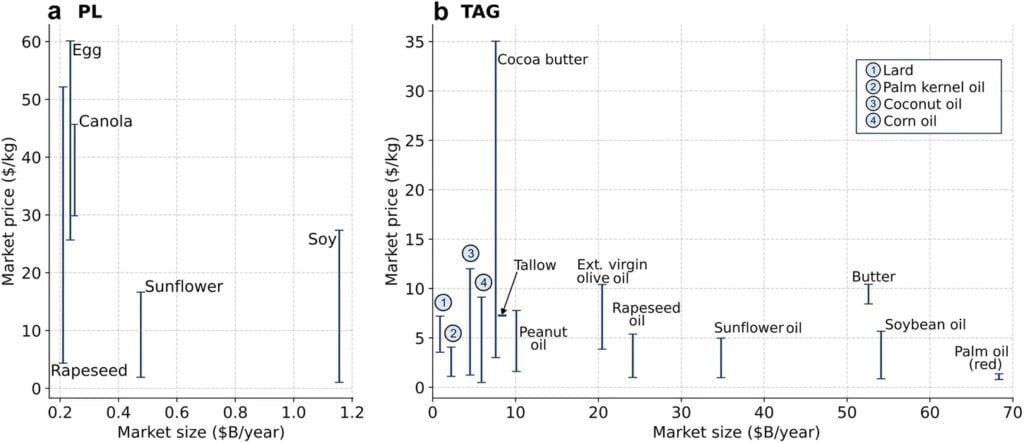
According to the study’s projections, the minimum per-kilogram production cost for these microbial fats currently stands at approximately $14.20 for phospholipids and $10 for triacylglycerols. These figures are not arbitrary; they are the result of comprehensive modeling that accounts for a multitude of factors, including the cost of feedstocks, electricity consumption for fermentation and processing, and the significant capital expenditure required for building dedicated production facilities. Crucially, these estimated costs fall within the established price range of premium ingredients such as cocoa butter, a highly sought-after fat in the chocolate industry, and phospholipids derived from eggs or soy.
The implications of these findings are profound. While current production costs are already competitive with premium ingredients, future scenarios paint an even more optimistic picture. The analysis projects that as feedstocks become more readily available and cost-effective, microbial strains are engineered for increased efficiency, and renewable energy sources become more affordable, the production costs for microbial phospholipids could plummet to as low as $6.10 per kilogram. Similarly, triacylglycerols could see their costs drop to $4.20 per kilogram. At these projected price points, waste-fermented microbial lipids would become competitive with a much broader spectrum of conventional fats, including those currently dominating the market, such as palm oil and animal fats.
The Circular Economy Advantage: Fermentation’s Dual Benefit
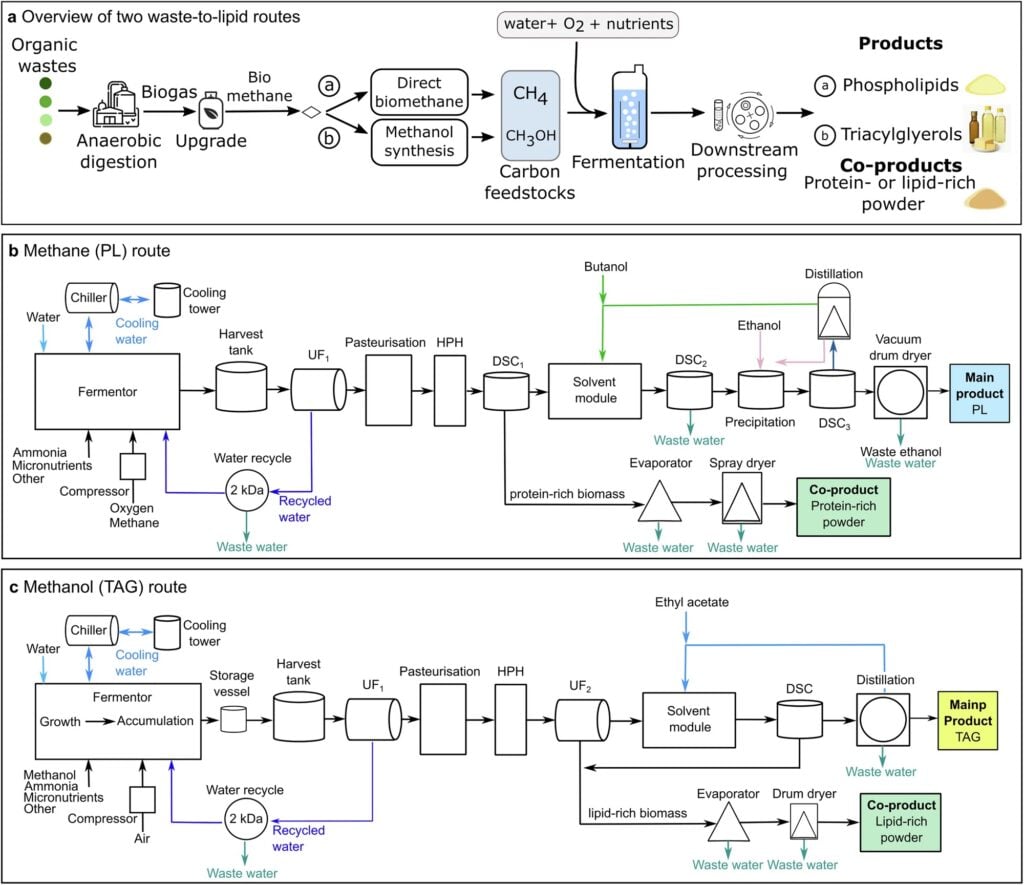
The fermentation process detailed in the Nature Communications Sustainability study offers a compelling advantage beyond its direct lipid production capabilities: it generates valuable co-products, further enhancing its economic and environmental appeal. The core of the process involves the breakdown of organic materials, sourced from food industry sidestreams and agricultural by-products, into biogas. This biogas is then refined into biomethane through the removal of impurities such as carbon dioxide and water.
The resulting biomethane can follow two distinct pathways for lipid synthesis. In the first route, biomethane serves as a direct feedstock for specific microbial strains to produce phospholipids. In the second pathway, biomethane is synthesized into methanol, which then acts as the fermentation base for the production of triacylglycerols.
A critical and often overlooked aspect of this waste-to-lipid technology is the generation of valuable co-products. For every kilogram of lipids produced via the biomethane-to-phospholipid route, the process yields approximately 2.6 kilograms of protein-rich biomass. This protein-rich biomass can find applications in animal feed, aquaculture, or even as a novel ingredient in human food products, thereby creating additional revenue streams and contributing to a more integrated circular economy. Similarly, the methanol-based route for triacylglycerol production generates about 0.9 kilograms of lipid-rich biomass per kilogram of lipids. This lipid-rich biomass can also be valorized for various applications, further enhancing the overall sustainability and profitability of the process.
Seren Kell, Head of Science and Technology at the Good Food Institute Europe, an organization that provided funding for the study, underscored the transformative potential of this approach. "Fermentation promises a new approach that contributes to a circular economy by turning waste sidestreams into valuable food ingredients," Kell stated. "This study provides a robust roadmap for how this potential can be realized across Europe." She further highlighted the persistent challenges in meeting the global demand for fatty acids and the quest for sustainable, scalable fats that can replicate the sensory qualities of animal fats, a key barrier to developing more appealing plant-based meat alternatives.
Addressing the Environmental Footprint of Conventional Fats
The emergence of waste-fermented microbial lipids is particularly significant when considering the environmental impact of conventional fat sources. Animal fats, for instance, are produced by an industry responsible for a substantial portion of global greenhouse gas emissions – estimated to be between 14.5% and 20% of all human-caused emissions. This industry also consumes vast amounts of land and freshwater resources, contributing to deforestation, biodiversity loss, and water scarcity.
Tropical plant-based fats, such as palm oil and coconut oil, have also come under intense scrutiny due to their association with widespread deforestation, habitat destruction, and the displacement of Indigenous communities. The insatiable global demand for these oils has driven the conversion of vital rainforest ecosystems into monoculture plantations, leading to significant carbon emissions from land-use change and threatening countless species.
This environmental imperative has spurred the growth of numerous alternative fat startups. Companies like Savor, Clean Food Group, Checkerspot, Alto, and NoPalm Ingredients are at the forefront of developing innovative solutions, often leveraging precision fermentation and biotechnology. These startups have collectively secured substantial funding in recent years and are forging partnerships with major players in the food and personal care industries. The current study’s findings suggest that waste fermentation technology can now join these innovative approaches as a cost-effective and scalable solution.
Scalability and Market Integration: A Path Forward
The authors of the Nature Communications Sustainability study are optimistic about the scalability of waste-fermentation technology. Europe alone generates an estimated 850 million tonnes of organic waste annually, a colossal resource that could be harnessed to produce thousands of tonnes of microbial fats. The study’s modeling indicates that a single, large-scale production facility, as envisioned in their projections, would still represent less than 1% of the global demand for cocoa butter. This suggests that the technology has ample room for growth and expansion without necessarily displacing existing, established markets. Instead, it offers an opportunity to supplement and diversify the global fat supply.
Milena Ivanisevic, co-founder of Cx Bio and lead author of the study, emphasized the role of this technology within a broader sustainability framework. "No single technology will solve the challenges of food sustainability, but our findings suggest that waste-to-lipid biomanufacturing could become one important piece of the puzzle," Ivanisevic stated. She further elaborated on the potential for this technology to transform underutilized waste streams into high-value food ingredients, fostering a more circular economy that operates in synergy with existing food production systems.
Future Projections and Technological Advancements
The economic viability of microbial lipid production is intrinsically linked to ongoing technological advancements. The study’s projections for future cost reductions are contingent upon several key developments:
- Feedstock Optimization: Exploring and securing a consistent, low-cost supply of diverse organic waste streams will be crucial. This could involve partnerships with food manufacturers, agricultural processors, and waste management companies. Diversifying feedstocks can also mitigate risks associated with the availability and price fluctuations of any single waste stream.
- Microbial Strain Engineering: Continuous research and development into engineering more efficient microbial strains is paramount. This includes enhancing their ability to convert specific waste components into lipids at higher yields and faster rates, as well as improving their tolerance to various feedstock compositions. Genetic engineering and directed evolution are key areas of focus.
- Process Intensification: Optimizing fermentation conditions, including temperature, pH, nutrient availability, and aeration, can significantly improve efficiency and reduce energy consumption. The development of continuous fermentation processes, as opposed to batch processes, could also lead to higher throughput and lower operational costs.
- Renewable Energy Integration: Transitioning to renewable energy sources for powering fermentation facilities and downstream processing is essential for both cost reduction and environmental sustainability. Investing in on-site renewable energy generation or securing long-term power purchase agreements for renewable electricity can stabilize energy costs and reduce the carbon footprint.
- Co-product Valorization: Maximizing the value derived from co-products like protein-rich and lipid-rich biomass is critical for improving the overall economics. This requires dedicated research into potential applications and market development for these side streams.
Broader Implications for the Food Industry and Beyond
The potential for cost-competitive, sustainably produced microbial lipids has far-reaching implications across the food industry and beyond. For manufacturers of confectionery and baked goods, it offers a viable, ethically sourced alternative to cocoa butter, which is subject to price volatility and supply chain complexities. In the plant-based meat sector, these lipids can enhance the palatability and sensory experience of products, making them more appealing to a wider consumer base and accelerating the transition away from conventional meat.
Furthermore, the development of these novel fats could spur innovation in other sectors. The lipid-rich biomass co-products, for instance, could be explored for use in personal care products, cosmetics, or even as components in bioplastics. The protein-rich biomass holds promise for animal feed and potentially as a sustainable source of protein for human consumption, contributing to food security.
The study’s findings represent a significant step forward in the pursuit of a more sustainable and circular global food system. By transforming waste into valuable ingredients, waste-fermented microbial lipids offer a tangible solution to some of the most pressing environmental challenges associated with traditional fat production. As technology continues to advance and economies of scale are achieved, these novel fats are poised to play an increasingly vital role in shaping the future of food. The journey from waste sidestreams to premium food ingredients is no longer a distant aspiration but a rapidly materializing reality, offering a compelling vision for a more resource-efficient and environmentally responsible future.
