
The burgeoning field of cultivated materials, which has seen significant advancements in sectors like protein and fat production, is now extending its innovative reach into the realm of wood. While companies are already exploring lab-grown leather and cotton, a Dutch startup, New Dawn Bio, has successfully captured investor attention with its groundbreaking technology to cultivate wood directly from tree cells within bioreactors. This development signals a significant shift in how we might source and utilize one of humanity’s oldest and most essential building materials, offering a potent solution to the escalating environmental crises driven by conventional forestry.
A Groundbreaking Approach to Wood Production
New Dawn Bio, headquartered in the Netherlands, has announced the closure of an oversubscribed pre-seed funding round, securing €2.1 million (approximately $2.4 million USD). This significant capital infusion was led by prominent venture capital firm CapitalT, with strategic participation from Norrsken Evolve, Ontdekkers Group, and a notable cohort of angel investors, including Jelle Prins. The funding is earmarked to accelerate the development and commercialization of their revolutionary cell-culture technology.
Tom Clement, CEO and co-founder of New Dawn Bio, established the startup in 2024 alongside COO Kianti Figler. Clement articulated the core motivation behind the company’s mission: "Wood has been a pinnacle to mankind for millennia, yet we still haven’t figured out a better way than to cut rectangular boards and beams from round tree trunks. For the first time in history, we can now grow pre-shaped premium wood. This funding lets us turn our breakthrough into a product that industries can actually use." This statement underscores the ambition to move beyond traditional timber harvesting, which has remained largely unchanged for centuries, and usher in an era of precisely engineered, sustainably sourced wood.
Addressing the Global Deforestation Crisis
The urgency behind New Dawn Bio’s innovation is underscored by the alarming statistics surrounding global wood consumption and its environmental toll. Annually, humanity utilizes approximately four billion cubic meters of wood for a myriad of applications, ranging from fuel and energy generation to construction, furniture manufacturing, and the production of paper and pulp. However, this immense demand is contributing to a severe ecological crisis.
Current estimates indicate that around 30% of all tree species are teetering on the brink of extinction. This dire situation is largely attributable to rampant deforestation, which not only decimates biodiversity but also severely undermines the stability of Earth’s climate systems. The impact of deforestation on global greenhouse gas emissions is profound; it accounts for an estimated 11% of total global emissions, a figure that dwarfs the contribution of the aviation industry by a factor of more than five.
Further compounding the issue, recent scientific research has raised significant concerns about the environmental impact of burning wood for energy. Some studies suggest that this practice could be more detrimental to the planet than burning natural gas, even when emissions are captured and stored. Each year, forest loss contributes over 8.1 gigatonnes of carbon emissions, surpassing the combined emissions from shipping, aviation, and road traffic.
The production of premium wood, often sourced from mature and rare tree species, presents its own set of challenges. These trees can take a decade or more to reach maturity, making their procurement difficult and often leading to the exploitation of endangered species. In some cases, harvesting these valuable timber varieties has become illegal due to their endangered status. New Dawn Bio’s technology offers a compelling alternative by circumventing the need for logging altogether.
The Science Behind Cultivated Wood
New Dawn Bio’s innovative process begins with the careful harvesting of stem cells from trees. These cells are then meticulously multiplied in a controlled laboratory environment within bioreactors. By providing the cells with the same biological signals that they would naturally receive within a tree trunk, the startup guides their development. This process encourages the cells to thicken, harden, and adhere to one another, ultimately forming a cohesive, interconnected tissue that replicates the structure and properties of natural wood.
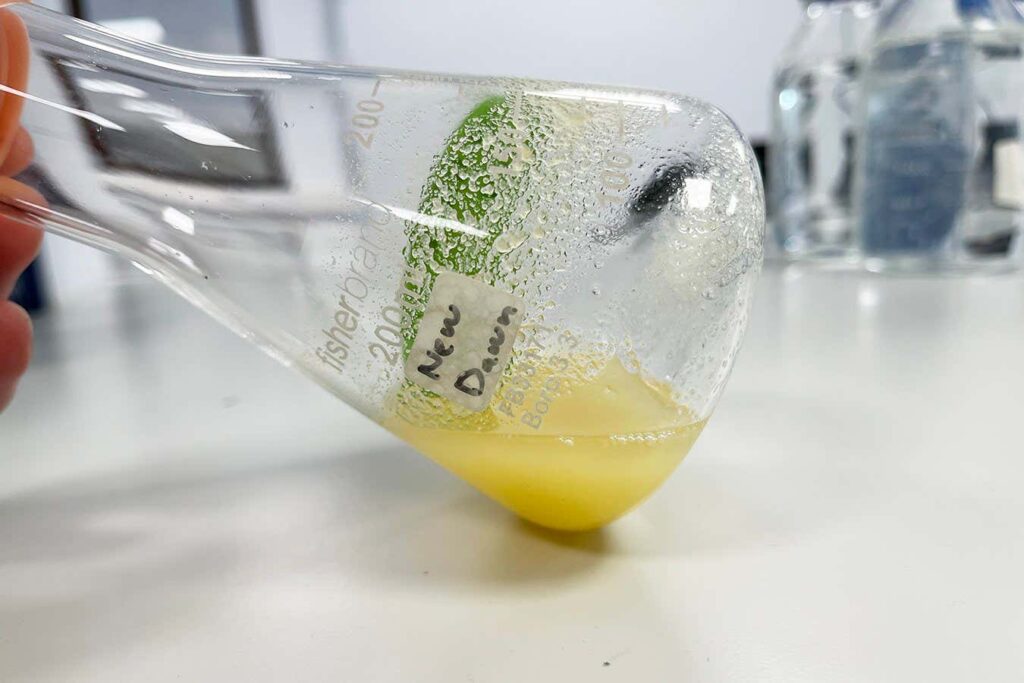
Crucially, this method employs an additive manufacturing approach rather than the subtractive sawing techniques of traditional forestry. This means the wood can be grown directly into the desired shape and dimensions of the final product. The implications are substantial: premium wood can be cultivated in a matter of days, a stark contrast to the years or decades required for natural tree growth. New Dawn Bio claims its process is an astonishing 10,000 times faster than conventional forestry, and it eliminates the need for any logging operations. This efficiency and speed are key to unlocking scalable, sustainable wood production.
Accelerating Innovation with AI and Deep Engineering
The financial backing secured by New Dawn Bio will be instrumental in advancing the product development of their lab-grown wood. A significant portion of the funding will be allocated to expanding their interdisciplinary research and development team. This team comprises experts in cell biology, materials engineering, physics, and process engineering, reflecting the complex, multi-faceted nature of the challenge.
The company is actively building what it terms a "deep-engineering organization." This approach integrates cutting-edge artificial intelligence (AI) to significantly accelerate data analysis and enable higher throughput in their research and development efforts. While leveraging advanced technology, the core of their mission remains firmly rooted in biological principles. AI will play a critical role in optimizing cell growth conditions, predicting material properties, and streamlining the entire cultivation process, further enhancing efficiency and scalability.
New Dawn Bio’s shaped-wood process holds the potential to dramatically reduce the cost of goods sold by as much as 80%. By growing wood to precise specifications, the technology inherently eliminates waste associated with traditional manufacturing processes such as sawing, routing, drilling, and the use of glues. This precision manufacturing not only reduces material waste but also minimizes the energy and resources required for post-processing.
Furthermore, the cell-cultured wood developed by New Dawn Bio can serve as a sustainable substitute for fossil-derived polymers in high-end industries. This substitution has the potential to significantly lower the environmental footprint of sectors that currently rely heavily on petroleum-based plastics and other non-renewable materials.

The scale of the problem New Dawn Bio is addressing is immense. With the world losing an estimated 5.3 million hectares of tropical forest each year, the ability to produce wood in bioreactors offers a tangible solution. By doing so, New Dawn Bio projects it can save up to 2.1 gigatonnes of direct emissions annually. Beyond emissions reduction, this approach directly contributes to forest preservation, safeguarding vital ecosystems that are home to over half of Earth’s biodiversity.
Janneke Niessen, founding partner at CapitalT, expressed strong confidence in the startup’s vision and team. "Tom and Kianti have assembled a world-class team tackling a problem that is both massive in scale and largely overlooked," Niessen stated. "Cultured wood has the potential to transform entire supply chains while making a meaningful contribution to the planet." This endorsement highlights the significant market opportunity and the profound environmental impact envisioned by the investors.
A Glimpse into the Future of Materials
The work of New Dawn Bio is not an isolated endeavor. Scientists at the Massachusetts Institute of Technology (MIT) have also explored similar avenues. In 2022, MIT researchers unveiled a technique for generating wood-like plant material in a laboratory setting. Their approach, utilizing 3D bioprinting, allows for the creation of materials that can be precisely tuned into shapes and sizes not found in nature, mirroring some of the key advantages of New Dawn Bio’s technology. These parallel advancements underscore a growing global interest and investment in bio-based material innovation as a critical component of the transition to a sustainable economy.
The implications of New Dawn Bio’s success extend far beyond the immediate production of wood. It represents a paradigm shift in material science, moving away from extractive and resource-intensive processes towards regenerative and bio-engineered solutions. The ability to grow materials with specific properties, tailored to exact applications, opens up a vast array of possibilities for industries seeking to reduce their environmental impact without compromising on performance or aesthetics. As the world grapples with climate change and resource scarcity, innovations like New Dawn Bio’s cultivated wood offer a beacon of hope for a more sustainable and circular future. The successful completion of this pre-seed round marks a critical first step in bringing this transformative technology from the lab to the market, promising to reshape our relationship with one of nature’s most fundamental resources.
