
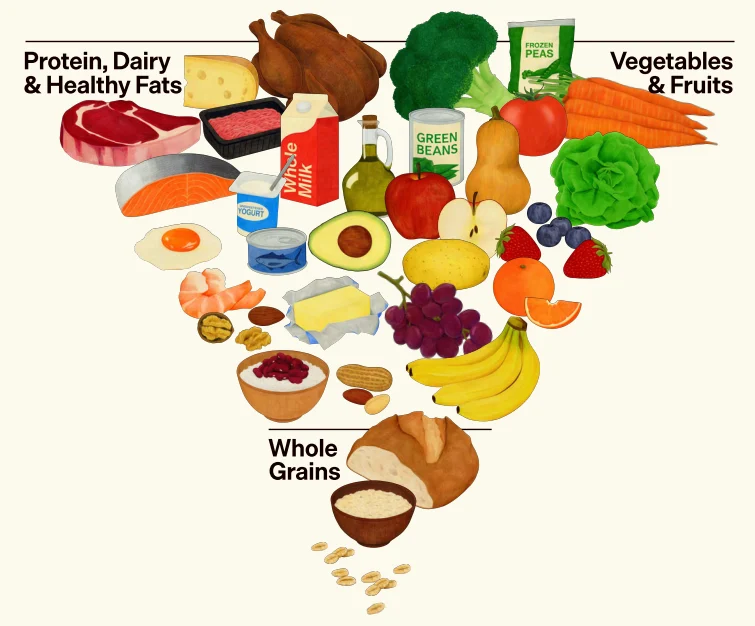
The United States Department of Agriculture (USDA) and the Department of Health and Human Services (HHS) unveiled the highly anticipated 2025-2030 Dietary Guidelines for Americans (DGAs) this week, a comprehensive set of recommendations intended to shape the nation’s eating habits. The latest iteration arrives with the prominent tagline, "Eat Real Food," signaling a strengthened emphasis on limiting added sugars and highly processed foods. However, alongside these widely lauded shifts, the release has been met with significant debate, particularly concerning a new, inverted pyramid graphic and perceived contradictions within the guidance.
This release marks a pivotal moment in national nutrition policy, building upon decades of evolving scientific understanding and public health objectives. The DGAs, first published in 1980, are updated every five years and serve as the cornerstone for federal food, nutrition, and health policies and programs. They are informed by a rigorous scientific review process, culminating in a Scientific Report from an independent Dietary Guidelines Advisory Committee (DGAC) before the final guidelines are issued by the USDA and HHS. This year’s process, however, has been marked by an unusual divergence between the advisory committee’s recommendations and the final published guidelines, sparking concerns about transparency and scientific integrity.
Key Shifts and Persistent Concerns in the 2025-2030 DGAs
A central theme of the new DGAs is the explicit targeting of "highly processed foods." While previous editions have advocated for whole foods and cautioned against excessive sodium and added sugars, this is the first time a broader category of processed items has been directly addressed. This move is seen by many as a crucial step in aligning dietary advice with contemporary nutritional science, which increasingly highlights the detrimental health effects associated with ultra-processed foods. The guidelines recommend avoiding sugar-sweetened beverages, salty or sweet packaged snacks, and ready-to-eat meals, with even illustrated yogurt containers specifying "unsweetened." Furthermore, the emphasis on whole, fiber-rich grains over refined carbohydrates, such as white bread, reinforces this push toward less processed options.
The guidelines also tighten restrictions on added sugars. The new recommendations state that "no amount of added sugars or non-nutritive sweeteners is recommended or considered part of a healthy or nutritious diet." This marks a significant departure from previous guidelines, which allowed for up to 10% of daily calories from added sugars. The 2025-2030 DGAs suggest that no single meal should exceed 10 grams of added sugars, a more granular approach that, while potentially challenging to implement, underscores the commitment to reducing sugar intake. For children, the guidelines now recommend avoiding added sugars until age 10, a notable increase from the previous age of two.
The "New Food Pyramid" and Saturated Fat Debate
Perhaps the most visually striking and controversial element of the new DGA release is the introduction of a pyramid-like graphic, notably flipped and emphasizing foods such as steak, full-fat milk, and butter at its apex. This visual representation has generated considerable confusion, as it appears to contradict the long-standing recommendation within the guidelines themselves to limit saturated fat intake to no more than 10% of total daily calories.
Dr. Frank Hu, Professor of Nutrition and Epidemiology and Chair of the Department of Nutrition at the Harvard T.H. Chan School of Public Health, commented on this apparent discrepancy: "I think the new Guidelines move in the right direction by reinforcing the importance of reducing added sugars and cutting back on refined grains and other highly processed foods. However, there appear to be several contradictions within the DGAs and between the DGAs and the new pyramid. The mixed messages surrounding saturated-fat-rich foods such as red meat, butter, and beef tallow may lead to confusion and potentially higher intake of saturated fat and increased LDL cholesterol and cardiovascular risk."
While the actual textual guidelines retain the 10% limit for saturated fat, the prominence of high-saturated-fat foods in the accompanying graphic has raised concerns about mixed messaging. The pyramid’s largest section is dedicated to vegetables and fruits, a positive inclusion. However, Dr. Hu also pointed out the relatively smaller depiction of whole grains compared to other food groups, despite the guidelines’ recommendation for 2-4 servings per day. This highlights the power of visual cues; images and taglines can often be more memorable than the nuanced details within the accompanying text, potentially influencing public perception and dietary choices.
Underlying Data and Implications of Saturated Fat Recommendations
To illustrate the potential impact of the saturated fat guidance, consider a 2,000-calorie diet. The 10% limit translates to approximately 22 grams of saturated fat per day. The DGAs’ guidance on daily servings by calorie level suggests three servings of dairy. If full-fat versions are chosen – for example, an 8-oz cup of whole milk (5 grams saturated fat), ¾ cup of full-fat Greek yogurt (6 grams), and 1 ounce of cheddar cheese (6 grams) – this already accounts for 17 grams of saturated fat. Adding a single tablespoon of butter (7 grams) or beef tallow (6 grams), both suggested as cooking fat options, would push an individual over the daily limit, even before accounting for other food consumption throughout the day.
The guidelines do mention olive oil as a healthy fat option, referencing its "essential fatty acids." While olive oil is a healthy choice with lower saturated fat (2 grams per tablespoon), Dr. Hu clarifies that other oils provide superior sources of essential fatty acids. "Olive oil contains mostly oleic acid, but relatively small amounts of essential fatty acids such as alpha-linolenic acid and linoleic acid compared with other oils that are rich sources of these fatty acids, such as soybean oil and canola oil," he explained. "Importantly, all these plant oils have been shown to lower LDL cholesterol and cardiovascular risk compared with animal fats such as butter or tropical fats such as coconut oil and palm oil." This further emphasizes the importance of understanding the nuances of fat sources beyond simple categorization.
Protein Intake: Quantity Over Quality?
The 2025-2030 DGAs also propose an increase in recommended protein intake for adults, suggesting 1.2 to 1.6 grams of protein per kilogram of body weight per day. This represents a 50-100% increase from previous minimum intake recommendations. While protein needs are indeed variable, and wider ranges are established by bodies like the National Academy of Medicine, experts caution against a blanket increase without sufficient emphasis on protein quality. Consuming excess protein can be converted to fat, potentially leading to weight gain.
Dr. Hu voiced concerns about this aspect of the guidelines: "Substantially raising overall protein intake without distinguishing between different protein sources may have unintended long-term health implications. Evidence continues to suggest that plant-based proteins and fish are associated with more favorable health outcomes than diets high in red meat." The "protein package" – the fats, fiber, sodium, and other nutrients accompanying protein sources – is critical for overall health. While the DGAs recommend a variety of protein foods from both animal and plant sources, the lack of clear messaging on prioritizing certain options, particularly in light of saturated fat limits, remains an area of concern.
Transparency and Controversy Surrounding the Advisory Process
Adding to the complexity of the DGA release is the unusual path taken to its finalization this year. Typically, the process involves the establishment of a DGAC, an independent body of nutrition science experts who review scientific evidence and produce a Scientific Report. This report then informs the USDA and HHS in developing the final guidelines. However, in a departure from this established procedure, the current administration reportedly rejected the DGAC’s report. Instead, a supplemental scientific analysis was conducted by a group selected through a "federal contracting process."
Concerns have been raised regarding the transparency of this supplemental analysis. Deirdre Tobias, an assistant professor in the Department of Nutrition at Harvard Chan School who served on the 2025-2030 DGAC, articulated these concerns in a Q&A with Harvard Chan News: "As of today, there has not been transparency in who wrote the new DGAs. Although there are documents included in the appendices by named scientists, there is no transparency in the methodology and rigor that was employed, or why certain topics were selected to be relitigated. The reviews themselves, as well as their overall presentation and integration, deviate significantly from the rigorous process that the HHS developed for the DGAs to ensure the evidence base and its committees’ conclusions were replicable, unbiased, transparent, and free from non-scientific influences."
Further scrutiny has focused on the disclosed financial ties of some reviewers in the supplemental analysis to the beef and dairy industries, raising questions about potential conflicts of interest, particularly given the prominent placement of meat and dairy products in the new DGA visuals. This deviation from the traditional, transparent review process has led to a less unified and more contentious reception of the 2025-2030 DGAs.
Alcohol and Environmental Considerations: Missed Opportunities?
The guidance on alcohol consumption is also notably vague, offering a general recommendation to "consume less alcohol for better health" without providing concrete limits. This lack of specificity makes it difficult for individuals to translate the advice into actionable steps.
Another significant omission, according to many public health advocates and researchers, is the lack of consideration for the environmental and socioeconomic impacts of dietary recommendations. Food choices have a profound effect on the environment, and conversely, socioeconomic and cultural factors significantly shape dietary patterns. By not integrating these considerations, the DGAs may overlook crucial aspects of sustainable and equitable food systems.
The Bottom Line: Navigating a Complex Landscape
The 2025-2030 Dietary Guidelines for Americans present a mixed bag of progress and perplexity. While the strengthened stance against added sugars and highly processed foods aligns with current scientific consensus and represents a step forward, the visual messaging and perceived contradictions, particularly regarding saturated fats and the prominent display of certain animal products, create significant potential for public confusion. The controversy surrounding the advisory process further complicates the interpretation and acceptance of these guidelines.
Historically, adherence to the DGAs has been a challenge for Americans, with past research indicating low compliance rates. It remains to be seen whether this edition, despite its attempts at being more consumer-friendly through shorter text and associated graphics, will fare any differently. For individuals seeking clarity amidst the conflicting messages, resources like the Harvard Healthy Eating Plate offer a well-established alternative, and consulting a registered dietitian can provide personalized, evidence-based guidance. The ultimate impact of these guidelines will depend not only on their scientific rigor but also on how effectively they are communicated and integrated into the daily lives of the American public, a task made more difficult by this year’s controversies.
