
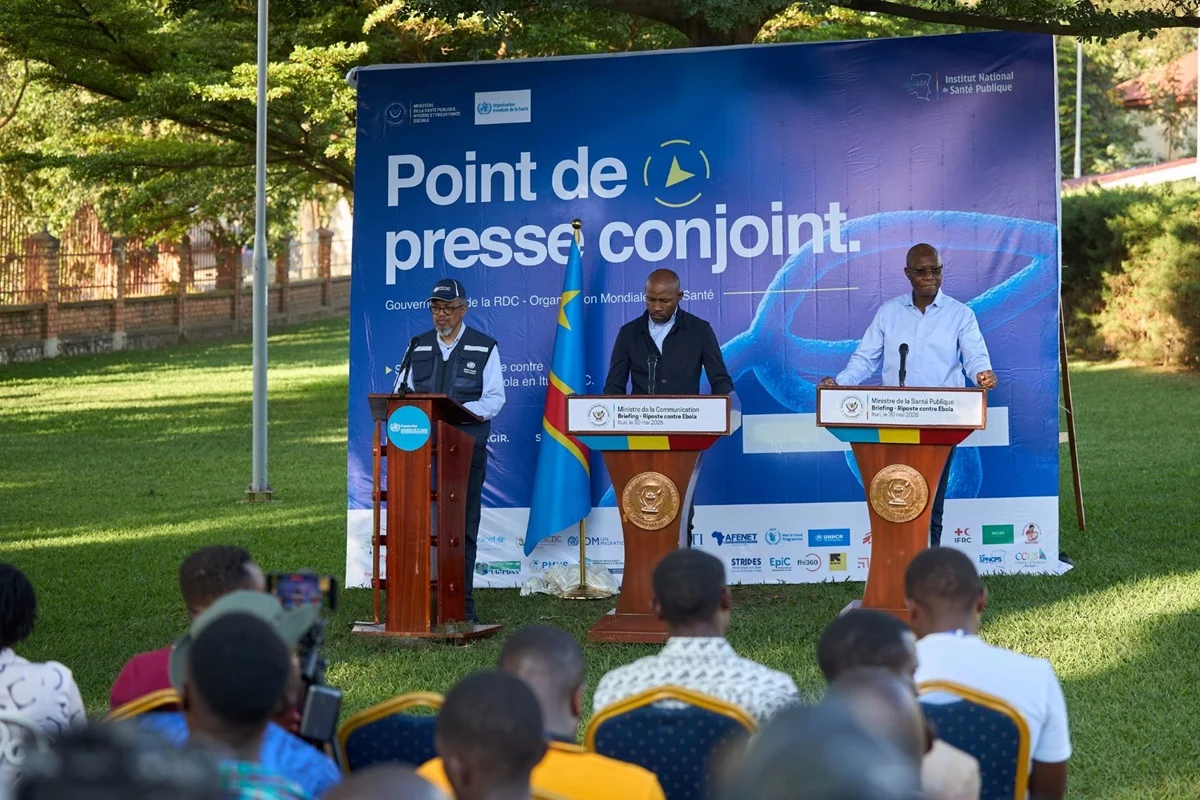
The Government of the Democratic Republic of the Congo (DRC) and the World Health Organization (WHO) have officially reaffirmed their strategic partnership and shared commitment to safeguarding the health of citizens in Ituri Province and across the nation following a high-level joint mission to Bunia. This mission, which included Dr. Samuel Roger Kamba, the Minister of Health, and Mr. Patrick Muyaya Katembwe, the Minister of Communication and Media, was punctuated by a significant visit from the WHO Director-General, Dr. Tedros Adhanom Ghebreyesus. The delegation’s arrival marks a critical juncture in the country’s public health landscape as it grapples with a burgeoning outbreak of Ebola virus disease caused by the Bundibugyo virus strain. The Ministry of Health has characterized the situation as rapidly evolving, with confirmed cases and fatalities reported across several health zones in Ituri, North Kivu, and South Kivu, necessitating an immediate and scaled-up response to interrupt the chain of transmission.
The current crisis represents a complex challenge for the DRC, a nation that has become a global leader in Ebola management due to its extensive history with the virus. However, the Bundibugyo strain presents unique hurdles that differ from the more common Zaire strain. Unlike the Zaire ebolavirus, for which licensed vaccines and monoclonal antibody treatments exist, the Bundibugyo strain currently lacks an approved vaccine or specific therapeutic regimen. This gap in the medical arsenal places a premium on traditional public health interventions, such as early detection, rigorous contact tracing, and community-led prevention measures. The joint mission to Bunia was designed not only to assess the ground-level reality but also to signal to the international community that the DRC government is taking a proactive, leadership-driven approach to this health emergency.
Chronology of the Outbreak and Response Measures
The timeline of the current outbreak began with the notification of several unexplained deaths and symptomatic cases in the rural health zones of Ituri. Local surveillance systems, bolstered by previous investments in community health monitoring, flagged the cluster as suspicious in the preceding weeks. Following laboratory confirmation of the Bundibugyo virus, the Ministry of Health immediately activated its National Emergency Response Plan. By the time the high-level delegation arrived in Bunia, the response had moved from an investigative phase to an active containment phase.
In the initial days following the outbreak’s declaration, the government focused on the deployment of rapid response teams to the most affected health zones. These teams, comprising epidemiologists, clinicians, and social mobilization experts, were tasked with establishing isolation centers and beginning the painstaking work of contact tracing. The visit by Dr. Tedros and the DRC ministers served as a catalyst for the next phase: the international mobilization of resources. This phase has seen the arrival of specialized laboratory equipment to reduce turnaround times for testing and the initiation of logistics for randomized control trials for candidate vaccines. The government’s strategy is now focused on a multi-provincial approach, recognizing that the high mobility of populations between Ituri and the Kivus necessitates a coordinated regional surveillance net.
Epidemiological Landscape and Supporting Data
While the DRC has faced over a dozen Ebola outbreaks since the virus was first discovered in 1976, the Bundibugyo strain is relatively rare. First identified in 2007 in Uganda, this strain typically exhibits a lower case-fatality rate than the Zaire strain—ranging from 25% to 50%—but it remains a severe threat to public health. Data from the Ministry of Health indicate that the current outbreak is spreading through familial clusters and health facility-based transmission, highlighting gaps in infection prevention and control (IPC) in local clinics.
Current surveillance data shows that the majority of cases are concentrated in Ituri, a province already strained by internal displacement and sporadic conflict. The presence of the virus in North and South Kivu further complicates the epidemiological picture, as these areas are among the most densely populated and mobile regions in Central Africa. Health officials have noted that the "doubling time" of cases in certain zones is a cause for concern, prompting the WHO to classify the risk at the national and regional levels as high. To combat this, the WHO has released emergency funds from the Contingency Fund for Emergencies (CFE) to support the first three months of the response, which includes the procurement of personal protective equipment (PPE) and the setup of mobile laboratory units.
The Centrality of Community Trust and Engagement
A recurring theme of the joint mission was the recognition that the success of the Ebola response hinges on the participation of local communities. History has shown that top-down medical interventions can face resistance if they do not account for local customs and the socio-political context. In Ituri, where trust in external authorities can be fragile due to years of insecurity, the government and the WHO are prioritizing a "community-first" model. This involves intensive dialogue with community leaders, women’s associations, youth groups, and religious figures to ensure that health protocols—particularly safe and dignified burials—are conducted in a way that respects local traditions while preventing the spread of the virus.
Minister Patrick Muyaya Katembwe emphasized the role of communication in this effort, stating that the "infodemic" of misinformation can be as dangerous as the virus itself. The Ministry of Communication is working to saturate local radio airwaves and social media channels with accurate, actionable health information. By co-developing solutions with local actors, the response teams aim to reduce the stigma associated with the disease, encouraging individuals to seek care at the first sign of symptoms rather than hiding cases within their homes.
Scientific Innovation and Clinical Trials
The absence of a licensed vaccine for the Bundibugyo strain has accelerated plans for scientific research in the midst of the outbreak. The Ministry of Health, in collaboration with the WHO and the Africa Centres for Disease Control and Prevention (Africa CDC), is working to fast-track randomized control trials (RCTs) for candidate vaccines and experimental treatments. These trials are essential for building the global knowledge base and providing future protection against this specific strain.
The ethical and logistical framework for these trials is being established with an emphasis on transparency and local ownership. Researchers are looking at several vaccine candidates that have shown promise in laboratory settings but have yet to be tested in a large-scale outbreak environment. Simultaneously, the response is utilizing "proven public health measures," which include the use of supportive care—hydration, electrolyte replacement, and treatment of co-infections—which has been shown to significantly improve survival rates even in the absence of virus-specific drugs.
Challenges to Containment: Security and Logistics
Despite the experience of the DRC’s health workers, the current response faces significant operational hurdles. The security situation in eastern DRC remains volatile, with the presence of various armed groups in Ituri and North Kivu. This insecurity limits the movement of health workers and makes it difficult to reach remote communities for contact tracing and decontamination. The government has pledged to provide security escorts for medical teams where necessary, while emphasizing the neutral, humanitarian nature of the health response.
Logistically, the "cold chain" required for certain diagnostic tools and the potential vaccines remains a challenge in areas with limited electricity and infrastructure. The WHO is supporting the government in deploying solar-powered refrigeration units and satellite communication kits to ensure that data from the field can be transmitted to the central command in Kinshasa in real-time. The goal is to create a seamless flow of information and supplies, ensuring that no health zone is left isolated during the crisis.
Analysis of Regional and International Implications
The outbreak in the DRC is not merely a national concern but a regional one. The proximity of Ituri and the Kivus to the borders of Uganda, Rwanda, and South Sudan means that the risk of cross-border transmission is ever-present. The DRC government and the WHO have called for sustained international solidarity, urging neighboring countries to strengthen their own surveillance systems without resorting to restrictive border closures that could hamper the movement of essential medical supplies and personnel.
From a broader perspective, this outbreak underscores the necessity of the "One Health" approach, which recognizes the link between human health, animal health, and the environment. As human populations expand into previously undisturbed forest areas, the frequency of zoonotic spillovers—where viruses jump from animals to humans—is expected to increase. The investments being made now in the DRC’s health infrastructure, including the strengthening of provincial laboratories and the training of a new generation of community health workers, are seen as vital contributions to global health security.
Institutional Memory and Long-Term Resilience
The DRC’s "unparalleled experience" in managing Ebola is a cornerstone of the current response. The country has developed a robust cadre of experts who have managed outbreaks in diverse environments, from the dense forests of Équateur to the conflict zones of the east. This institutional memory allows for a rapid "surge" capacity that few other nations possess. However, both the government and the WHO are clear that the response must go beyond immediate containment.
The strategy emphasized during the Bunia mission involves integrating the Ebola response into the broader primary health care system. This means that the resources brought in for Ebola—such as improved water and sanitation facilities in hospitals, better-trained nurses, and enhanced diagnostic capabilities—should remain in place long after the outbreak is declared over. By strengthening the resilience of the health system, the DRC aims to reduce its vulnerability to future epidemics, whether they be Ebola, measles, or cholera.
Conclusion and Call to Action
As the joint mission concluded, the message from the DRC government and the WHO was one of cautious optimism backed by a call for continued international support. The partnership between the Ministry of Health, the Ministry of Communication, the WHO, and the Africa CDC represents a unified front against a formidable pathogen. The success of this intervention will depend on the continued mobilization of resources, the safety of health workers in the field, and, most importantly, the trust and cooperation of the Congolese people.
The Government of the DRC and the WHO have expressed their sincere gratitude to international donors and partners who have already contributed to the response. However, they emphasize that the window to contain the Bundibugyo outbreak is narrow. Sustained funding and technical cooperation are required to ensure that the DRC can once again demonstrate its ability to overcome an Ebola crisis, protecting not only its own citizens but the health of the entire region. The legacy of this response, as envisioned by Dr. Tedros and Minister Kamba, will be a more resilient health system capable of providing quality care to the people of Ituri and the Democratic Republic of the Congo for generations to come.
