
The global food system is navigating an increasingly turbulent landscape, marked by escalating geopolitical conflicts, the relentless march of climate change, and the unpredictable influence of climatic phenomena like El Niño. These interconnected challenges are projected to intensify supply chain disruptions and fuel persistent food price inflation, thereby exacerbating the economic disparity between different income brackets. Within this complex environment, certain food categories, particularly animal proteins such as meat and dairy, are proving more susceptible to these destabilizing forces. Global meat prices, for instance, reached an unprecedented high in August of the previous year, according to data from the Food and Agriculture Organization of the United Nations (FAO), a record that was subsequently surpassed again in the following month.
Concurrently, a growing body of research indicates a contrasting trend for plant-based alternatives. The cost of many vegan meat and dairy products has experienced a gradual decline or has remained stable, leading to a retail environment where some plant-based options are now more affordable than their conventional animal-derived counterparts. This price convergence is a significant development in the ongoing evolution of consumer food choices.
A recent comprehensive study, conducted by researchers at Simon Fraser University, delves deeper into this dynamic, revealing that consumers exhibit less sensitivity to price fluctuations in plant-based food products compared to those derived from animals. This finding challenges the long-held assumption that price is the primary impediment to the widespread adoption of plant-based diets.
Key Findings: Price Sensitivity and Socioeconomic Stratification
The research, led by Cameron McRae, analyzed over 87,000 grocery carts from consumers in Canada and Finland over a two-year period, utilizing loyalty card data. The study meticulously tracked monthly purchases across seven plant-based categories, including legumes, plant-based milk and meat alternatives, and tofu, alongside fourteen animal-derived categories such as various meats, eggs, and dairy products. By quantifying the impact of pricing changes on the sales of each product type, the researchers observed a notable difference in consumer responsiveness.
"When prices rose, people bought less, and that was true for both animal-based and plant-based proteins," stated McRae. "What surprised us was that price differences hit meat purchases harder than plant-based ones." This observation suggests that the traditional narrative of price being a major barrier to plant-based food consumption may be an oversimplification.
The study’s findings also illuminated significant differences in price sensitivity across various socioeconomic groups. For animal-based products, price elasticity was most pronounced among low-income consumers, indicating a higher degree of sensitivity to price changes compared to higher-income individuals. The researchers noted that this finding is "consistent with prior research on resource constraints and food purchasing behavior," highlighting the critical role of affordability for budget-conscious households.
Conversely, the gap in price sensitivity between high- and low-income shoppers was considerably smaller for plant-based products. This suggests that while price remains a factor, other motivations are at play when consumers opt for plant-based alternatives. The study posits that the decision to purchase plant-based foods "may be shaped less by price considerations and more by other intrinsic motivations—such as ethical commitments, sustainability values, or dietary preference," as detailed in their publication in Nature Communications Sustainability.
The influence of education also emerged as a relevant factor, though its effect was less pronounced than socioeconomic status. Education had a more noticeable impact on the purchasing of animal proteins, aligning with existing evidence that educational attainment can shape food choices through enhanced nutritional awareness and the adoption of specific values.
The Rise of Price Parity and its Impact on Plant-Based Sales
Despite the nuanced differences observed across income groups, the study underscores a universal truth: affordability remains a central consideration for consumers across the board, whether they are purchasing plant-based or animal-derived foods.
The researchers offered a potential explanation for the observed price sensitivities within the plant-based sector, suggesting that these categories are still in their developmental stages in markets like Finland and Canada. With fewer brands and a more limited range of price points available, consumers have fewer options to "trade down" within the plant-based category when prices fluctuate. For instance, if the cost of a specific type of plant-based milk increases, and there are few comparable alternatives at different price levels, consumers may be compelled to purchase it at a premium or forgo it altogether.
Market analyses conducted in Canada consistently identify cost as a significant barrier to adopting plant-based diets. Similarly, surveys in Finland reveal a substantial segment of the population, termed the "no-change" group, that continues to sustain demand for meat despite a growing interest in flexitarian eating patterns.
However, evidence from European retailers offers compelling insights into the power of price parity. Temporary price-parity trials, where plant-based proteins were offered at the same price as their animal-derived counterparts, consistently led to immediate and measurable increases in sales. This suggests that when plant-based options are economically competitive, consumers are more likely to choose them.
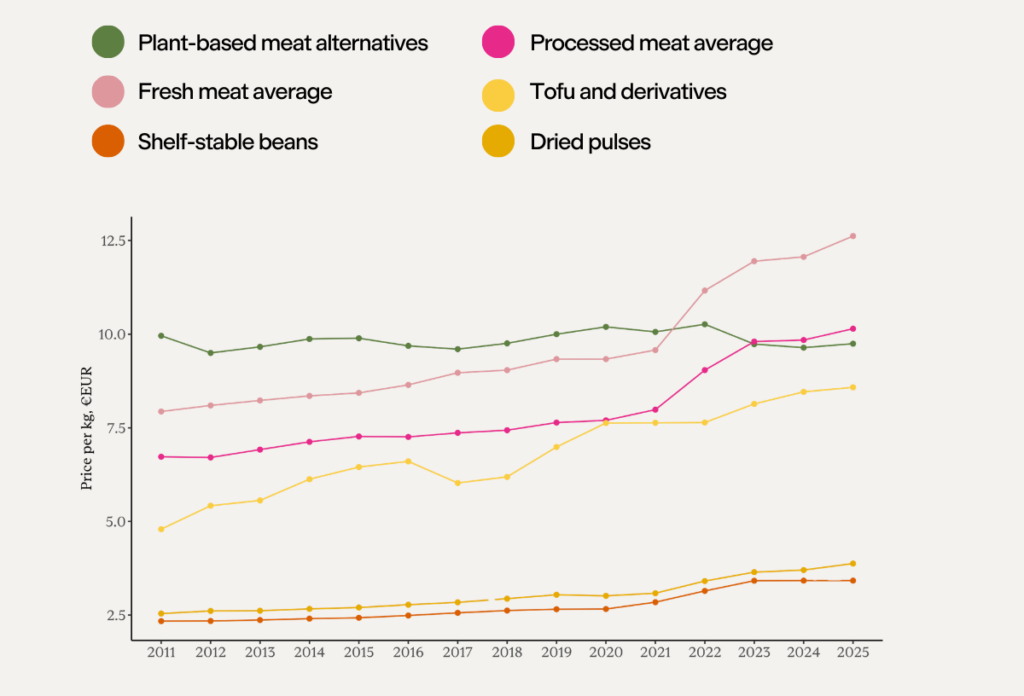
This understanding has prompted some retailers to implement permanent price parity strategies. In Germany, for example, Lidl has been selling its own-label vegan products at prices equal to or lower than comparable meat and dairy items since 2023. This initiative has contributed to a situation where, across most major German supermarkets, a basket of plant-based groceries is now approximately 5% more affordable than one comprising animal proteins.
The trend towards price competitiveness is not confined to Germany. In Spain and the UK, plant-based meat options are now, on average, cheaper than their animal-derived counterparts. In the UK, specifically, soaring beef prices have already begun to steer consumers toward more economical plant-based proteins like legumes, a phenomenon that mirrors the findings of the Simon Fraser University study.
Further analysis by the Good Food Institute Europe corroborates this trend, indicating that the narrowing price gap between plant and animal proteins in Europe has been a significant driver of a 3% increase in plant-based sales in 2025.
Cameron McRae further elaborated on the dynamics of price sensitivity, stating, "With meat, shoppers can usually trade down when prices are higher, choosing ground beef instead of steak, for example. If there are only two or three plant-based options on the shelf, consumers who want those products have fewer cheaper alternatives to switch to." He concluded with a crucial point for the future of sustainable food systems: "If sustainability is the goal, plant-based foods can’t remain a premium option." This highlights the imperative for the plant-based food industry to achieve and maintain price parity with conventional animal products to facilitate broader consumer adoption and contribute effectively to global sustainability goals. The convergence of geopolitical instability, climate change impacts, and evolving consumer preferences is creating a unique environment where the economic accessibility of food choices is becoming increasingly paramount.
