
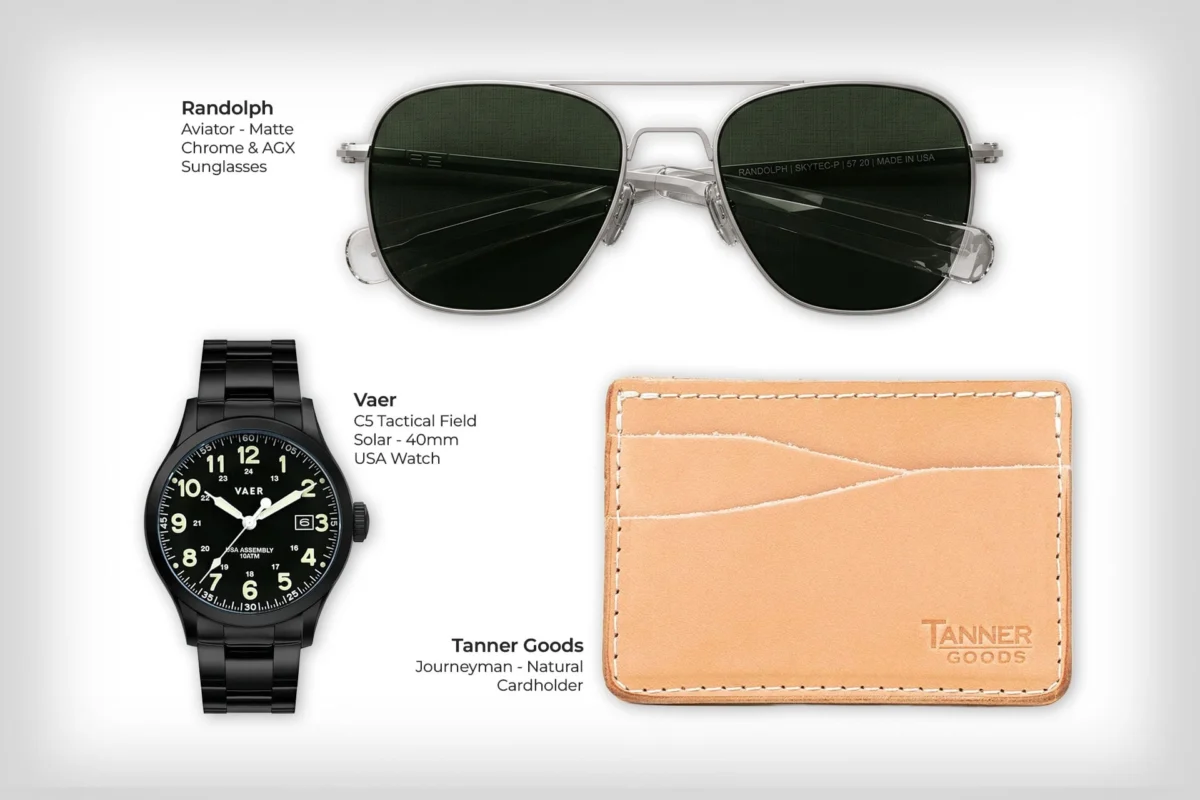
The concept of Everyday Carry (EDC) has evolved from a niche hobbyist pursuit into a significant pillar of modern personal organization, blending functional utility with aesthetic durability. As of September 2026, the market for high-quality, domestically manufactured essentials—specifically those crafted within the United States—has seen a measurable uptick in consumer interest. This shift is driven by a growing demand for supply chain transparency, long-term product viability, and the support of artisanal manufacturing sectors. This report examines three standout products currently defining the domestic EDC landscape: Randolph Engineering’s Aviator sunglasses, Vaer’s C5 Tactical Field watch, and the Tanner Goods Journeyman cardholder.
The Evolution of Domestic EDC Trends
The "Everyday Carry" philosophy centers on the curation of items that are carried daily to assist in dealing with common tasks or emergency situations. Over the last decade, the market has matured significantly. Data from retail analytics firms suggest that consumers are increasingly moving away from "fast-fashion" accessories in favor of "buy-it-for-life" items. This trend is rooted in a desire to reduce personal waste and an appreciation for the craftsmanship associated with legacy American manufacturing.
In 2026, the emphasis on domestic production is no longer just a patriotic sentiment; it is a quality assurance metric. By keeping production cycles closer to home, brands like Randolph, Vaer, and Tanner Goods can maintain rigorous oversight of their material sourcing and labor standards, resulting in products that often outperform their mass-produced, overseas-manufactured counterparts in stress tests and longevity evaluations.

Randolph Engineering: The Gold Standard of Eyewear
Randolph Engineering has remained a staple in the optics industry since its inception, largely due to its historical contract work with the U.S. military. Their Aviator line, particularly the Matte Chrome finish with AGX lenses, represents a synthesis of technical precision and timeless design.
The manufacturing process for a single pair of Randolph aviators involves over 200 production steps, a majority of which are performed by hand at their facility in Massachusetts. The AGX (Army Green) lens technology is engineered to reduce eye fatigue by filtering out specific wavelengths of light, a feature originally requested by the U.S. Air Force to ensure pilot performance during extended sorties. For the civilian user, this translates to superior visual clarity and structural integrity that resists the bending and oxidation common in lower-cost eyewear.
Timekeeping Precision: The Vaer C5 Tactical Field
In the watch sector, the Vaer C5 Tactical Field stands as a testament to the viability of American-assembled timepieces. Vaer, based in Venice, California, has carved out a market share by offering robust, field-ready watches that utilize high-end components—often Swiss movements—housed in rugged, vacuum-tested casings.
The C5 Tactical Field, specifically, addresses a demand for a watch that can endure extreme environmental conditions. Featuring solar-powered quartz movement, the watch eliminates the need for battery replacements, aligning with the sustainability-focused ethos of the EDC community. The 40mm casing size is calculated to provide maximum legibility while maintaining a low profile, making it suitable for both professional environments and outdoor excursions. The assembly process in the United States serves as a critical quality control gate, ensuring that every watch meets strict water-resistance and shock-absorption benchmarks before reaching the consumer.

Tanner Goods and the Craft of Leatherwork
Tanner Goods, based in the Pacific Northwest, represents the third pillar of this domestic ecosystem: leather craft. Their Journeyman cardholder is a masterclass in minimalism. As the EDC movement has trended toward "slim-carry" setups—where bulky bi-fold wallets are replaced by thin, streamlined organizers—the Journeyman has become a primary benchmark.
The use of vegetable-tanned leather is a defining characteristic of Tanner Goods’ output. Unlike chrome-tanned leathers, which use harsh chemicals to achieve a uniform, plastic-like finish, vegetable-tanned leather utilizes natural tannins found in bark and plant matter. This allows the material to develop a "patina"—a darkening and softening process that occurs through interaction with the oils in a user’s skin and environmental exposure. This aging process ensures that each cardholder becomes a unique historical record of the owner’s daily routine, providing a level of personalization that mass-produced nylon or synthetic wallets cannot replicate.
Economic and Industrial Implications
The rise of these specific brands highlights a broader economic trend: the "reshoring" of mid-market manufacturing. While large-scale assembly may still occur globally, the specialized production of high-end consumer goods has found a profitable niche in the United States.
From an economic perspective, the increased consumer spend on these items represents a shift in capital allocation. Instead of purchasing four or five lower-quality items annually, consumers are allocating a higher initial investment into a single, durable product. This creates a more stable demand for skilled labor, such as master leatherworkers and precision machinists, which in turn fosters growth in regional manufacturing hubs.

Expert Analysis: The Sustainability Factor
Industry analysts note that the EDC sector is one of the most effective barometers for changing consumer values regarding sustainability. The longevity of a $110 Tanner Goods cardholder or a $300+ pair of Randolph glasses, compared to cheaper alternatives that require replacement every 12 to 18 months, underscores a significant reduction in long-term carbon footprint.
"The modern consumer is becoming increasingly educated about the lifecycle of their purchases," notes a retail consultant familiar with the sector. "When you purchase an item that is designed to be repaired rather than replaced, you are fundamentally changing your relationship with the product. That is the core of the modern domestic EDC movement."
Official Perspectives and Industry Standards
While these brands operate in a competitive space, they share a common commitment to transparency. Vaer, for instance, maintains a public log of its supply chain, identifying exactly where components are sourced. Randolph Engineering continues to lobby for the preservation of domestic manufacturing subsidies that allow them to maintain their Massachusetts facility.
These practices are not merely marketing tactics; they are defensive measures against the saturation of low-quality imports. By clearly defining their production methods and the origins of their materials, these companies have managed to build high levels of brand loyalty among a demographic that prioritizes authenticity over convenience.

Future Outlook for the EDC Market
As we look toward the remainder of 2026 and into 2027, it is anticipated that the domestic EDC sector will continue to expand into adjacent categories, such as home organization tools and travel gear. The convergence of technology and traditional craftsmanship is likely to produce new innovations, such as integrated GPS tracking for leather goods or modular eyewear systems.
For the individual, the takeaway remains clear: the curation of an "Everyday Carry" kit is an investment in personal readiness and professional presentation. By prioritizing products manufactured with high-grade materials and ethical labor practices, the modern consumer is not only enhancing their daily efficiency but also supporting an industrial ecosystem that values quality over volume. Whether it is the precision of a field watch or the resilience of hand-stitched leather, the items we choose to carry daily reflect our broader commitments to sustainability, quality, and the support of domestic craft.
As market data continues to favor these durable, domestic goods, the influence of the EDC community on mainstream retail is expected to grow, potentially forcing larger conglomerates to re-evaluate their own manufacturing and sourcing strategies to compete with the rising tide of high-quality, artisan-backed essentials.
