
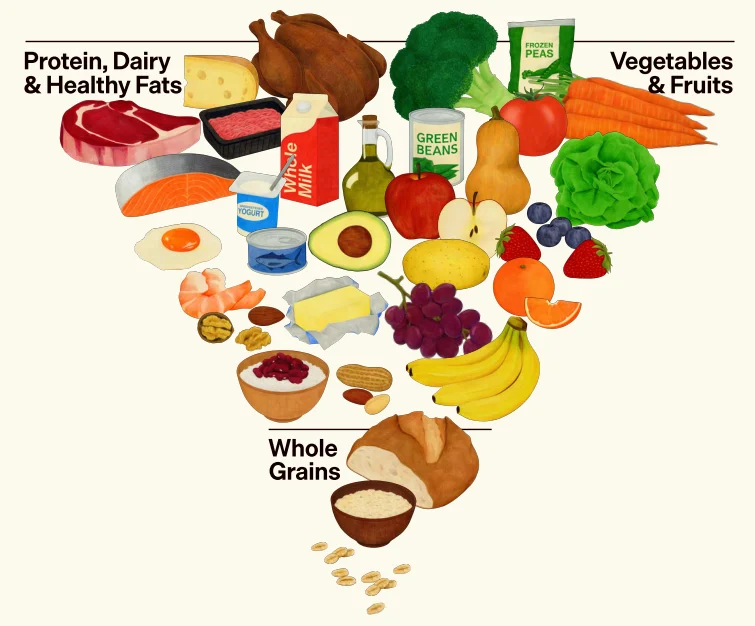
The release of the 2025–2030 Dietary Guidelines for Americans (DGAs) marks a pivotal moment in federal nutrition policy, arriving with an ambitious "eat real food" mandate and a concerted effort to curb the consumption of highly processed products and added sugars. However, the rollout has been met with significant scrutiny, as the accompanying visual aids—specifically a new, inverted pyramid graphic—appear to clash with the textual recommendations, raising questions about the influence of industry interests and the clarity of public health messaging.
The Evolution of Federal Nutrition Policy
For decades, the U.S. government has issued dietary guidance every five years, a mandate established by the National Nutrition Monitoring and Related Research Act of 1990. These guidelines serve as the bedrock for federal food programs, including the National School Lunch Program, the Special Supplemental Nutrition Program for Women, Infants, and Children (WIC), and the Supplemental Nutrition Assistance Program (SNAP). They also influence institutional menu planning for hospitals, military bases, and government facilities.
The process typically begins with an independent Dietary Guidelines Advisory Committee (DGAC), a panel of scientific experts tasked with reviewing current nutrition research. Their findings are distilled into a scientific report, which then serves as the basis for the final guidelines authored by the U.S. Department of Agriculture (USDA) and the Department of Health and Human Services (HHS).
The 2025–2030 cycle, however, diverged from this established protocol. After the independent advisory committee submitted its report, the current administration opted to bypass certain recommendations, instead commissioning a supplemental scientific analysis through a federal contracting process. This decision has drawn criticism from public health experts who argue that the lack of transparency in the selection of these supplemental researchers and the potential for industry-aligned biases undermines the scientific integrity of the final document.
Decoding the New Nutritional Pyramid
The most visible—and perhaps most contentious—addition to this year’s guidelines is the "New Food Pyramid." Unlike the classic 1992 pyramid or the subsequent MyPlate initiative, this iteration is inverted. It places a heavy visual emphasis on protein-dense animal products, including red meat, full-fat dairy, and butter, near its most prominent sections.
Nutritional scientists have noted a glaring discrepancy between this visual representation and the written guidelines. While the text maintains the long-standing scientific consensus that saturated fat intake should be capped at 10% of total daily calories, the graphic’s prioritization of butter and red meat suggests a lifestyle that would make adhering to that 10% limit mathematically improbable for the average consumer.
For a standard 2,000-calorie diet, the 10% saturated fat limit equates to approximately 22 grams per day. If a consumer follows the DGAs’ recommendation of three daily servings of dairy and utilizes butter or beef tallow as primary cooking fats—as the pyramid suggests—they would likely exceed this threshold by midday. This creates a "mixed messaging" problem: the text warns against heart-risk factors, while the accompanying graphic encourages the very habits that contribute to them.
Confronting Highly Processed Foods and Sugar
The new edition is the first to explicitly categorize and address "highly processed foods." This represents an attempt to simplify complex nutritional data for the public. The guidelines now strongly advise against the consumption of sugar-sweetened beverages, ready-to-eat snacks, and refined carbohydrates like white bread.
The stance on added sugar is particularly stringent. The guidelines state that no amount of added sugar is inherently "nutritious," and they have lowered the recommended threshold for daily intake. Furthermore, the guidelines now recommend that children under the age of 10 avoid added sugars entirely, a significant shift from the previous threshold of age two.
Despite these clear directives, critics point to a lack of practical application. While the goal of reducing sugar is scientifically sound, the guidelines offer little in the way of actionable advice for consumers navigating a food environment where added sugars are pervasive in even seemingly "healthy" packaged goods.
The Protein Debate and Industry Influence
Another major shift is the increase in recommended protein intake, which has jumped to 1.2 to 1.6 grams per kilogram of body weight—an increase of 50% to 100% over previous minimums. While increased protein can be beneficial for specific demographics, such as the elderly or high-performance athletes, nutritionists warn that without context, this recommendation may lead to an overconsumption of poor-quality protein sources.
Dr. Frank Hu, chair of the Department of Nutrition at the Harvard T.H. Chan School of Public Health, has emphasized that the "protein package"—the fats, fiber, and sodium that accompany protein—is as important as the protein itself. Replacing plant-based proteins, such as legumes and nuts, or lean fish with red meat to meet these new, higher protein targets could have adverse long-term cardiovascular outcomes.
The inclusion of these recommendations has fueled concerns regarding the influence of the beef and dairy industries. Reports have emerged detailing the financial ties between several individuals involved in the supplemental analysis process and these specific agricultural sectors. Critics argue that the prominence of animal products in the new pyramid is a direct result of this influence, rather than a reflection of emerging nutritional science.
The Absence of Sustainability and Socioeconomic Context
A persistent critique of the DGAs is their refusal to incorporate environmental sustainability into their recommendations. Global health organizations, including the EAT-Lancet Commission, have long argued that dietary health is inextricably linked to planetary health. High-consumption diets centered on land-intensive livestock are a significant driver of climate change, yet the current guidelines treat human nutrition as a siloed issue, disconnected from the environmental impact of the food system.
Furthermore, the guidelines struggle to address the socioeconomic reality of the American consumer. The recommendation to consume "real food"—fresh fruits, vegetables, and whole grains—ignores the "food desert" phenomenon, where healthy, fresh produce is either unaffordable or unavailable to millions of Americans. By failing to account for these systemic barriers, the DGAs remain an aspirational document for many rather than a practical tool for the general population.
Implications for Public Health
The impact of these guidelines will be felt in school cafeterias and federal food assistance programs across the country. Because these guidelines define what constitutes a "healthy" meal for federal funding purposes, the move to include more animal-based fats and potentially higher protein quotas could change the nutritional composition of millions of school lunches.
If the goal of the 2025–2030 DGAs was to provide a clearer, more accessible framework for the American public, the result is arguably a mixed success. While the explicit warnings against processed foods and sugar represent progress, the confusing visual messaging regarding fats and the lack of transparency in the development process have created a climate of skepticism.
As the nation faces rising rates of metabolic disease and obesity, the importance of authoritative, unbiased nutritional guidance has never been greater. Whether this iteration of the guidelines will serve as a corrective measure or a source of further confusion remains to be seen. Public health experts continue to urge consumers to look beyond the pyramid and toward established, peer-reviewed resources, such as the Healthy Eating Plate, which prioritize unsaturated fats, whole grains, and diverse plant-based protein sources, to navigate the complexities of modern nutrition.
Looking Ahead
The process of drafting the next set of guidelines will likely face calls for increased transparency and a return to the rigorous, independent committee-led model that defined previous cycles. Until then, the 2025–2030 DGAs will stand as the official, if controversial, policy of the United States. For policymakers, health professionals, and the public, the challenge remains to filter these federal recommendations through the lens of robust, replicable science, ensuring that dietary choices are guided by evidence rather than conflicting visual messaging or industry-driven priorities.
