
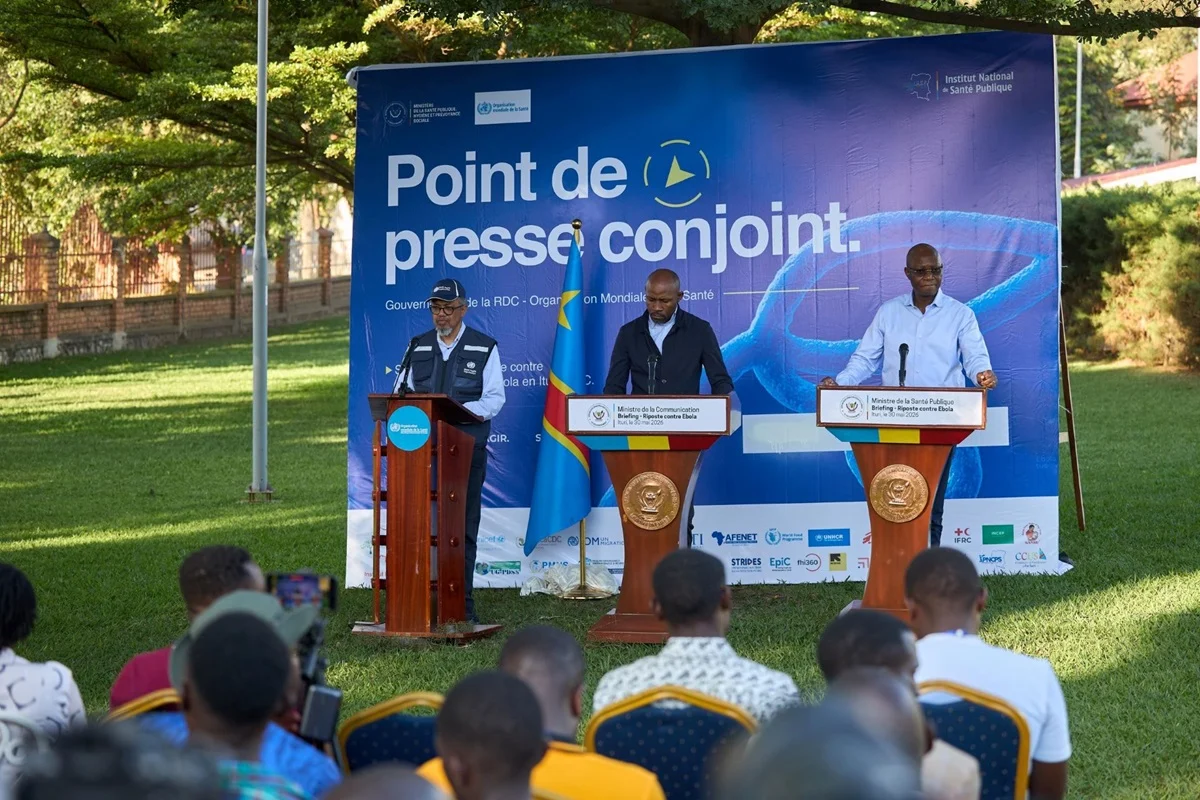
The Government of the Democratic Republic of the Congo (DRC) and the World Health Organization (WHO) have formally reaffirmed their strategic partnership and shared commitment to safeguarding the health and well-being of the population in Ituri Province and across the nation. This high-level declaration follows a critical joint mission to Bunia, the capital of Ituri, led by the DRC Minister of Health, Dr. Samuel Roger Kamba, and the Minister of Communication and Media, Mr. Patrick Muyaya Katembwe. The delegation was joined by WHO Director-General Dr. Tedros Adhanom Ghebreyesus, marking a significant moment of international solidarity as the country grapples with a complex epidemiological situation.
The visit serves as a mobilization effort against a burgeoning outbreak of Ebola disease caused by the Bundibugyo virus (BDBV). Unlike the more common Zaire strain, the Bundibugyo virus presents unique clinical and logistical challenges. The Ministry of Health has reported a rapidly evolving scenario, with confirmed cases and fatalities notified across several health zones in Ituri, North Kivu, and South Kivu. The government, with technical and financial backing from the WHO and various international partners, is currently intensifying its surveillance protocols, laboratory diagnostic capacities, and patient care frameworks to interrupt the chain of transmission with maximum urgency.
The Evolution of the Bundibugyo Outbreak: A Chronology of Response
The current health crisis in the eastern DRC began to take shape several weeks ago when health surveillance systems detected a cluster of unexplained hemorrhagic fever cases. Subsequent laboratory analysis confirmed the presence of the Bundibugyo virus, a rare strain of the Ebola virus that was first identified in 2007 in the Bundibugyo District of neighboring Uganda. This is not the DRC’s first encounter with this specific strain; the country successfully managed a Bundibugyo outbreak in 2012 in the former Orientale Province, which resulted in 62 cases and 34 deaths.
Following the initial confirmation in Ituri, the virus was detected in the volatile provinces of North Kivu and South Kivu, suggesting a significant degree of community transmission and population movement. The timeline of the response has been characterized by a rapid transition from localized containment to a multi-provincial emergency framework. By the time Dr. Tedros and the DRC ministers arrived in Bunia, the government had already activated the National Emergency Operations Center (COUSP) to coordinate a synchronized response across the affected regions.
Understanding the Bundibugyo Challenge: Data and Context
The Bundibugyo strain of Ebola is distinct from the Zaire strain, which was responsible for the devastating 2018–2020 outbreak in the same region. Historically, the case fatality rate for Bundibugyo has ranged from 25% to 50%, which, while lower than the Zaire strain’s potential 90%, remains a severe threat to public health.
A primary concern for health authorities is the current absence of a licensed vaccine or specific therapeutic treatment for the Bundibugyo virus. During previous Zaire-strain outbreaks, the use of the Ervebo vaccine proved instrumental in controlling the spread through "ring vaccination" strategies. However, these vaccines do not provide cross-protection against the Bundibugyo virus. Consequently, the Ministry of Health and the WHO are working to rapidly implement randomized control trials (RCTs) for candidate vaccines and experimental treatments that have shown promise in laboratory settings.
In the absence of pharmaceutical interventions, the response relies heavily on traditional public health measures. These include:
- Early Detection: Identifying symptomatic individuals before they can transmit the virus to others.
- Contact Tracing: Meticulously tracking every individual who has come into contact with a confirmed case for a period of 21 days.
- Infection Prevention and Control (IPC): Ensuring that health facilities do not become hubs for transmission through the rigorous use of personal protective equipment (PPE) and sterilization protocols.
- Safe and Dignified Burials (SDB): Managing the highly infectious remains of the deceased in a manner that respects cultural traditions while preventing further infection.
Strategic Leadership and International Cooperation
The DRC government is leading the comprehensive national response with a focus on provincial integration. Minister of Health Dr. Samuel Roger Kamba emphasized that the state’s primary objective is to provide a unified command structure that empowers local health zones. This leadership is supported by the WHO, the broader United Nations system, and the Africa Centres for Disease Control and Prevention (Africa CDC).
During the mission to Bunia, Dr. Tedros Adhanom Ghebreyesus expressed his confidence in the DRC’s ability to manage the crisis, citing the nation’s "unparalleled experience" in handling Ebola. The DRC has faced over a dozen Ebola outbreaks since the virus was first discovered near the Ebola River in 1976. This institutional memory is a vital asset, providing a deep pool of trained epidemiologists, laboratory technicians, and community mobilizers who understand the nuances of hemorrhagic fever containment.
The WHO has committed to mobilizing additional resources from the Contingency Fund for Emergencies (CFE) to ensure that the response is not hindered by financial constraints. Furthermore, the collaboration aims to ensure that international borders remain open for the movement of essential goods and medical personnel, adhering to International Health Regulations (IHR) while maintaining necessary screening protocols at points of entry.
Community Engagement: The Heart of the Response
A recurring lesson from previous outbreaks in the DRC is that clinical interventions are ineffective without the trust and cooperation of the local population. The eastern DRC is a region marked by years of conflict, displacement, and systemic neglect, which has fostered a climate of skepticism toward government and international interventions.
To address this, the government and the WHO are intensifying dialogue with a broad spectrum of community stakeholders. This includes engagement with:
- Religious Leaders: Who play a pivotal role in influencing community behavior and burial practices.
- Women’s Groups and Youth Representatives: Who are often the primary caregivers and information sharers within households.
- The Private Sector: To ensure that local businesses support hygiene measures and facilitate the movement of health workers.
By co-developing solutions that are culturally appropriate, authorities hope to avoid the "resistance" that hampered previous efforts. This involves transparently addressing local concerns regarding the trial of new vaccines and treatments, ensuring that communities feel like partners in the research process rather than subjects of it.
Challenges of Insecurity and Logistics
The geographical focus of the outbreak—Ituri and the Kivus—presents significant logistical hurdles. These provinces are currently the site of ongoing armed conflict involving various non-state armed groups. Insecurity often limits the ability of health workers to reach remote villages for contact tracing or to transport samples to laboratories in a timely manner.
The Minister of Communication and Media, Patrick Muyaya Katembwe, highlighted the importance of the "humanitarian corridor" and the need for all parties to respect the neutrality of health interventions. The government is working to ensure that security forces provide a safe environment for medical teams without militarizing the health response, a delicate balance that is essential for maintaining community trust.
Long-term Implications for Health System Resilience
While the immediate priority is the containment of the Bundibugyo outbreak, both the DRC government and the WHO are looking toward the future. The investments currently being made—expanding laboratory networks, training health workers in IPC, and strengthening disease surveillance—are intended to leave a lasting legacy.
The goal is to transition from a cycle of "panic and neglect" to a sustained model of primary healthcare and health system resilience. By integrating Ebola response activities into the broader healthcare system, the DRC aims to improve its ability to detect and respond to other endemic diseases, such as measles, cholera, and malaria, which continue to claim lives across the country.
The mission concluded with a call for sustained international solidarity. The DRC and its partners have expressed deep gratitude for the support provided thus far but warned that the window for containment is narrow. As the government and the WHO continue to scale up operations, the focus remains on equitable access to life-saving interventions, ensuring that even the most marginalized communities in the conflict-affected east are not left behind in the fight against Ebola.
