
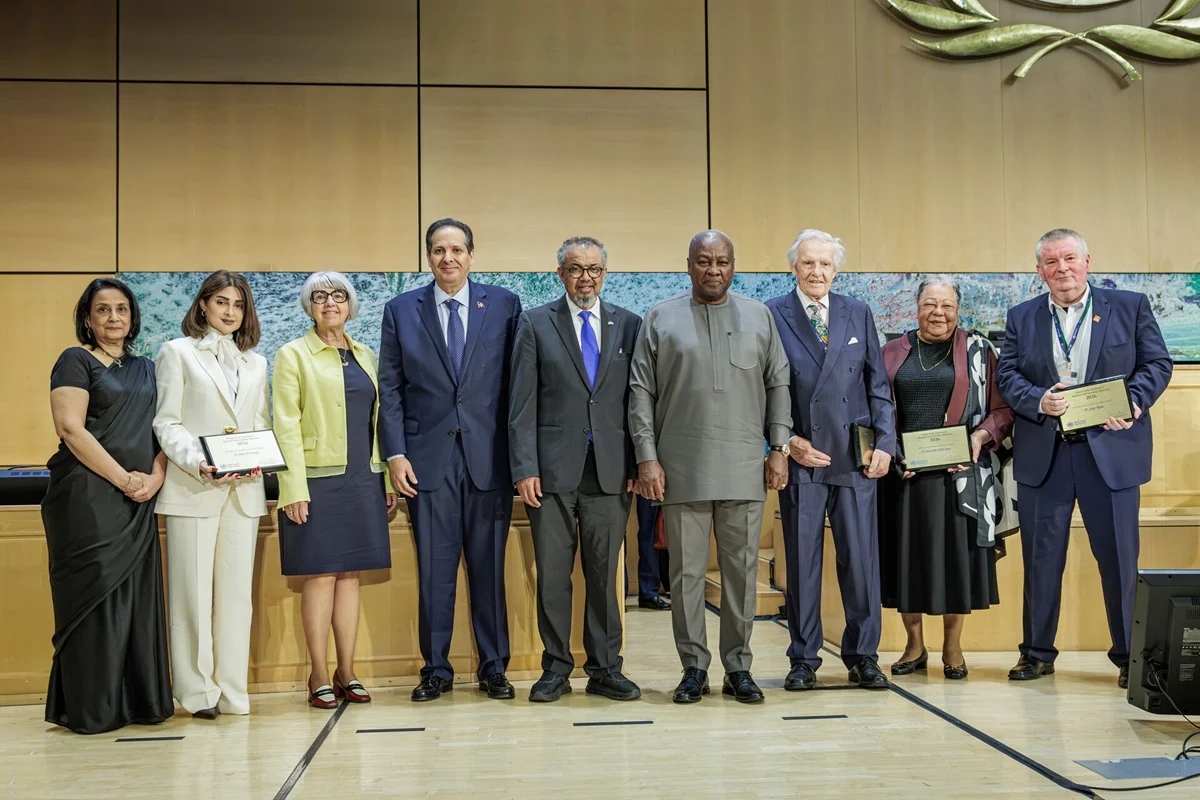
Dr. Tedros Adhanom Ghebreyesus, the Director-General of the World Health Organization (WHO), presented the prestigious Global Health Leaders Award to four distinguished pioneers during the High-Level Welcome of the Seventy-ninth World Health Assembly in Geneva. This year’s laureates—Dr. Tore Godal, Dr. Merceline Dahl-Regis, Dr. Mike Ryan, and Dr. Heba El Sewedy—were honored for their lifetime achievements and exceptional contributions to the improvement of global health outcomes. The ceremony took place against the backdrop of the World Health Assembly’s (WHA) 2026 theme, “Reshaping global health: a shared responsibility,” emphasizing the need for collaborative leadership in an era of complex, interconnected health threats.
Established in 2019, the Director-General’s Global Health Leaders Awards serve as a mechanism to recognize individuals whose dedication has transcended borders, resulting in measurable improvements in the health and well-being of populations worldwide. The 2026 ceremony highlighted a diverse range of expertise, from the eradication of infectious diseases and the management of global pandemics to humanitarian innovation and the elimination of regional health disparities.
A Legacy of Immunization and Innovation: The Contributions of Dr. Tore Godal
Dr. Tore Godal was recognized for his transformative leadership in the fields of immunization and infectious diseases. Often described as a "quiet titan" of global health, Dr. Godal’s career has spanned several decades, during which he played a central role in elevating vaccines to the top of the international development agenda. His work was instrumental in the founding of Gavi, the Vaccine Alliance, an organization that has helped vaccinate more than 1 billion children since its inception in 2000, preventing more than 17 million deaths.
Dr. Godal’s influence extends beyond immunization. While leading the WHO’s Special Programme for Research and Training in Tropical Diseases (TDR), he spearheaded efforts to combat neglected tropical diseases (NTDs). His advocacy for community-based distribution of ivermectin revolutionized the fight against onchocerciasis, commonly known as river blindness. By empowering local communities to manage their own treatment programs, Dr. Godal helped protect millions of people across sub-Saharan Africa from permanent disability.
In addition to his work with Gavi and TDR, Dr. Godal was a founding figure in the Roll Back Malaria partnership and the Coalition for Epidemic Preparedness Innovations (CEPI). These organizations have become cornerstones of the global health architecture, particularly in the rapid development of vaccines for emerging threats. His ability to bridge the gap between rigorous scientific research and large-scale public health implementation remains a benchmark for global health leadership.
Regional Excellence and Disease Elimination: The Impact of Dr. Merceline Dahl-Regis
Dr. Merceline Dahl-Regis was honored for her lifelong commitment to expanding immunization coverage and achieving disease elimination milestones in the Region of the Americas. As a former Chief Medical Officer of the Bahamas and a leading figure within the Pan American Health Organization (PAHO), Dr. Dahl-Regis was the architect of several historic public health victories.
Most notably, her leadership was instrumental in the Americas becoming the first region in the world to be certified free of measles and rubella. These achievements required decades of meticulous surveillance, rigorous vaccination campaigns, and unprecedented regional cooperation. Dr. Dahl-Regis also chaired the International Expert Review Panel for the elimination of mother-to-child transmission of HIV and syphilis. Her work on the Dual Elimination Initiative provided a framework that has since been adopted by other regions, proving that with political will and technical precision, the transmission of these diseases from parent to child can be halted.
Through her focus on community engagement and primary healthcare, Dr. Dahl-Regis demonstrated that health equity is not merely a policy goal but a fundamental human right. Her holistic approach to health and development has had a profound impact on the Caribbean and the broader international community, ensuring that vulnerable populations are not left behind in the pursuit of global health targets.
Crisis Management and Global Security: The Leadership of Dr. Mike Ryan
Dr. Mike Ryan, the Executive Director of the WHO Health Emergencies Programme, was recognized for his decades of service on the front lines of the world’s most dangerous health crises. Dr. Ryan’s career is synonymous with the evolution of modern health emergency response. He was a founding member of the Global Outbreak Alert and Response Network (GOARN), a multidisciplinary collaboration of over 250 institutions that provides technical support and personnel during international health emergencies.
Throughout his tenure, Dr. Ryan has led operational responses to a litany of threats, including SARS, cholera, Ebola, polio, and the COVID-19 pandemic. His leadership style is characterized by a "boots-on-the-ground" approach, often working in conflict zones and areas with fragile health infrastructure. During the 2014-2016 West Africa Ebola outbreak, Dr. Ryan was a critical figure in coordinating the international response, and his subsequent work in the Democratic Republic of the Congo helped refine the use of new vaccines and therapeutics in active outbreak settings.
His recognition at the 79th WHA underscores the importance of global health security. Dr. Ryan has consistently advocated for the strengthening of national health systems as the first line of defense against future pandemics. His commitment to protecting vulnerable communities and his transparent communication during times of uncertainty have made him one of the most respected figures in contemporary public health.
Humanitarian Action and Social Justice: The Vision of Dr. Heba El Sewedy
Dr. Heba El Sewedy was honored for her pioneering work in humanitarian action and the treatment of trauma. In 2013, she founded the Ahl Masr Foundation, the first non-profit organization in the Middle East and Africa dedicated to the comprehensive research, prevention, and treatment of burn injuries. Burn victims often face significant social stigma and a lack of specialized medical care; Dr. El Sewedy’s work has been transformative in providing these individuals with a pathway to recovery and reintegration.
The Ahl Masr Hospital in Cairo stands as a testament to her vision, offering state-of-the-art medical and psychological support to survivors regardless of their ability to pay. Beyond burn care, Dr. El Sewedy has been a vocal advocate for social justice and humanitarian aid. Her foundation has played a significant role in providing emergency medical relief to those affected by the conflict in Gaza, demonstrating a commitment to human dignity in the face of extreme adversity.
Dr. El Sewedy’s recognition highlights the intersection of public health and humanitarianism. Her people-centered approach serves as an inspiration for a new generation of advocates who view health as a vehicle for social change and peacebuilding.
Chronology of Global Health Leadership (1975–2026)
The achievements of the 2026 laureates represent a timeline of progress in the global health landscape:
- 1975–1990: Dr. Tore Godal leads the TDR, establishing the foundations for the fight against tropical diseases like leprosy and malaria.
- 2000: The launch of Gavi, the Vaccine Alliance, with Dr. Godal as its first CEO, marking a new era of public-private partnerships in health.
- 2000–2003: Dr. Mike Ryan helps establish GOARN and leads the international response to the SARS epidemic.
- 2013: Dr. Heba El Sewedy establishes the Ahl Masr Foundation, filling a critical gap in trauma care in the MENA region.
- 2015–2016: The Americas region is certified free of rubella (2015) and measles (2016) under the technical guidance of Dr. Merceline Dahl-Regis.
- 2019: The WHO Director-General’s Global Health Leaders Awards are inaugurated to recognize exceptional service.
- 2020–2023: Dr. Mike Ryan becomes a global household name during the COVID-19 pandemic, coordinating the WHO’s emergency operations.
- 2026: The 79th World Health Assembly convenes in Geneva to honor these four leaders under the theme of shared responsibility.
Supporting Data and Global Health Impact
The impact of the work led by these four individuals can be quantified through significant global health metrics:
- Vaccine Efficacy: Through Gavi (founded by Dr. Godal), vaccine coverage in the world’s poorest countries has risen from less than 20% in 1990 to over 80% for basic childhood vaccines today.
- Disease Elimination: Before the efforts led by Dr. Dahl-Regis, measles caused over 100,000 deaths annually in the Americas. Today, the region maintains its status as a leader in vaccine-preventable disease elimination.
- Emergency Response: GOARN, shaped by Dr. Ryan, has deployed over 3,500 experts to more than 100 countries in response to over 150 outbreaks since its creation.
- Trauma Care: The Ahl Masr Foundation estimates that over 250,000 people suffer from burn injuries annually in Egypt alone. Dr. El Sewedy’s foundation has provided direct medical intervention to thousands who previously had no access to specialized care.
Official Responses and Strategic Implications
During the award ceremony, Dr. Tedros Adhanom Ghebreyesus emphasized that the laureates embody the spirit of the WHO’s mission. "I am honored to present the Global Health Leaders Awards to four individuals who have made outstanding lifetime contributions to global health," Dr. Tedros stated. He noted that their work reflects the "diversity of approaches" required to achieve health for all, ranging from high-level scientific innovation to grassroots humanitarian aid.
International observers and health ministers present at the Assembly noted that the recognition of these leaders comes at a critical juncture. The theme of "shared responsibility" reflects a shift in global health strategy toward sustainability and local ownership. Analysts suggest that the 79th WHA serves as a pivot point, moving away from the reactive posture of the pandemic years toward a proactive, integrated health security framework.
The inclusion of Dr. Heba El Sewedy, in particular, signals the WHO’s increasing focus on non-communicable diseases and trauma in conflict-affected regions. Meanwhile, the honors for Dr. Godal and Dr. Dahl-Regis reinforce the importance of maintaining momentum in immunization, especially as climate change and migration threaten to reintroduce eliminated diseases to previously safe zones.
Conclusion: A Roadmap for Future Generations
The 2026 Global Health Leaders Awards do more than celebrate past successes; they provide a roadmap for the future. By honoring leaders who have navigated the complexities of international diplomacy, scientific research, and humanitarian crisis, the WHO is setting a standard for the next generation of public health professionals.
As the Seventy-ninth World Health Assembly continues its deliberations in Geneva, the achievements of Dr. Godal, Dr. Dahl-Regis, Dr. Ryan, and Dr. El Sewedy serve as a reminder that global health progress is not inevitable. It is the result of persistent leadership, evidence-based policy, and an unwavering commitment to equity. Their legacy remains a source of inspiration for a world striving to be healthier, safer, and more equitable for all.
