
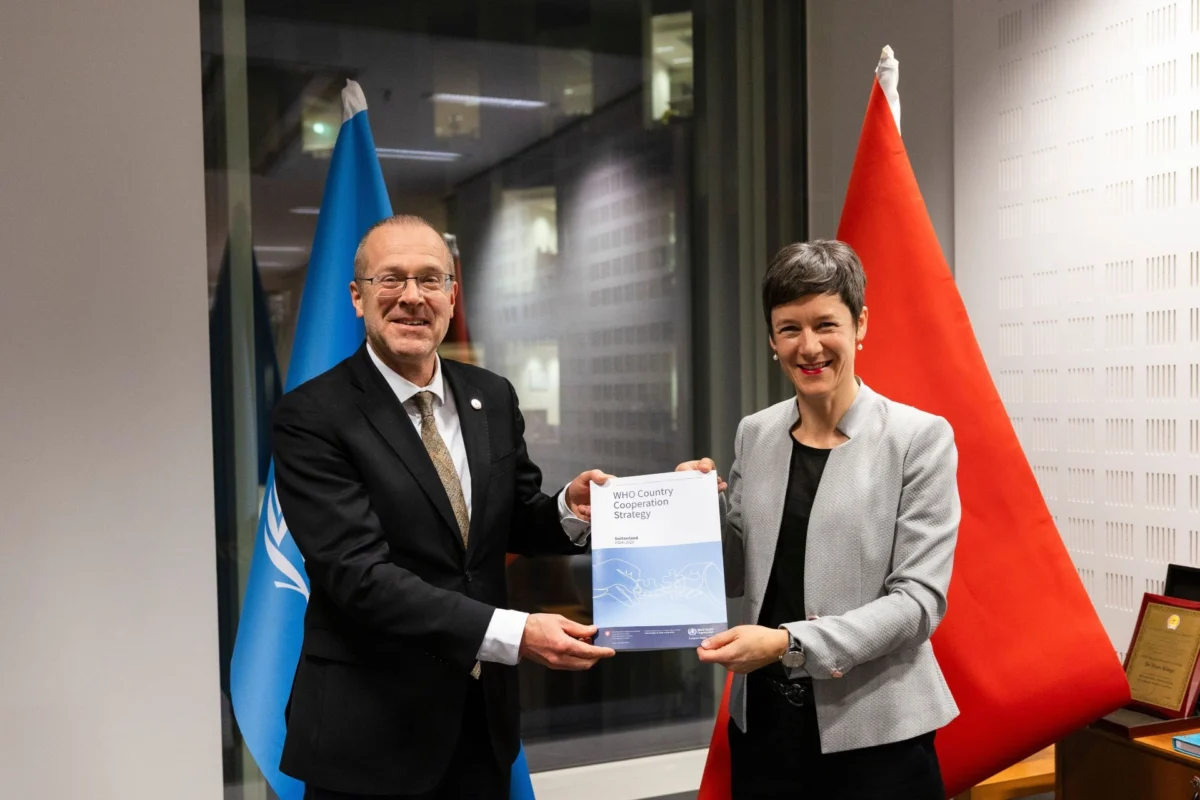
The World Health Organization (WHO) and the Swiss Confederation have officially formalized the extension of their collaborative framework, launching the WHO-Switzerland Country Cooperation Strategy (CCS) for the 2024–2028 period. This agreement, finalized on March 4, 2025, at the WHO Regional Office for Europe in Copenhagen, represents a milestone in the long-standing relationship between the global health agency and its host nation. By formalizing these objectives, both entities aim to harmonize Switzerland’s domestic public health priorities with international health mandates, effectively setting a roadmap for integrated health governance over the next four years.
A Historical Precedent for High-Income Cooperation
The origins of this unique strategic alliance date back to 2013, when Switzerland became the first high-income nation within the WHO European Region to initiate a formal Country Cooperation Strategy. Historically, the CCS instrument was designed primarily for low- and middle-income countries to assist them in aligning national health policies with WHO technical expertise. Switzerland’s decision to adopt this framework over a decade ago signaled a shift in the perceived utility of the tool, demonstrating that even highly developed health systems benefit from a structured, collaborative relationship with the UN’s specialized health agency.
The renewal of this strategy in 2025 follows a decision made in 2022 to conduct a comprehensive review of the preceding decade’s progress. This evaluation phase sought to identify emerging health challenges—such as post-pandemic recovery, the integration of digital health, and the increasing burden of non-communicable diseases—that necessitate a modern, agile approach to international health cooperation.
Chronology of the Partnership
The trajectory of the WHO-Switzerland relationship is characterized by increasing institutional alignment:
- 2013: Switzerland breaks new ground by becoming the first high-income country to implement a formal CCS, setting a benchmark for future partnerships.
- 2020–2021: The COVID-19 pandemic tests the limits of the partnership, leading to unprecedented cooperation in global health security, supply chain management, and vaccine equity.
- 2022: Both parties formally initiate the process to update the CCS, acknowledging that the post-pandemic landscape requires a shift in strategic focus.
- 2024: Collaborative efforts intensify, particularly in the realm of the Global BioHub system, aimed at sharing biological materials to combat potential future pandemics.
- March 4, 2025: The signing ceremony in Copenhagen formalizes the 2024–2028 strategy, solidifying the objectives for the coming years.
The Strategic Pillars of the 2024–2028 Framework
The newly minted cooperation strategy is built upon several critical pillars designed to address both internal Swiss health requirements and the broader European and global health agenda. Key focus areas include:
1. Strengthening Health Security and Pandemic Preparedness
Building on lessons learned during the COVID-19 crisis, the partnership emphasizes the operationalization of the Global BioHub system. This initiative, which Switzerland hosts through its advanced laboratory infrastructure, facilitates the rapid sharing of pathogens with pandemic potential. The strategy outlines a commitment to refining these mechanisms to ensure they are legally sound, scientifically robust, and accessible to the international community.
2. Digital Health and Data Governance
As Switzerland continues to digitize its health records and clinical research, the partnership aims to align national standards with global WHO recommendations. This includes promoting interoperability, ensuring data security, and utilizing big data to track health trends, which serves as a model for other European nations navigating the digital transition.
3. Addressing Non-Communicable Diseases (NCDs)
Given the aging demographic profile of the Swiss population, the strategy prioritizes the prevention and management of NCDs, such as cardiovascular diseases, cancer, and diabetes. The WHO provides the technical framework for standardized health reporting, while Switzerland provides the clinical data and innovative research capacity that can be scaled to other high-income settings.
4. Global Health Diplomacy and Sustainable Development
Switzerland’s role as a neutral diplomatic hub is leveraged to advance the Sustainable Development Goals (SDGs), specifically Goal 3 (Good Health and Well-being). The cooperation strategy ensures that Swiss policy-making remains consistent with the WHO’s "Thirteenth General Programme of Work," which seeks to ensure that a billion more people benefit from universal health coverage.

Supporting Data and Institutional Context
The efficacy of this partnership is underpinned by significant financial and technical investments. Switzerland is one of the largest voluntary contributors to the WHO, consistently supporting both the core budget and specific thematic funds. According to recent WHO financial reports, Switzerland’s contributions have been instrumental in maintaining the organization’s presence in emergency response zones.
Furthermore, the integration of the Swiss health system into the WHO framework allows for a bi-directional flow of knowledge. While the WHO provides policy guidance and global standards, Switzerland’s health sector—renowned for its high quality and innovation—serves as a "living lab." For instance, data gathered from the Swiss Federal Office of Public Health regarding antimicrobial resistance (AMR) management has been used by the WHO to inform policy recommendations for the broader European region.
Official Responses and Diplomatic Alignment
The ceremony in Copenhagen, attended by Dr. Hans Kluge, WHO Regional Director for Europe, and Barbara Schedler, Ambassador for Global Health at the Swiss Federal Office of Public Health, underscored the importance of the partnership.
In official statements, the emphasis has been placed on "mutual benefit." While the WHO gains a reliable partner that sets a high bar for health governance, Switzerland gains a structured platform to amplify its health priorities on the global stage. Dr. Kluge noted that the cooperation strategy is not merely a bureaucratic document but a dynamic instrument that allows for the rapid deployment of resources and expertise in times of crisis. Ambassador Schedler reiterated that Switzerland’s commitment to the WHO remains a cornerstone of its foreign policy, reflecting the country’s dedication to a robust, multilateral approach to health security.
Analysis: Implications for Global Health Governance
The renewal of this strategy carries significant implications for the landscape of global health. By formalizing this relationship, both parties are effectively demonstrating how high-income nations can better contribute to the WHO’s mission beyond simple monetary funding.
The "Host-Country" Model:
There is a unique dynamic between the WHO and Switzerland, given that the WHO’s global headquarters is located in Geneva. The CCS acts as a "bridge" between the global operations of the WHO and the national health authorities of the host country. This model minimizes friction in policy implementation and ensures that the WHO has a secure, stable environment in which to conduct its high-level operations.
Standardization in High-Income Nations:
Often, international health organizations are criticized for focusing disproportionately on low-resource settings. By maintaining a formal, strategy-driven relationship with a high-income country, the WHO ensures that its standards—such as those concerning digital infrastructure and health equity—remain relevant for advanced economies. This helps to prevent a "fragmentation" of global health standards, where high-income countries might otherwise develop isolated, incompatible health systems.
Resilience in the Face of Future Threats:
The explicit mention of the Global BioHub system in the new strategy highlights a shift toward proactive, rather than reactive, health governance. The world is increasingly aware of the dangers posed by zoonotic diseases and antibiotic resistance. By cementing this partnership, Switzerland and the WHO are creating a reliable pipeline for the exchange of knowledge and biological materials, which is essential for developing vaccines and diagnostics at record speed.
Conclusion and Future Outlook
The WHO-Switzerland Country Cooperation Strategy for 2024–2028 serves as a template for what an effective, high-level international partnership looks like in the 21st century. It moves beyond the traditional donor-recipient dynamic, evolving into a collaborative partnership focused on shared challenges and common objectives.
As the world continues to grapple with the long-term consequences of the COVID-19 pandemic and the escalating challenges of climate change on human health, the stability provided by this agreement will likely prove invaluable. The next four years will test the implementation of these goals, particularly in the areas of digital health and pandemic preparedness. However, given the established track record of the past decade, there is a strong expectation that this renewed strategy will provide the necessary foundation for both the WHO and Switzerland to navigate the complexities of an evolving global health landscape with resilience and foresight.
