
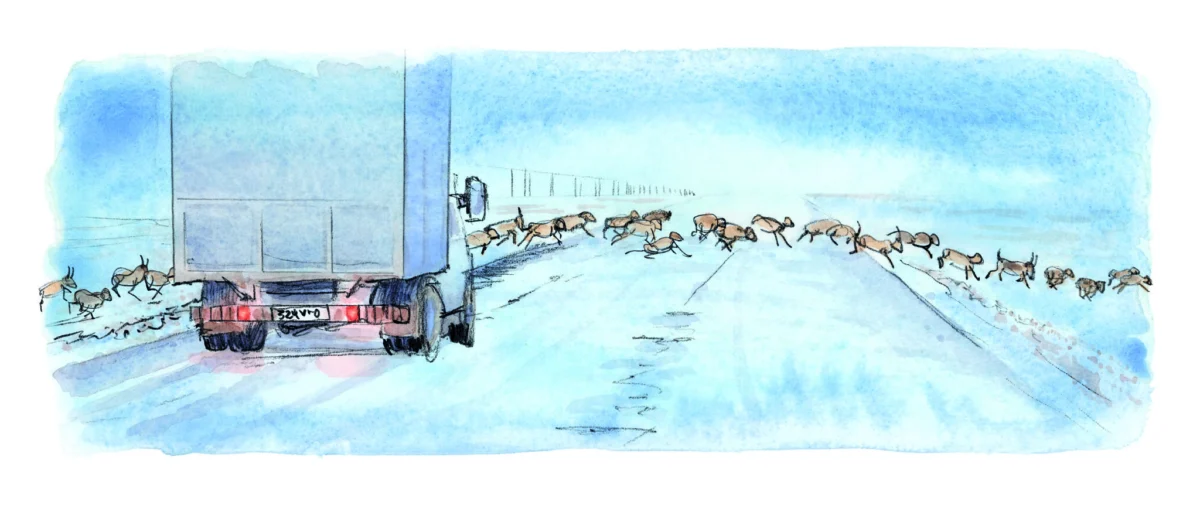
As the vehicle skidded off the paved road and onto a rough mud path, maintained primarily by tire tracks, the familiar lines of human geography began to blur. Flanking the narrow trail were a series of parallel lanes, no more than a foot wide, that forked, merged, and crisscrossed our own trajectory. The dashboard GPS indicated our destination was a cluster of green and red dots on the map. In the distance, a faint silhouette emerged, a spectral presence amplified by the howling Siberian winds. Through borrowed binoculars, a breathtaking scene unfolded – an ancient tableau seemingly untouched since the dawn of humanity. On the far horizon, hundreds of nomadic travelers, their ringed horns piercing the frigid air, their distinctive nasal structures inhaling the brittle shards of the steppe, sprinted across the desolate landscape. Witnessing their charge across the treeless plain at full speed, a resonant saying heard just prior to this journey echoed in my mind: "The saiga is a freedom-loving animal."
This evocative image, captured by Ryan Huling, senior writer at the Good Food Institute Asia Pacific and author of the book The Hidden Nations of Animals, serves as a poignant introduction to the profound challenges facing the saiga antelope. Their millennia-old existence, deeply intertwined with the vast open spaces of Central Asia, is now under severe threat from the relentless march of human development, particularly agriculture and infrastructure expansion.
The Ancient Nomads of the Steppe
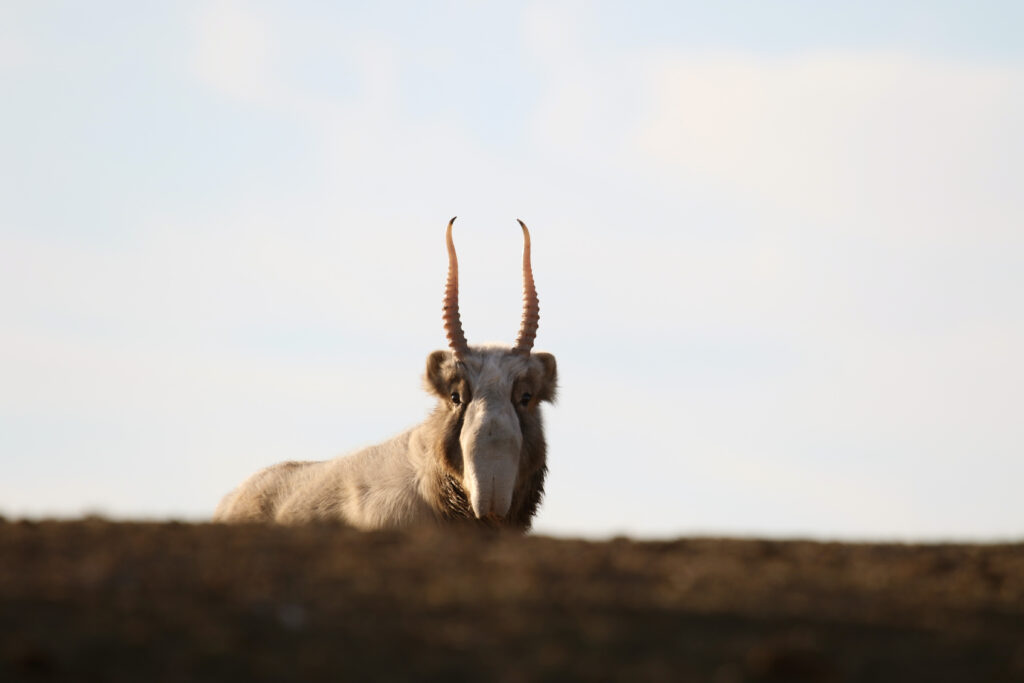
Saiga antelopes (Saiga tatarica) have roamed the vast grasslands of Eurasia for millennia, their existence a testament to adaptation and resilience. Since the last ice age, these nomadic herbivores have navigated challenging environments where natural cover is scarce. Their survival has depended on an extraordinary hyper-alertness to the slightest hint of predators. Scientific studies utilizing satellite tracking data have revealed intricate behavioral patterns; for instance, when choosing calving grounds, saigas deliberately select locations that straddle known wolf territories. This strategy aims to minimize the risk of encountering predators by utilizing the perceived safety of multiple zones.

This evasive strategy, honed over countless generations, served the saiga remarkably well until the relatively recent advent of human infrastructure. The construction of rattling railroads and roaring highways has irrevocably altered the landscape, fragmenting their ancient migratory routes and isolating populations. Historical GPS data has illuminated the saigas’ former freedom of movement, showcasing their routine passage across the Kazakh and Uzbek borders. However, the construction of a new rail line in 2014 dramatically disrupted these patterns. Animals attempting to cross were met with an impassable barrier, forcing them to turn back. Reports indicated that saigas on the northern side of the tracks appeared despondent, while the vital fresh grasses and water sources they relied on lay inaccessible to the south. This stark reality forced many saigas to "update their mental maps," effectively cordoning off significant portions of their ancestral range as too perilous for any self-respecting antelope to approach. For creatures born to traverse vast distances, this confinement represents a profound existential crisis.
A Shifting Landscape: From Nomadism to Sedentarization
The human history of Central Asia is also deeply rooted in nomadism. The very word "Kazakh" is believed to derive from the Turkic word "qaz," meaning "wanderer" or "vagabond." For millennia, human groups in the region followed seasonal migrations, moving to higher altitudes during the hot summer months for abundant water and greenery, and retreating to sheltered valleys before the harsh winter winds. These nomadic movements were not merely about survival; they fostered a rich cultural tapestry, with disparate groups congregating for formal meetings, cultural festivals, and physical contests.
These ancient transit corridors, shaped by the seasonal movements of nomads, may have even influenced the development of the Great Silk Road. Far from a single, fixed route, the Silk Road was a dynamic network of pathways and bypasses, connecting reliable stopovers. During its peak, the region of western Kazakhstan, particularly along the fertile banks of the Ural River, served as a crucial transcontinental crossroads. This river continues to mark the geographical boundary between Asia and Europe, making this part of Kazakhstan a literal meeting point of East and West.
Strategic settlements along the riverbanks provided essential respite for weary caravans. Travelers could rest, engage in public baths, exchange knowledge, replenish supplies, and regroup before continuing their journeys. Among these overland voyagers, the saiga antelope was often spoken of with a near-mythical reverence. Ancient cave paintings dating back to the seventh century BCE depict the antelope as resilient, elusive, and charismatic – expert navigators embodying the spirit of an unforgiving terrain.
Human societal structures in the region evolved, with various Turkic tribes, Genghis Khan’s empire, and the Russian Empire claiming and reclaiming territories. However, it was the rise of the Soviet Union in the 20th century that brought about a fundamental shift. Mandatory sedentarization policies forcibly settled nomadic populations, compelling them to adopt agricultural practices and effectively extinguishing a millennia-old way of life. Denied the freedom of perpetual motion, the navigational instincts of these communities began to atrophy.
This transition, often framed as "modernization," represented a significant departure from humanity’s own deep-seated history. For the vast majority of Homo sapiens‘ approximately 300,000 years of existence, humans lived in small, mobile groups, following the migratory patterns of other animals. The imposition of agriculture on the steppe was also a practical failure, as much of the soil proved unsuitable for cultivation – a primary reason for the region’s nomadic heritage in the first place. As filmmaker Werner Herzog astutely observed, "whatever went wrong and makes our civilization something doomed is the departure from the nomadic life." Today, the majority of Kazakh people lead settled lives in urban centers. The world that nomads once freely traversed has been dramatically transformed, not only by agriculture but by the construction of new roads and railways to support it. For the saigas, whose nomadic existence never ceased, these new layers of human development pose an existential threat.
Agriculture as the Primary Driver of Displacement
Globally, human activity has significantly altered approximately 75 percent of the Earth’s land surface, leaving diminishing space for other species. Agricultural land-use change stands out as the single most significant driver of wildlife displacement in the modern era. This development often begets further development, leading to increasing compression of both human and nonhuman populations. As habitable space shrinks, competition and conflict over finite resources intensify.
The impact of this trend is particularly pronounced in emerging markets. Projections indicate that from 2020 to 2060, humanity is expected to construct infrastructure equivalent to a New York City every month, with developing nations in Asia anticipating some of the most substantial transformations.
In response to these escalating pressures, the United Nations released its first Atlas of Ungulate Migration in 2024. This dynamic map utilizes GPS data to identify critical migration corridors used by a wide range of hoofed animals, including saigas, mule deer, ibex, gazelles, reindeer, and zebras. Research has demonstrated that many ungulate species share knowledge and cultural transmissions to maintain ancient routes. Consequently, interruptions to these transit pathways can lead to the "expunging of generations of knowledge."
Conservation Efforts and Lingering Threats
In Kazakhstan, conservationists have collaborated with government officials to implement crucial interventions. Dozens of saiga-friendly crossing points have been constructed over new railway lines, facilitating safer passage. Border fences along the Uzbek border have also been modified, transitioning from impassable barbed-wire barriers to X-shaped barricades that permit saiga passage while preventing vehicle traversal. The hope is that these targeted efforts will eventually allow the saiga antelope to confidently reclaim territories they once relied upon.
However, as one travels southeast along the Syr Darya, a major river feeding into the Aral Sea, the precariousness of the saiga’s situation becomes starkly evident. Once the world’s fourth-largest lake, the Aral Sea began a catastrophic decline in the 1960s when the Syr Darya and other rivers were diverted for an ill-conceived agricultural irrigation project. In some years, the river’s flow to the sea ceased entirely, pushing the Aral to the brink of ecological collapse.
Over the subsequent decades, the inland refuge for both humans and wildlife shrank dramatically. By 2007, the exposed lakebed and surrounding desert had fragmented the once-unified body of water into four smaller lakes, including the North Aral Sea and the South Aral Sea. This geographical fragmentation serves as a powerful indicator of the land’s increasing disjointedness.
The Kazakh government has initiated several projects aimed at revitalizing and preserving the remaining Aral Sea ecosystem. Yet, these belated efforts face an uphill battle. The summer of 2014, the same year the new rail line severed the saigas’ southbound migration route, marked the first time in recorded history that the eastern basin of the South Aral Sea dried up completely – a chilling testament to the region’s severe ecological distress.
This environmental degradation sets the stage for a potentially heartbreaking scenario. When the saigas eventually attempt to return to their ancestral grounds after more than a decade of disruption, they may find a world irrevocably changed, a landscape no longer able to sustain them as it once did. The fate of these ancient nomads, intertwined with the ecological health of Central Asia, serves as a stark reminder of the profound and often devastating impact of human development on the natural world.
The Hidden Nations of Animals by Ryan Huling (Avery/Penguin Random House) is now available wherever books are sold.
