
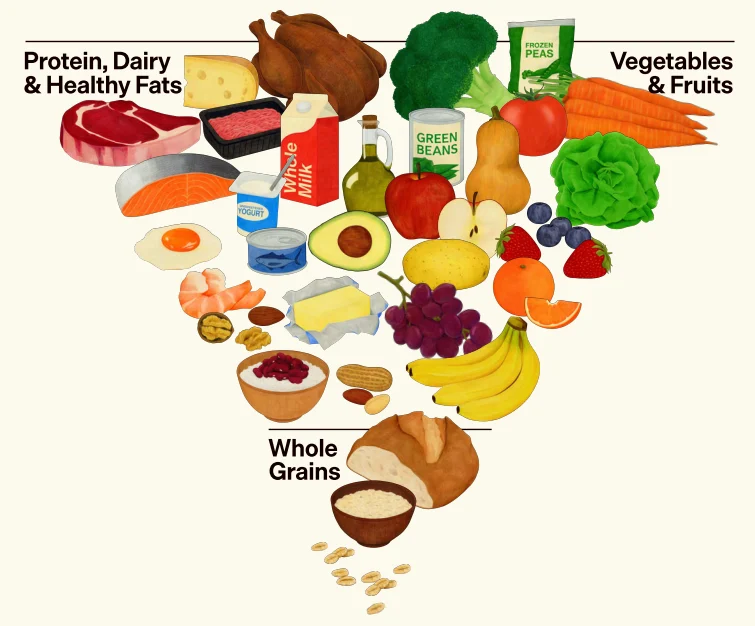
The eagerly anticipated 2025-2030 Dietary Guidelines for Americans (DGAs) were unveiled this week, championing a powerful, yet simplified, central tenet: "eat real food." This iteration of the nation’s leading nutrition advice marks a significant evolution, featuring a more pronounced emphasis on curtailing added sugars and minimizing highly processed food consumption. However, alongside these progressive directives, the release also introduced a visually striking, albeit perplexing, pyramid-style graphic that appears to contradict some of the core textual recommendations, sparking debate and potential confusion among health professionals and the public alike.
The new DGAs, a crucial document guiding federal nutrition programs, policymaking, and public health initiatives, are developed every five years by the U.S. Departments of Agriculture (USDA) and Health and Human Services (HHS). The process typically involves an independent Dietary Guidelines Advisory Committee (DGAC) that meticulously reviews the latest scientific evidence. This committee, composed of nutrition science experts, undergoes rigorous vetting, ethics training, and its meetings are publicly accessible, with opportunities for public comment. The DGAC then submits a Scientific Report to the USDA and HHS, forming the foundation for the final guidelines.
This year’s process, however, deviated from the norm. The 2025-2030 DGAC’s comprehensive Scientific Report, developed over two years of extensive evidence review, was reportedly rejected by the current administration. Instead, a supplemental scientific analysis was commissioned through a "federal contracting process." While this supplemental document asserts that evidence was evaluated solely on scientific rigor and underwent internal quality checks with external peer review, concerns have been raised regarding the transparency of this methodology. Deirdre Tobias, an assistant professor in the Department of Nutrition at Harvard T.H. Chan School of Public Health and a member of the 2025-2030 DGAC, highlighted these concerns in a Q&A with Harvard Chan News. "As of today, there has not been transparency in who wrote the new DGAs," Tobias stated. "Although there are documents included in the appendices by named scientists, there is no transparency in the methodology and rigor that was employed, or why certain topics were selected to be relitigated. The reviews themselves, as well as their overall presentation and integration, deviate significantly from the rigorous process that the HHS developed for the DGAs to ensure the evidence base and its committees’ conclusions were replicable, unbiased, transparent, and free from non-scientific influences." Further complicating the landscape, other observers have pointed to potential financial ties between some reviewers of the supplemental analysis and the beef and dairy industries, as disclosed in the supplemental analysis itself, given the prominent placement of meat and dairy products in the accompanying visuals.
"Eat Real Food": A Renewed Focus on Minimally Processed Diets
The central tagline, "eat real food," underscores a significant shift towards prioritizing whole, unprocessed, or minimally processed foods. This edition is notably the first to explicitly identify and recommend limiting "highly processed foods." While the term "highly processed" can encompass a wide spectrum of food preparation, the guidelines offer practical examples of what to avoid, including sugar-sweetened beverages, salty or sweet packaged snacks, and ready-to-eat meals. Even visual elements, like the illustrated yogurt container in the new pyramid, specify "unsweetened" to reinforce this message.
Regarding grains, the DGAs advocate for a strong preference for whole, fiber-rich options, while strongly recommending a substantial reduction in highly processed, refined carbohydrates, such as white bread. This aligns with extensive scientific literature demonstrating the health benefits of whole grains, including improved digestive health, better blood sugar control, and reduced risk of chronic diseases like type 2 diabetes and cardiovascular disease. For instance, studies have consistently shown that replacing refined grains with whole grains can lead to a significant reduction in cardiovascular risk factors.
Stricter Guidelines for Added Sugars, Especially for Children
The 2025-2030 DGAs adopt an unequivocally strict stance on added sugars, stating that "no amount of added sugars or non-nutritive sweeteners is recommended or considered part of a healthy or nutritious diet." This represents a notable tightening of previous recommendations, which previously focused on limiting added sugars to less than 10% of total daily calories. The new guidelines propose a more practical, albeit challenging, recommendation: no single meal should exceed 10 grams of added sugars. While tracking added sugar by meal is not a common consumer practice, the intent is to drive down overall intake.
Perhaps one of the most significant changes is the recommendation for children to avoid added sugars entirely until the age of 10, a substantial increase from the previous age cutoff of 2 years. This heightened focus on early childhood exposure to added sugars reflects growing concerns about the link between early consumption and the development of unhealthy eating habits, obesity, and associated health problems later in life. Data from the Centers for Disease Control and Prevention (CDC) consistently show high rates of added sugar consumption among American children, contributing to alarming childhood obesity statistics, which have more than tripled since the 1970s. The guidelines aim to curb this trend by promoting a foundation of nutrient-dense foods from the earliest stages of life.
Contradictory Messaging on Saturated Fats and the "New Food Pyramid"
Despite the explicit focus on limiting added sugars and highly processed foods, the DGAs retain the long-standing recommendation to limit saturated fat intake to no more than 10% of total daily calories. This scientific consensus is well-established, with numerous studies linking high saturated fat intake to elevated LDL cholesterol levels and an increased risk of cardiovascular disease.
The confusion arises from the accompanying "New Food Pyramid," a graphic that visually emphasizes foods such as steak, full-fat milk, and butter. This prominent placement of saturated-fat-rich animal products appears to contradict the textual guidance on limiting saturated fat. Dr. Frank Hu, Professor of Nutrition and Epidemiology and Chair of the Department of Nutrition at the Harvard T.H. Chan School of Public Health, expressed concern over these mixed messages. "I think the new Guidelines move in the right direction by reinforcing the importance of reducing added sugars and cutting back on refined grains and other highly processed foods," Dr. Hu stated. "However, there appear to be several contradictions within the DGAs and between the DGAs and the new pyramid. The mixed messages surrounding saturated-fat-rich foods such as red meat, butter, and beef tallow may lead to confusion and potentially higher intake of saturated fat and increased LDL cholesterol and cardiovascular risk."
The graphic also features vegetables and fruits as a large segment, a positive reinforcement. However, Dr. Hu noted that whole grains are depicted with relatively smaller prominence on the pyramid compared to their recommended intake of 2-4 servings per day within the written guidelines. This discrepancy between visual representation and textual recommendation is critical, as images and taglines often hold greater memorability and influence than detailed textual explanations.
To illustrate the potential impact of the saturated fat guidance, consider a 2,000-calorie diet, where the 10% limit translates to approximately 22 grams of saturated fat per day. The DGAs’ guidance on daily servings by calorie level recommends three servings of dairy. If full-fat versions are chosen – for example, one 8-oz cup of whole milk (approximately 5 grams of saturated fat), ¾ cup of full-fat Greek yogurt (approximately 6 grams), and 1 ounce of cheddar cheese (approximately 6 grams) – this alone accounts for 17 grams of saturated fat. Adding a single tablespoon of butter (7 grams) or beef tallow (6 grams), both suggested cooking fat options, would push an individual over the 22-gram limit, even before accounting for saturated fat present in other foods consumed throughout the day, including protein sources.
While olive oil is depicted in the pyramid and noted for its "essential fatty acids," Dr. Hu clarifies that other oils offer superior sources for these specific nutrients. Olive oil primarily contains oleic acid. Oils like soybean and canola oil are richer in essential fatty acids such as alpha-linolenic acid and linoleic acid. Importantly, all these plant oils have demonstrated the ability to lower LDL cholesterol and reduce cardiovascular risk when compared to animal fats like butter or tropical fats such as coconut and palm oil.
Increased Protein Recommendations: Quantity Over Quality Concerns
The 2025-2030 DGAs propose an increase in recommended protein intake for adults, suggesting 1.2 to 1.6 grams of protein per kilogram of body weight per day. This is a substantial increase, ranging from 50% to 100% more than previous minimum intake recommendations. While protein needs are indeed variable and can be influenced by factors like age, activity level, and health status, the broader ranges set by organizations like the National Academy of Medicine acknowledge this variability. However, experts emphasize that optimal protein intake should be determined on an individual basis, ideally with guidance from a healthcare provider or registered dietitian. Consuming excess protein can lead to its conversion into fat, potentially contributing to weight gain.
A significant omission in the Guidelines, according to critics, is the lack of clarity regarding the quality of different protein sources. This is particularly relevant given that many Americans already consume more than sufficient protein. Dr. Hu warns of potential unintended consequences: "Substantially raising overall protein intake without distinguishing between different protein sources may have unintended long-term health implications. Evidence continues to suggest that plant-based proteins and fish are associated with more favorable health outcomes than diets high in red meat."
The "protein package"—the fats, fiber, sodium, and other nutrients accompanying protein sources—is crucial for overall health. While the DGAs recommend a "variety of protein foods" from both animal and plant sources, the messaging lacks clear guidance on which options should be prioritized for regular consumption. This is a critical consideration, especially in light of the stated saturated fat limits, as different protein sources contribute varying amounts of saturated fat.
Vague Guidance on Alcohol and Environmental Impact Omissions
The DGAs offer a generalized recommendation to "consume less alcohol for better health." This phrasing lacks concrete numerical limits, leaving consumers uncertain about what constitutes "less" and how to interpret this guidance effectively for health improvement.
Furthermore, a notable omission in the 2025-2030 DGAs is any consideration of the environmental and socioeconomic impacts of dietary recommendations. This is a significant oversight, as food choices have a profound influence on the environment, and conversely, dietary patterns are strongly shaped by socioeconomic and cultural factors. Ignoring these interconnected aspects limits the holistic applicability and sustainability of the guidelines.
Implications and the Path Forward
Despite a stronger stance against added sugars and highly processed foods, and technical alignment with the scientific consensus on saturated fat limits, certain aspects of the 2025-2030 Dietary Guidelines for Americans present a confusing tableau. The "New Food Pyramid" graphic, with its conspicuous emphasis on saturated-fat-rich animal products, stands out as particularly puzzling and potentially counterproductive to the stated goals of reducing saturated fat intake.
While DGAs are typically designed as policy documents, this edition appears to aim for greater consumer accessibility, evidenced by its shorter length, accompanying graphics, and interactive website. However, historical data from the CDC indicates that Americans have historically struggled to adhere to the dietary guidelines. It remains to be seen whether this iteration will achieve greater compliance.
For individuals seeking clarity amidst the conflicting messages, resources like the Harvard T.H. Chan School of Public Health’s Healthy Eating Plate offer a visually intuitive and evidence-based approach to healthy eating. Consulting a registered dietitian for personalized nutritional advice is also highly recommended. The ongoing dialogue surrounding the DGAs underscores the complex interplay between scientific evidence, public health communication, and the realities of dietary choices in a diverse society. The ultimate impact of these guidelines will depend not only on their content but also on how effectively they can be translated into actionable, consistent, and transparent advice for all Americans.
