
More than 80 alternative protein startups have experienced mergers, acquisitions, insolvencies, or outright closures over the past two years, a trend that industry leaders and investors anticipate will continue as the sector matures and faces increased economic pressures. This significant consolidation reflects a broader recalibration within the venture capital landscape and a shift in investor focus towards profitability and sustainable growth over rapid expansion.
The recent surge in consolidation, with 54 instances occurring in the last 12 months alone—a 35% increase from the previous year—is attributed by many to the significant slowdown in investment that began around 2023. Deniz Ficicioglu, co-founder of BettaF!sh, an alternative seafood startup acquired by US firm Bayou Best Foods in June, explains, "Investment into food and alternative proteins slowed significantly around 2023. Most startups had between 18 and 24 months of runway, so we’re seeing the consequences now. Companies that couldn’t reach profitability, adapt their business model, raise additional capital, or find the right strategic partner are facing difficult decisions."
This sentiment is echoed by investors active in the alternative protein space. Yoni Glickman, managing partner at PeakBridge, a venture capital firm with a portfolio including companies like Vow, Rival Foods, Imagindairy, and Standing Ovation, notes, "Many of these companies raised in 2021 and 2022 and have reached the end of their runway. Investors are more interested in companies that have proven product-market fit and traction, as opposed to investing in an alternative protein vision that was overhyped over those years."
Christian Nagel, co-founder and partner at Earlybird, an investor in alternative protein startups, concurs, stating, "The sector is moving from a capital-abundant phase to one defined by execution and economics. Many companies were funded on expectations of rapid category adoption, but consumer demand, manufacturing scale, and margins have taken longer to materialize."
The Economic Undercurrents Driving Consolidation
The current wave of consolidation can be traced back to broader macroeconomic shifts, including rising interest rates. Steve Simitzis, founder and managing partner of Replicator VC, points to the US Federal Reserve’s rate hikes and the collapse of Silicon Valley Bank and First Republic as pivotal moments signaling a departure from the previous investment cycle. "If we take 2023-24 as the beginning of the funding drought, many of these companies still have cash in the bank from their previous raise, and others raised bridges or found a way to run on fumes (for example, with layoffs and hard pivots)," Simitzis observes. "At some point, the money just runs out. If the typical startup round is capital for 18-24 months, plus a bridge for 12-18 months, that puts us at about 2025-26 for the big crashout."
This economic environment has fostered a more selective funding landscape, compelling a "necessary market correction," according to Nagel. He elaborates, "This correction is separating businesses with differentiated technology and commercial traction from those that relied primarily on growth narratives."
Companies that have strategically embraced mergers and acquisitions (M&A) as a growth strategy include the Livekindly Collective, owner of brands like Oumph! and Fry’s. After achieving its first profitable month last year, the company acquired Germany’s Greenforce. David Suarez, CEO of Livekindly Collective, views this as a sign of industry maturation. "Over the past decade, significant investment drove innovation and the launch of many new businesses. While that accelerated category development, it also created a highly fragmented marketplace," Suarez explains. "Today’s environment is different. Investors are focused on sustainable growth, profitability, and operational discipline. At the same time, retailers are looking for partners that can deliver scale, reliability, and category expertise. As industries mature, consolidation is a natural outcome as stronger business models emerge and companies seek greater scale and efficiency." Suarez emphasizes that for Livekindly, M&A is about building stronger businesses with the necessary scale and efficiencies, not just growth for its own sake.
Investment Trends and the Shifting Investor Mindset
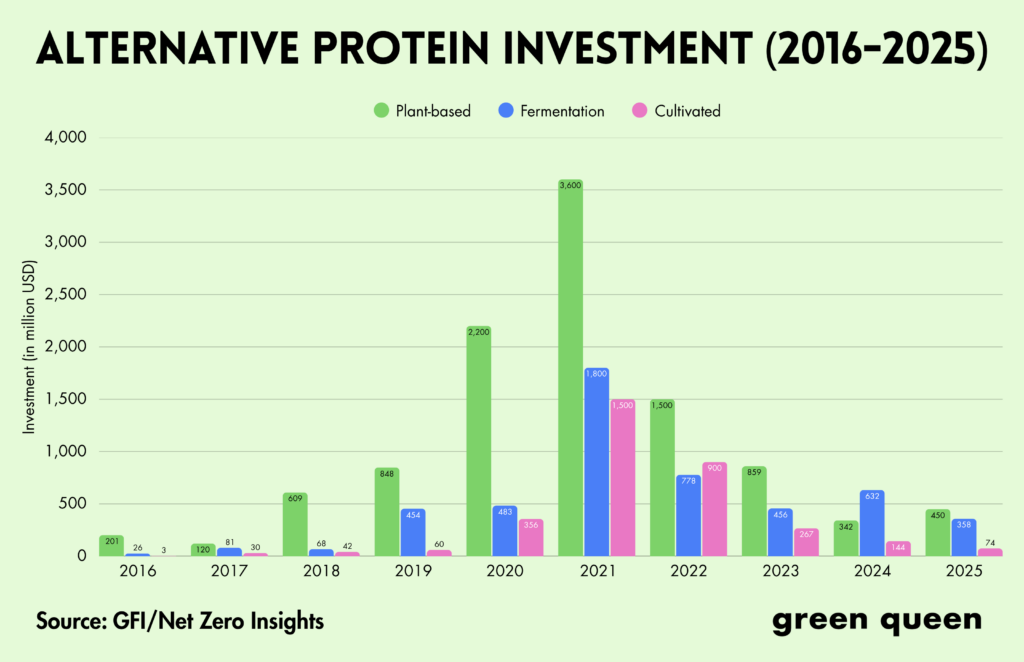
The overall investment in the alternative protein industry underscores the challenges. In 2025, total investment fell to $881 million, dipping below the $1 billion mark for the first time since 2018. Fermentation companies saw a 43.5% decline, and cultivated meat startups raised more capital in 2021 than in the subsequent four years combined. While plant-based firms experienced a 31.5% increase from 2024, this was largely due to a $100 million debt financing round by Beyond Meat; without it, the sector’s growth would have been a mere 2%.
Glickman attributes this to a shift in investor expectations. "At the beginning of the decade, generalist VCs entered the space with unreasonable expectations around time horizons and exit scenarios. Similarly, the alternative protein bubble has largely burst due to both changes in consumer sentiment and overly hyped startups that were focused on a vision rather than proven product-market fit," he states.
Founders agree that investors are now prioritizing fundamental strengths. Suarez highlights the focus on "profitability, cash generation, efficient operations, and a clear path to sustainable growth." For plant-based companies, the conversation has moved from "potential to execution," with investors seeking strong brands, differentiated products, demonstrable consumer demand, and disciplined business performance.
Ficicioglu believes the industry’s prior overemphasis on trends and hype, rather than on solving fundamental problems and building robust businesses, contributed to the current situation. She views the evolving investor mindset as a positive development, encouraging founders to build companies addressing genuine consumer needs, not just those that align with fleeting investment trends. "We’ll see a different type of investor in food tech going forward: investors who understand the industry, think longer term, and want to build sustainable businesses rather than chase the next hype cycle," she predicts.
The AI Factor and Reigniting Investor Interest
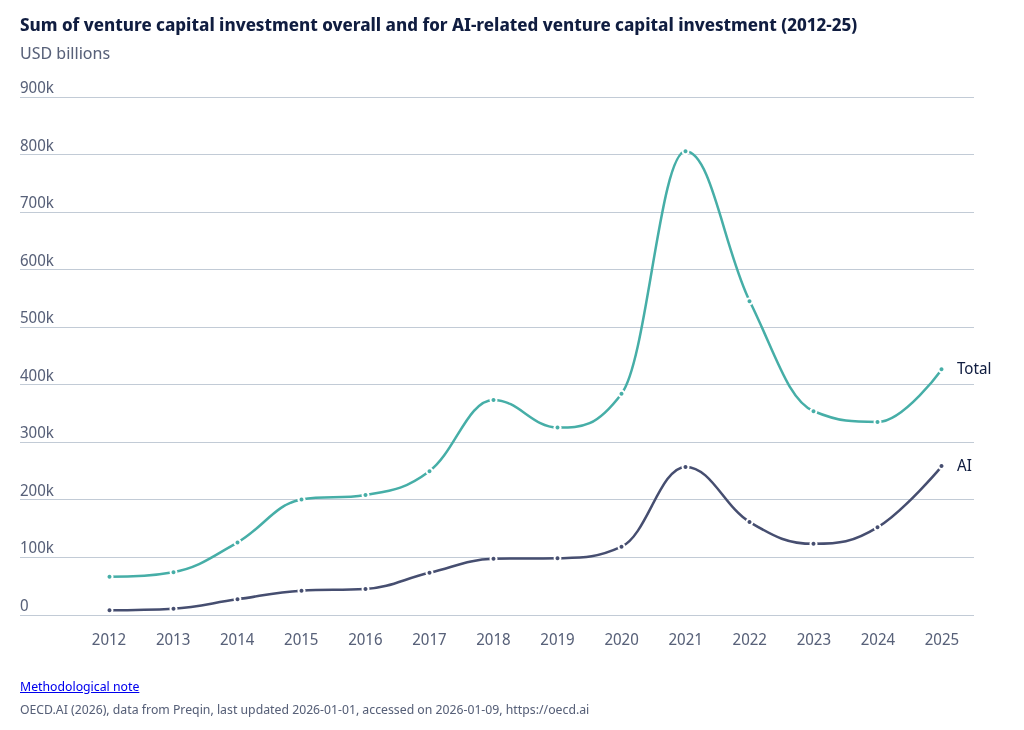
The venture capital landscape has become significantly more disciplined across all sectors, not just food technology. Pitchbook’s analysis indicates that by Q1 2026, US venture capital fundraising had fallen by 70% from its 2022 peak. Glickman notes, "Investors are now more aware of the long time horizons and capital intensity of synthetic biology. The companies that are fundraising successfully are those that have largely proven they can scale in capex-light scenarios, have attractive unit economics, and regulatory approvals."
Nagel reiterates the demand for "clear technical differentiation, defensible IP, capital efficiency, and a credible path to profitability." In this context, artificial intelligence (AI) has emerged as a dominant force, capturing 61% of global venture funding in 2025.
This trend presents an opportunity for alternative protein companies. Simitzis asserts, "AI is the unlock for alternative protein, period. You can develop better and cheaper products, faster. This reduces burn and gets these companies commercial-ready with less capital than the previous wave." Suarez acknowledges AI’s potential to enhance forecasting, product development, and operational efficiency but stresses that "investors ultimately back businesses that deliver value to consumers and can create long-term sustainable returns. Technology can be a powerful enabler, but it is not a substitute for a strong business model."
Nagel believes that while AI attracts significant capital, other categories remain investable. "Companies will continue to attract funding if they solve meaningful problems with proprietary technology and can show strong unit economics. The bar has simply become much higher," he states.

Simitzis identifies validating scalability as a baseline requirement, but emphasizes that proving consumer demand is the critical factor for attracting capital. "Alternative protein startups need to identify a customer or segment with a burning need for your product," he advises. He suggests that persistent food inflation, increasing demand for protein driven by trends like GLP-1 medications, the rising affluence of developing nations demanding Western diets, and the environmental pressures on livestock farming all create significant business problems for food producers that alternative protein startups can uniquely address. Even the cost of whey, a byproduct, has risen, further highlighting opportunities.
Plant-Based Sector Bears the Brunt of Consolidation
The plant-based food category has been disproportionately affected by the current consolidation trend, accounting for 72% of M&A deals, insolvencies, and closures since July 2025. Cultivated protein and fermentation-focused firms represented only 15% and 11% of these instances, respectively. This disparity is largely attributed to the plant-based sector being the most mature and commercially established, housing a significantly larger number of companies.
Suarez explains, "Plant-based brands already have retail distribution, manufacturing infrastructure, consumer awareness, and established revenue streams, making them more attractive candidates for acquisitions and consolidation. Many cultivated meat and fermentation businesses remain at an earlier stage of commercial development, with significant focus on technology scale-up, production economics, and regulatory pathways."
Nagel points out that many plant-based businesses operate in crowded product categories with limited differentiation, increasing the likelihood of M&As and market exits. He agrees that the primary challenges for cultivated meat and fermentation firms lie in scalability and regulation, rather than consolidation.

Simitzis further attributes the higher consolidation rate in the plant-based sector to the difference in survival rates between consumer-facing models and B2B models. He notes a consumer backlash against plant-based options, exemplified by the decline of Beyond Meat’s stock. In contrast, fermentation companies, particularly in Europe, are finding success as ingredient providers, selling to larger food producers. Cultivated meat companies are also pivoting to B2B applications in adjacent industries like biopharma and beauty. Simitzis links the consumer model’s struggles to food inflation and a broader backlash against plant-based products.
Suarez sees the plant-based category moving towards greater scale, with fewer, stronger players emerging to drive innovation and serve retailers more effectively. He views consolidation not as a reduction in choice, but as a means to build sustainable businesses that can foster long-term category growth.
Consolidation Continues: A Necessary and Healthy Evolution
Industry experts anticipate that consolidation within the alternative protein sector will persist. With finite retail shelf space, intense competition, and a growing demand for consistent quality, innovation, and value from both retailers and consumers, the trend towards fewer, stronger players is expected to continue.
Ficicioglu expresses optimism about the emergence of a new generation of startups that will be leaner, more focused, and centered on solving real customer problems from the outset. She views consolidation as a crucial phase for industry maturation, enabling the combination of complementary expertise, technologies, and market access to create more robust companies with a greater likelihood of long-term success.

Glickman notes that many food tech startups have successfully developed innovative technologies or brands but have deployed capital inefficiently. "Through combinations, overhead and opex costs can be deployed more efficiently, giving both founders and investors better outcomes," he states.
Both Nagel and Suarez characterize consolidation as a healthy and necessary step in the sector’s maturation. Nagel observes, "Every emerging industry goes through a period of rapid expansion, followed by rationalization as scale becomes increasingly important. Consolidation can help create stronger businesses with the resources to invest in innovation, manufacturing capabilities, consumer engagement, and category development." He anticipates continued consolidation over the next couple of years, contingent on improving financing conditions and consumer demand, ultimately leading to a more focused ecosystem of stronger global businesses.
Simitzis offers a "creative destruction" perspective, suggesting that consolidation is a natural outcome rather than an inherently good or bad event. He believes that while some companies may continue to operate in a "zombie state," the pace of consolidation will naturally slow as the wave of companies founded during the era of abundant capital subsides. He also points out that talent and intellectual property can be successfully redeployed, allowing good ideas to persist even if individual companies falter.
Ficicioglu emphasizes that while startups can push boundaries, transforming the food system also requires leadership from governments, industry, and retailers. She advocates for change from both the top and the bottom, highlighting her own company’s acquisition by Bayou Best Foods as an example of synergistic growth, combining BettaF!sh’s European seaweed expertise and proprietary know-how with Bayou’s US foodservice market strength and manufacturing capabilities. This collaboration aims to create a stronger platform with a broader product portfolio and a shared vision for the future of food.
