

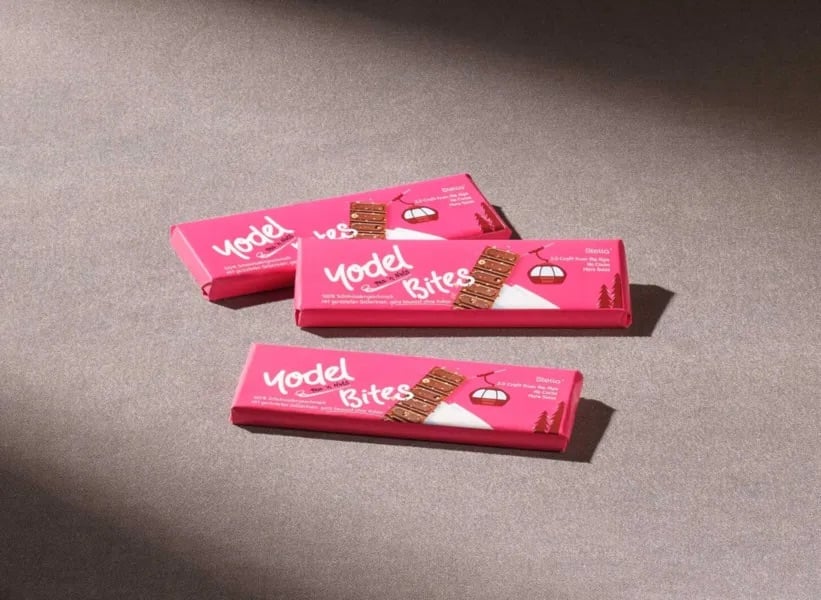
The Swiss alternative food landscape has entered a new phase of commercial visibility as Food Brewer, a food technology startup supported by confectionery major Lindt, rolls out its flagship cocoa-free chocolate bars across the nation’s railway system. Designated as Yodel Bites, the product is now available in all dining cars operated by Elvetino on SBB trains throughout Switzerland. This milestone marks a critical transition for the enterprise, moving its proprietary formulations from controlled laboratory settings and academic test kitchens directly into the hands of daily commuters and long-distance travelers.
Formed in 2021 by a multidisciplinary founding team comprising Christian Schaub, Yannick Senn, Géraldine Senn, Corinne John, Stefan Bingisser, and Klaus Kienl, Food Brewer initially established its reputation in the cellular agriculture space through the development of cell-based cocoa. However, recognizing the intricate and often protracted timelines required for novel food regulatory clearances, the company diversified its product pipeline. By leveraging agricultural byproducts and climate-resilient local crops, the firm has successfully engineered consumer-ready alternatives designed to bypass the vulnerabilities inherent in traditional monoculture supply chains.
The debut of Yodel Bites represents a strategic partnership with Stella Bernrain, a prominent Swiss private-label chocolate manufacturer. Beyond the on-board railway catering service, these cocoa-free confections are currently accessible at select Stella Bernrain retail locations in Kreuzlingen and Giubiasco, as well as through direct-to-consumer channels via Food Brewer’s corporate website. For the national rail operator, the inclusion of the novel treat aligns with broader corporate strategies to modernize passenger offerings while promoting sustainability. Renato Citrini, head of offer and experience at Elvetino, emphasized that the inclusion of Yodel Bites fulfills the company’s objective of surprising passengers with innovative culinary concepts that resonate with contemporary ecological values.
The Engineering and Sourcing Behind Yellow Pea Upcycling
At the core of Food Brewer’s current commercial offerings is the utilization of yellow pea sidestreams. The startup deliberately selected yellow peas as a foundational ingredient due to their agronomic profile: they are robust legumes capable of year-round cultivation across diverse global climates, require minimal chemical intervention, promote soil health through nitrogen fixation, and integrate seamlessly into mechanized harvesting infrastructure. Furthermore, sourcing yellow peas locally or regionally drastically shortens supply chains, insulating production cycles from geopolitical disruptions, fuel price volatility, and extreme weather shocks that frequently plague tropical agricultural commodities.
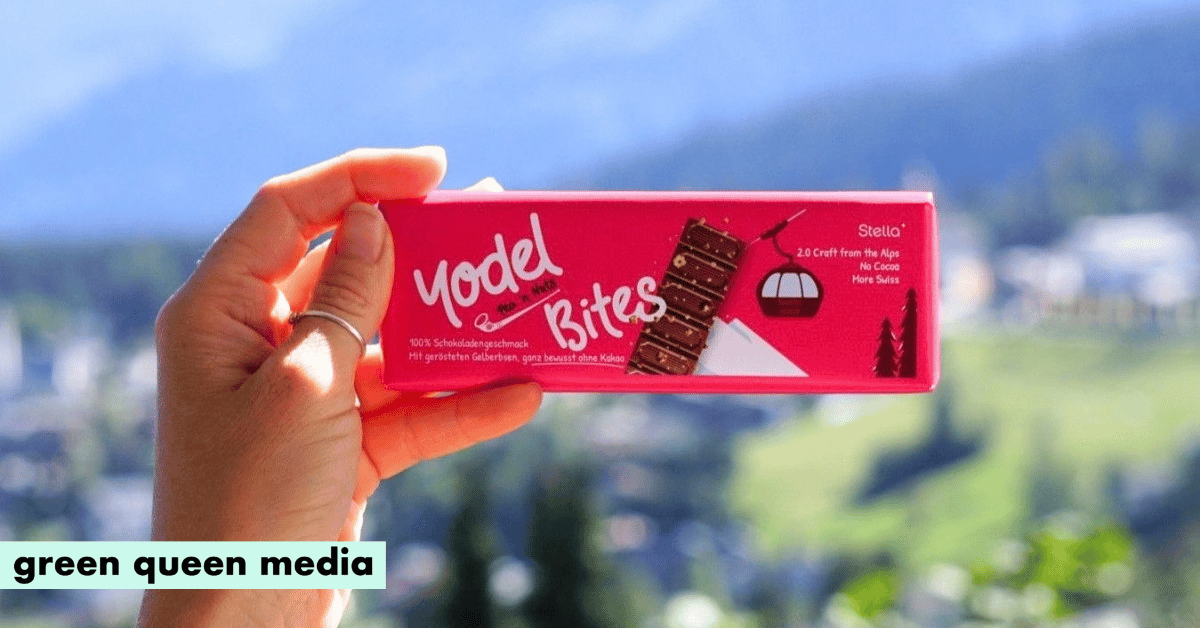
Rather than utilizing the primary pea protein isolates common in plant-based meat substitutes, Food Brewer targets an overlooked industrial byproduct of the yellow pea processing sector, effectively giving these sidestreams a secondary lifecycle. This raw material undergoes a complex transformation involving precision fermentation, controlled roasting, and proprietary processing parameters. These steps are meticulously calibrated to unlock deep, roasty, nutty, and inherently chocolate-like sensory notes.
When combined with fats, sugars, and complementary ingredients, the processed pea base forms a smooth, viscous liquor that mimics the mouthfeel, melt characteristics, and rheological properties of conventional chocolate. In the specific formulation of Yodel Bites, the upcycled yellow pea base is paired with carob—a traditional Mediterranean legume utilized for decades as a chocolate substitute—alongside palm and shea fats, sugar, whole milk powder, roasted hazelnut pieces, sunflower lecithin, and natural flavorings. This precise matrix yields a milk chocolate style alternative containing 30 percent less sugar than traditional dairy-based chocolate bars, catering to health-conscious consumers without compromising on indulgence.
Chronology and Growth of Alternative Cocoa
The commercial deployment of Yodel Bites arrives against a backdrop of severe systemic distress within the global cocoa market. Over recent years, traditional cocoa supply chains have faced unprecedented pressures driven by changing climatic patterns, aging tree stocks, and persistent tree diseases in West Africa, which historically accounts for the vast majority of global cocoa production. In 2024, international cocoa inventories plummeted to a decade-long low, sending commodity futures to historic all-time highs. These economic realities have squeezed profit margins for confectionery manufacturers worldwide while driving retail chocolate prices up for consumers.
Concurrently, environmental audits have underscored the severe ecological footprint associated with traditional chocolate production. Scientific assessments indicate that the generation of dark chocolate produces higher greenhouse gas emissions per kilogram than almost any other food product, second only to beef production. Moreover, land-use change driven by cocoa expansion has been identified as a primary engine of deforestation in nations such as Ghana and the Ivory Coast, threatening biodiversity and drawing intense regulatory scrutiny regarding ethical labor practices and environmental compliance.
Recognizing these converging crises, Food Brewer has spent the intervening years expanding its technological capabilities. The startup offers a comprehensive portfolio of milk, vegan, and dark couverture alternatives designed either to be blended with conventional cocoa butter and liquor or to replace them entirely in industrial applications. Additionally, the company produces cost-effective cocoa powder substitutes intended for varying levels of inclusion in baked goods, confectionery, and beverages.
Rigorous sensory validation has accompanied this technical development. In blind taste tests administered by the Bern University of Applied Sciences, consumer cohorts evaluated Food Brewer’s cocoa-free formulations with high favorability, with a notable segment of participants expressing a preference for the alternative formulations over traditional chocolate counterparts. Crucially, consumer acceptance metrics remained stable—and in several instances, improved—over extended multi-week trial periods, indicating long-term palatability rather than mere novelty appeal.
Advancing Cellular Agriculture and Investor Backing
While upcycled plant-based formulations represent Food Brewer’s immediate commercial footprint, the startup continues to advance its foundational research into cellular agriculture. The company’s long-term roadmap centers on cell-based cocoa and coffee innovations, which utilize plant cell culture technology to grow authentic bean matter inside industrial bioreactors, completely independent of arable land, seasonal harvests, or agricultural labor.
The proprietary cellular process begins with the extraction of viable plant cells from a traditional cocoa bean. These cells are transferred into a specialized nutrient gel, where they undergo cellular division and organization to form a callus. After approximately two weeks of preliminary growth, selected cells are transferred into large-scale fermentation vessels filled with a nutrient-dense liquid medium. Once the cellular biomass achieves the targeted density and biochemical profile, the resulting material is harvested, dried, and roasted to replicate the complex flavor precursors found in conventionally harvested beans.
A significant operational milestone was achieved last year when Food Brewer successfully scaled its bioreactor operations to a 6,000-liter capacity. This expansion enabled the enterprise to transition from bench-scale experimentation to fully automated, high-volume bioprocessing, paving the way for expansive industrial partnerships. To fund this infrastructure, the startup secured $5.6 million in a funding round backed by prominent industry stakeholders, including confectionery giant Lindt & Sprüngli, Sparkalis (the venture capital arm of bakery and confectionery group Puratos), and Swiss chocolate maker Felchlin, with the latter actively collaborating to test cell-based cocoa powder in commercial applications. Company leadership has confirmed that regulatory clearance in the United States is the next major objective for its cell-based portfolio.
Broader Industry Trends and Market Implications

Food Brewer is far from isolated in its pursuit of cocoa independence. The broader food technology sector has seen a massive influx of venture capital and strategic corporate partnerships aimed at commercializing sustainable, beanless chocolate alternatives. Competitor startups such as Planet A Foods, Voyage Foods, and Celleste Bio have all secured substantial funding rounds and entered into joint development agreements with multinational food conglomerates.
Major industry players—including Nestlé, Barry Callebaut, Cargill, Mondelēz International, Mars, and Döhler—have increasingly invested in or partnered with alternative ingredient startups. These legacy corporations view beanless and cell-based chocolate not merely as a temporary hedge against raw material price volatility, but as an essential component of their long-term environmental sustainability commitments. By incorporating upcycled sidestreams, plant-based replacers, and eventually cellular ingredients into their product lines, these conglomerates aim to drastically reduce their Scope 3 greenhouse gas emissions and meet corporate deforestation targets.
The launch of Yodel Bites on SBB trains serves as a bellwether for the broader acceptance of climate-resilient foods in mainstream European markets. By placing an innovative, cocoa-free product in a high-visibility, everyday consumer environment, Food Brewer and its partners are testing the waters of public readiness. As supply chain pressures mount and consumer awareness regarding the ecological cost of conventional confections continues to grow, initiatives that successfully marry agricultural upcycling with high-end culinary execution are positioned to redefine the future of the global confectionery industry.
