
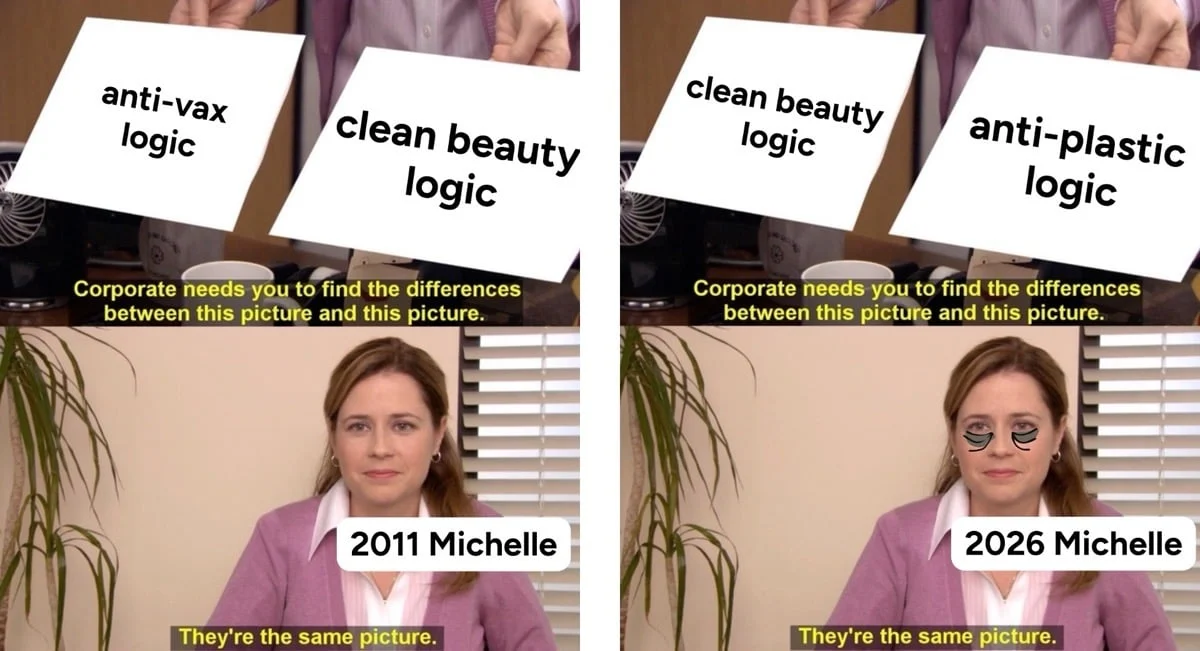
A recent observation shared on Threads by user @idea.soup sparked a critical re-evaluation of current environmental trends within the beauty and consumer goods sectors. The post posited, "I don’t have any evidence for it but I have a weird feeling the anti-polyester movement is about to become a right-wing pipeline." This sentiment resonated deeply with science communicator Michelle Wong of Lab Muffin Beauty Science, who immediately drew parallels to the "clean beauty" movement and its historical connections to anti-vaccination beliefs. Wong, who began her scicomm journey in 2011 to counter the pseudoscientific underpinnings of "non-toxic" beauty, noted that both movements often employ identical logical fallacies and demonize the same substances, such as aluminium and formaldehyde. The current anti-plastic trend, she argues, exhibits strikingly similar patterns, raising concerns about the spread of misinformation and its potential to derail genuine environmental efforts.
The Echo of "Clean Beauty": A Precedent of Pseudoscience
To understand the concerns surrounding the "plastic-free" movement, it’s essential to first examine the trajectory of "clean beauty." This movement, which gained significant traction in the 2010s, capitalized on consumer anxieties regarding synthetic chemicals and perceived toxins in personal care products. It propagated "free-from" lists, cautioning against ingredients like parabens, sulfates, and phthalates, often without robust scientific backing. The core argument rested on an "appeal to nature" fallacy – the assumption that anything natural is inherently good, and anything synthetic is inherently bad.
Clean beauty messaging frequently disregarded fundamental principles of toxicology, notably "the dose makes the poison." Ingredients that might be harmful in high concentrations were demonized even when present in minute, safe amounts in cosmetic formulations. For instance, the widely cited "parabens in breast tumours" study, which suggested a link between parabens and breast cancer, failed to measure paraben levels in normal tissue, thus preventing any meaningful comparison or causal inference. Despite scientific consensus on the safety of parabens as preservatives at regulatory-approved levels, the narrative of their danger persisted, fueled by influencers and brands. This often led to companies reformulating products with less effective or potentially more allergenic alternatives, inadvertently compromising product safety and efficacy.
The Rise of "Plastic-Free": A New Frontier for Misinformation?
The "plastic-free" movement, particularly within the beauty industry, is now mirroring many of these patterns. Brands and influencers are increasingly adopting blanket "plastic-free" claims and employing fearmongering tactics, especially concerning microplastics. While genuine concerns about plastic waste and pollution are valid and require urgent attention, the current discourse often overstates risks and promotes alternatives without adequate evidence-based scrutiny.
The critical issue, as Wong highlights, is that many individuals who readily identify "clean beauty" as pseudoscientific fail to apply the same critical lens to anti-plastic messaging. Even reputable scientific outlets and experts have, at times, inadvertently fallen into these tropes, demonstrating the pervasive nature of these narratives. The core problem lies not in acknowledging the environmental challenges posed by plastic, but in the uncritical adoption of "eco" alternatives and the overblown rhetoric that often accompanies them, potentially leading to misaligned outcomes for both human and environmental health.
Shared Logical Fallacies and Scientific Oversights
The parallels between the anti-plastic and clean beauty movements extend to several key logical fallacies and scientific oversights:
-
The Appeal to Nature Fallacy: This is perhaps the most fundamental shared fallacy. Just as clean beauty posited "natural = good, chemical = bad," the plastic-free movement often promotes "plastic = bad, natural/alternative = good." This extends even to bioplastics, derived from natural starting materials, which are frequently assumed to be inherently superior without rigorous assessment. The flaw in this logic is clear: a substance’s origin reveals little about its safety or environmental impact. Many natural substances are highly toxic, while many synthetic materials are benign or even essential.
-
Ignoring the Basics of Relevant Science – Life Cycle Assessment (LCA): The anti-plastic narrative frequently overlooks the comprehensive methodology of sustainability science. Life Cycle Assessment (LCA) is the scientific standard for quantifying a product’s environmental impact across its entire lifespan: from raw material extraction, manufacturing, transport, and use, to its end-of-life disposal or recycling.
Most discussions around plastic disproportionately focus on end-of-life issues – microplastics, landfills, decomposition rates, and ocean waste. However, for many products, the end-of-life stage is not the largest environmental impact. Climate change, often universally agreed upon as the most significant environmental threat, frequently sees plastic packaging performing favorably due to its lightweight and efficient production.
For example, a 2011 Denkstatt report found that switching from plastic to glass, paper, or aluminum alternatives would, on average, require 3.6 times more material, 2.2 times more energy, and result in 2.7 times more carbon emissions. Plastics offer benefits such as lower weight, which reduces transportation emissions, and excellent product protection, which minimizes spoilage and waste. While these are not blanket statements, and every case requires individual LCA, the widespread blanket demonization of plastic without such holistic assessment is often counterproductive. Many beauty brands, for instance, promote "plastic-free" alternatives that, when subjected to LCA, demonstrate a higher overall environmental footprint. This "performative greenwashing" can be highly misleading, even for informed consumers. -
Citing Studies with Serious Methodological Issues: A significant challenge in the microplastics discourse is the reliance on studies with methodological flaws. Measuring minute quantities of substances is inherently difficult, and microplastic research faces additional complexities. Contamination from lab equipment or clothing is a pervasive issue, leading to false positives or exaggerated findings. Analytical methods, such as pyrolysis-GCMS (Py-GCMS), can also misidentify substances; for instance, fats can appear identical to polyethylene, leading researchers to over-report microplastic presence. This issue was highlighted in a study that claimed a "spoon’s worth of microplastics" in human brains, a finding later brought into question by experts. The Guardian, a mainstream media outlet, notably published an article in January 2026 discussing these measurement issues and correcting previous reports, a commendable act of scientific self-correction often rare in fast-paced environmental reporting.
-
Assuming Presence Means Harm (Correlation vs. Causation): The detection of microplastics in diseased tissues, such as artery plaque or the brains of dementia patients, is frequently presented as evidence of causation. However, as with the clean beauty narrative surrounding parabens and breast tumors, correlation does not equate to causation. The presence of microplastics could be a benign finding, a result of reverse causation (e.g., diseased tissue accumulating microplastics rather than microplastics causing the disease), or simply a confounding factor unrelated to the disease’s etiology. Scientific rigor demands controlled studies to establish causality, which are often absent or misinterpreted in popular discourse.
-
Ignoring Other Reasons for Using the Material: Beyond environmental considerations (which are often inaccurately assessed), plastics offer numerous practical benefits frequently overlooked in the "plastic-free" movement. These include superior product protection (preventing spoilage and extending shelf life), enhanced hygiene, cost-effectiveness, accessibility for diverse consumer bases, and safety (e.g., plastic packaging is less likely to shatter than glass). Demonizing plastic without considering these crucial factors can lead to unintended negative consequences, such as increased product waste, higher costs, or reduced accessibility. Just as parabens offer powerful and safe preservation at low concentrations, plastic provides functional advantages that are often difficult to replicate with alternatives without incurring other environmental or practical trade-offs.
-
Science-washing and Convenient Experts: Both movements are adept at "science-washing," where brands and influencers selectively use scientific language, cherry-picked data, or unqualified "experts" to bolster their claims. This creates a veneer of scientific credibility without genuine adherence to scientific principles. Regulatory bodies in major regions, such as the US FTC, UK CMA, and Australian ACCC, have issued guidelines against misleading sustainability claims, indicating a growing recognition of this problem. However, the issue persists, often through the amplification of individuals whose expertise is either tangential or whose views align with a predetermined narrative. This pattern of misrepresenting or misunderstanding relevant expertise is a hallmark of science-washing in various industries, from fitness to beauty.
Broader Societal Implications: Motivated Reasoning and Misplaced Conservation
The proliferation of misinformation within the anti-plastic movement highlights a broader societal challenge: identity-based motivated reasoning and confirmation bias. Individuals are increasingly prone to accepting evidence that aligns with their existing beliefs or political alignments, and dismissing information that challenges them, regardless of its scientific merit. This phenomenon was strikingly evident in the public reaction to The Guardian’s article on microplastic measurement issues. Despite quoting two independent scientists from public institutions and referencing a letter from nine European scientists, the article faced accusations of being "bought by Big Plastic" simply because one quoted expert had a past affiliation with Dow. As cosmetic scientist Jen Novakovich notes, "Discounting something solely based on funding source or affiliation is actually the opposite of critical thinking." Evaluating the arguments themselves, rather than merely the perceived biases of the source, is a far more rigorous approach.
The consequences of this motivated reasoning and the ensuing misinformation are profound. While the desire to reduce plastic waste is laudable and necessary, blanket demonization without proper evidence-based assessment can lead to misplaced conservation efforts. Consumers, driven by well-intentioned but misinformed narratives, may switch to "eco" alternatives that, when holistically evaluated through LCA, prove to have a greater overall environmental impact. This ultimately undermines the very goals of better human and environmental health.
Experts like Jen Novakovich (The Eco Well), who is currently pursuing a PhD on the impacts of environmental misinformation, are crucial in navigating these complex issues. Their work emphasizes the importance of critical thinking, understanding scientific methodologies, and advocating for genuine, evidence-based solutions rather than succumbing to fearmongering or performative activism.
In conclusion, the "plastic-free" movement, while born from legitimate environmental concerns, faces the risk of becoming the "new clean beauty" if it continues to rely on pseudoscientific arguments, logical fallacies, and an oversimplification of complex environmental science. A genuinely sustainable future requires a commitment to rigorous scientific assessment, holistic thinking, and a critical evaluation of all claims, ensuring that well-intentioned actions lead to truly positive outcomes for the planet and its inhabitants. Reducing overall consumption remains the most sustainable option, but when choices must be made, they should be guided by data, not dogma.
