
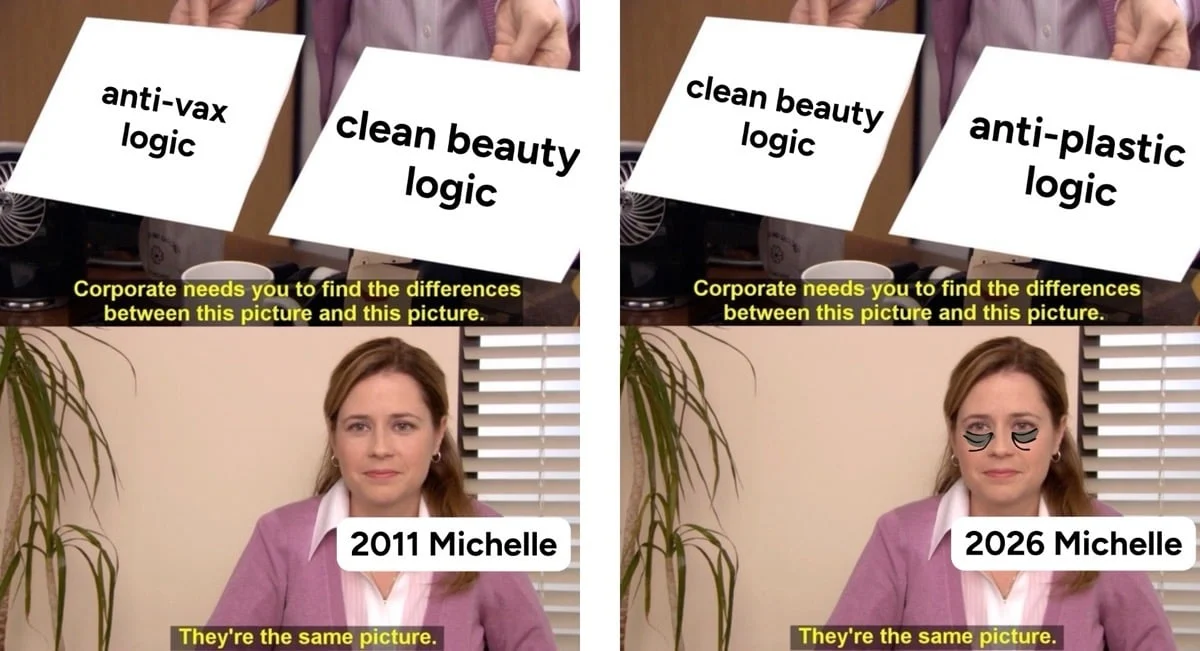
A burgeoning skepticism is emerging within the scientific community and among informed consumers regarding the parallels between the "plastic-free" movement and the earlier "clean beauty" trend. Both phenomena, while ostensibly driven by concerns for health and environment, are increasingly seen as susceptible to pseudoscientific claims, marketing hyperbole, and a fundamental misunderstanding of scientific principles, potentially misdirecting efforts for genuine sustainability. This observation, recently articulated by cosmetic chemist Michelle Wong of Lab Muffin Beauty Science, highlights a critical juncture where well-intentioned movements risk becoming conduits for misinformation.
The catalyst for this deeper examination was a social media post from @idea.soup, suggesting a potential "right-wing pipeline" emerging from the anti-polyester movement. For Wong, this immediately resonated with her decade-long experience in science communication, which began in 2011 specifically to counter the "non-toxic" clean beauty movement. She noted that the logical fallacies underpinning clean beauty, particularly its demonization of common substances like aluminum and formaldehyde, mirrored those often found in anti-vaccination rhetoric. Today, a similar pattern appears to be unfolding with the widespread anti-plastic trend, characterized by sweeping "plastic-free" claims and fearmongering around microplastics, often without robust scientific backing.
The Rise of "Clean Beauty" and Its Criticisms
The "clean beauty" movement gained significant momentum in the early to mid-2010s, advocating for products free from a rapidly expanding list of "toxic" or "harmful" ingredients. Driven largely by influencers and niche brands, it tapped into a growing consumer desire for transparency and perceived safety, often leveraging emotional appeals rather than scientific evidence. Common targets included parabens, phthalates, sulfates, and synthetic fragrances, frequently branded as "nasties" or "dirty ingredients."
However, scientific and regulatory bodies consistently critiqued the movement for its lack of precise definitions, reliance on an appeal to nature fallacy, and misinterpretation of toxicology. Experts emphasized that "the dose makes the poison," meaning the presence of a substance does not automatically equate to harm, especially at the trace levels found in consumer products. Furthermore, removing well-studied and effective ingredients often led to the adoption of less effective or even less safe alternatives, particularly concerning preservatives crucial for product stability and microbial safety. Despite these scientific rebuttals, the clean beauty narrative permeated mainstream media and retail, shaping consumer perceptions and product development across the industry.
The "Plastic-Free" Imperative: A New Wave of Concern
Following closely on the heels of the clean beauty movement, the "plastic-free" trend has emerged as a dominant force in environmental discourse and consumer product marketing by the mid-2020s. Public awareness of plastic pollution, fueled by images of ocean waste and concerns about microplastics in ecosystems and the human body, has created a powerful imperative for change. Brands, eager to demonstrate their environmental credentials, have increasingly adopted "plastic-free" labels, promoting alternatives like glass, aluminum, paper, and various "bioplastics."
However, this widespread adoption has, according to critics like Wong and other science communicators, begun to exhibit the same problematic patterns observed in clean beauty. While the goal of reducing plastic waste is undeniably critical, the blanket demonization of all plastics and the uncritical embrace of alternatives often overlook the complex environmental trade-offs involved, frequently leading to misaligned outcomes that may inadvertently worsen overall environmental impact.
Shared Flaws: Parallels in Pseudoscience
The core argument against the uncritical "plastic-free" narrative rests on several key parallels with the debunked premises of clean beauty:
-
Appeal to Nature Fallacy: Just as "natural" was equated with "good" in clean beauty, the "plastic-free" movement often operates on the assumption that "plastic = bad, natural/alternative = good." This extends even to bioplastics, which are derived from natural starting materials. This fallacy ignores the fundamental scientific principle that a material’s origin does not dictate its health or environmental impact. Many natural substances are highly toxic, while many synthetic materials are safe and beneficial. This oversimplification prevents a nuanced understanding of material science and sustainability.
-
Ignoring Fundamentals of Relevant Science: The clean beauty movement famously disregarded basic toxicology, particularly the concept of "the dose makes the poison." Similarly, blanket "plastic-free = better for the environment" claims often ignore the fundamentals of sustainability science, specifically Life Cycle Assessment (LCA). LCA is the gold standard for quantifying environmental impact, evaluating all stages of a product’s life: raw material extraction, manufacturing, transport, use, and end-of-life.
- Raw Material Extraction: What resources are consumed? What are the environmental impacts (e.g., deforestation, mining)?
- Manufacturing/Processing: How much energy is used? What emissions are generated? What waste is produced?
- Transport: What are the fuel requirements and associated emissions?
- Use Phase: How does the product perform? Does it enable efficiency (e.g., food preservation)?
- End-of-Life: Is it recyclable, compostable, or does it contribute to landfill?
Studies consistently show that consumers tend to overemphasize the end-of-life stage, leading to incorrect judgments about environmental impact. For many products, factors like manufacturing energy and transportation emissions contribute far more to environmental footprints than disposal.
A significant concern is the almost exclusive focus of anti-plastic discourse on end-of-life issues like microplastics, landfills, and ocean trash, while largely overlooking climate change, which is widely recognized by scientists as the paramount environmental threat. Plastic packaging, despite its fossil fuel origins, often offers significant climate benefits due to its lightweight nature, which reduces transport emissions, and its efficiency in preventing product spoilage. For instance, one analysis indicated that switching from plastic to glass, paper, or aluminum could require, on average, 3.6 times more material, 2.2 times more energy, and 2.7 times more carbon emissions. These benefits are not universal but highlight the need for case-by-case LCA rather than broad assumptions.
-
Citing Studies with Serious Methodology Issues: A critical parallel lies in the selective use and misinterpretation of scientific studies. Just as clean beauty often cherry-picked or misrepresented early, inconclusive research on ingredients, the anti-plastic movement frequently cites microplastic studies that suffer from significant methodological flaws. Measuring minute quantities of substances accurately is inherently challenging, and microplastic research faces additional complexities.
A common issue is contamination, where microplastics from laboratory equipment, clothing, or the environment are mistakenly counted as part of the sample, leading to false positives or exaggerated numbers. Another concern involves quantification methods; for example, pyrolysis-GCMS (Py-GCMS), a commonly used technique, can misidentify fats as polyethylene unless carefully corrected, potentially inflating microplastic counts. Such issues contribute to sensational headlines, like the claim of a "spoonful of microplastics in our brains," which was based on a study employing Py-GCMS without adequate controls. This propagation of flawed research undermines public trust and diverts resources from genuinely impactful solutions. -
Assuming Presence Means Harm: A prevalent fallacy in both movements is the assumption that the mere presence of a substance automatically implies harm. In clean beauty, the detection of parabens in breast tumors, for instance, was widely publicized without acknowledging that the study lacked a control group (i.e., measurement of paraben levels in healthy tissue) or any evidence of causation. Similarly, the finding of microplastics in diseased tissues, such as artery plaque or the brains of individuals with dementia, is often presented as causal evidence. However, correlation does not equal causation. Such findings could be attributed to:
- Coincidence: The disease and microplastic presence might be unrelated.
- Reverse Causation: The diseased state might make the tissue more susceptible to accumulating microplastics.
- Confounding Factors: Other environmental or lifestyle factors could be responsible for both the disease and microplastic exposure.
Drawing definitive conclusions of harm from mere detection requires rigorous epidemiological and mechanistic studies, which are often absent in initial, headline-grabbing reports.
-
Ignoring Other Reasons for Using the Material: Both clean beauty and anti-plastic movements frequently overlook the functional benefits of the materials they demonize. Parabens, for example, are highly effective and widely studied preservatives, requiring lower concentrations than many alternatives, which often translates to fewer allergic reactions for sensitive skin. Replacing them indiscriminately can lead to products that spoil faster or contain higher concentrations of less effective preservatives, potentially increasing risks.
Similarly, plastics offer numerous advantages beyond environmental impact, which are often ignored in the "plastic-free" narrative:- Affordability: Plastics are generally cost-effective, making products accessible to a wider demographic.
- Durability and Safety: Plastics are robust, shatterproof, and lightweight, reducing breakage during transport and use, and preventing injuries.
- Product Protection: Plastic packaging is excellent at protecting contents from contamination, moisture, and oxygen, extending shelf life and reducing product waste.
- Sterility: Plastics are easily sterilized, making them indispensable in medical and pharmaceutical applications.
These benefits contribute to product integrity, safety, and reduced overall waste (e.g., food spoilage), factors that must be weighed in any comprehensive sustainability assessment.
-
Science-Washing Using Convenient Myths and Experts: A troubling parallel is the pervasive practice of "science-washing." Many brands and influencers claim to be "science-backed" or "evidence-based" while promoting products and narratives rooted in anti-plastic myths, supported by cherry-picked evidence and "convenient experts." This mirrors the clean beauty industry’s use of vague scientific jargon and endorsements from individuals lacking relevant expertise.
Science-washing is a marketing tactic that leverages scientific language without adhering to scientific rigor. Sustainability claims, in particular, are under increasing scrutiny from regulators worldwide. Bodies like the US Federal Trade Commission (FTC), the UK Competition and Markets Authority (CMA), and the Australian Competition and Consumer Commission (ACCC) have issued guidelines to combat misleading "eco-friendly" claims, emphasizing the need for robust, quantifiable evidence. Brands that genuinely wish to avoid misleading consumers are advised to engage qualified sustainability experts to vet their claims and implement their recommendations.
Moreover, there’s a recurring pattern where brands and influencers often misinterpret or dismiss legitimate scientific expertise, preferring those whose views align with pre-existing narratives. This often involves:- Lack of relevant qualifications: Promoting individuals without formal training in toxicology, environmental science, or material science as "experts."
- Ignoring industry consensus: Disregarding the broad scientific consensus in favor of fringe opinions.
- Misinterpreting data: Presenting preliminary or isolated findings as definitive conclusions.
This selective engagement with expertise perpetuates misinformation, making it difficult for consumers to distinguish genuine scientific insight from marketing ploys.
Motivated Reasoning and Identity-Based Thinking
A significant challenge in combating misinformation in both clean beauty and anti-plastic discourse is the prevalence of identity-based motivated reasoning and confirmation bias. Individuals often accept evidence only when it aligns with their political, social, or personal beliefs, and conversely, dismiss information that challenges their worldview, regardless of its scientific merit.
This phenomenon was starkly illustrated when mainstream media outlets, such as The Guardian, began publishing articles in January 2026 that openly discussed the methodological issues in microplastic measurement studies and corrected previous reports on "brain microplastics." While such self-correction and engagement with complex science are commendable, these articles faced immediate backlash. Critics accused The Guardian of being "bought by Big Plastic" because one of the quoted experts was a former chemist from Dow. This dismissal occurred despite the article also citing two independent scientists from public institutions and referencing a response letter penned by nine European scientists, all echoing the same concerns.
As cosmetic scientist Jen Novakovich, founder of The Eco Well, rightly points out, "Discounting something solely based on funding source or affiliation is actually the opposite of critical thinking." While financial conflicts of interest are a legitimate factor to consider, they should not be the sole determinant for dismissing arguments. Critical thinking necessitates engaging with the presented arguments themselves, a more demanding task than simply scrutinizing affiliations.
Broader Implications and the Path Forward
The parallels between the "plastic-free" movement and "clean beauty" extend beyond specific fallacies to encompass broader systemic issues, including the proliferation of fear-based marketing, the creation of "greenwashing" opportunities, and the potential for regulatory confusion. Both movements, when driven by dogma rather than data, risk diverting consumer attention and industry resources away from truly impactful solutions.
Experts like Jen Novakovich, whose work heavily influences the understanding of environmental misinformation, emphasize the importance of a holistic, evidence-based approach to sustainability. Her research, particularly on microplastics, packaging, and greenwashing, underscores that genuine environmental progress requires rigorous scientific assessment, such as LCAs, and a critical evaluation of all claims.
Ultimately, while reducing plastic waste is a laudable goal, blanket demonization of plastics without proper evidence assessment leads to misdirected conservation efforts. Just as removing "dirty" ingredients without scientific justification can lead to less safe products, an uncritical embrace of "plastic-free" alternatives can, paradoxically, result in worse overall environmental outcomes. The imperative remains to foster critical thinking, demand scientific rigor from brands, and base environmental and health decisions on comprehensive, peer-reviewed evidence rather than on emotionally charged or ideologically driven narratives. Only through such a discerning approach can society hope to achieve genuine and lasting improvements in human and environmental health.
