
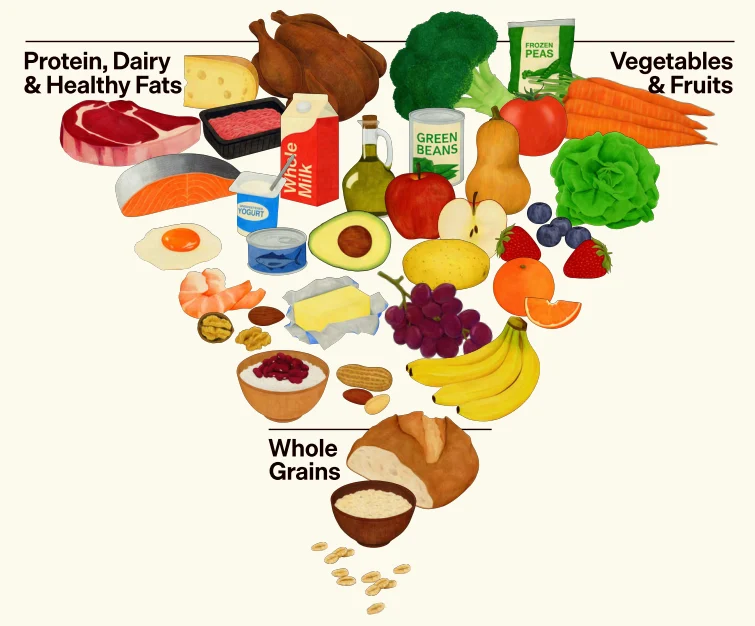
The release of the 2025–2030 Dietary Guidelines for Americans (DGAs) this week has ignited discussion and, for some, considerable confusion. With the overarching theme of "eat real food," the new guidelines aim to steer Americans toward healthier eating patterns, placing a more significant emphasis on limiting added sugars and highly processed foods. However, alongside these progressive directives, the unveiling of a new, inverted pyramid graphic has sparked debate, particularly concerning its depiction of foods rich in saturated fats. This visual representation, alongside the detailed written recommendations, presents a complex picture that warrants careful examination.
A Shifting Landscape in Nutritional Guidance
The DGAs, a cornerstone of U.S. nutrition policy, are updated every five years by the U.S. Departments of Agriculture (USDA) and Health and Human Services (HHS). These guidelines serve as the scientific basis for federal food, nutrition, and health policies and programs, influencing everything from school lunch menus to public health campaigns. The process of their development is intended to be rigorous, involving an independent Dietary Guidelines Advisory Committee (DGAC) that reviews the latest scientific evidence.
For the 2025–2030 cycle, the DGAC’s comprehensive Scientific Report was submitted to USDA and HHS. This report synthesized years of research, offering recommendations that leaned towards plant-forward diets, emphasized whole foods, and continued to advocate for reduced intake of added sugars, saturated fats, and sodium. However, in a departure from previous cycles, the administration chose not to adopt the DGAC’s report in its entirety. Instead, a supplemental scientific analysis was commissioned and conducted by a group selected through a federal contracting process. This decision has drawn criticism regarding transparency and potential influences on the final guidelines.
Key Tenets of the 2025–2030 DGAs
At its core, the 2025–2030 DGAs champion the consumption of "real food," a principle that translates into specific recommendations:
-
Targeting Highly Processed Foods: For the first time, the DGAs explicitly identify and recommend limiting "highly processed foods." While the term itself can be somewhat broad, the guidelines specify avoiding sugar-sweetened beverages, salty or sweet packaged snacks, and ready-to-eat meals. This extends to a focus on whole, fiber-rich grains over refined carbohydrates like white bread, aligning with a growing body of research on the health impacts of ultra-processed items.
-
Stricter Limits on Added Sugars: The new guidelines adopt an even more stringent stance on added sugars. They state that "no amount of added sugars or non-nutritive sweeteners is recommended or considered part of a healthy or nutritious diet." Practically, this translates to a recommendation that no single meal should exceed 10 grams of added sugars. This is a significant reduction from the previous DGA’s limit of 10% of total daily calories (approximately 50 grams for a 2,000-calorie diet). Furthermore, the age at which children are advised to avoid added sugars has been raised from age 2 to age 10, reflecting growing concerns about early childhood exposure to excessive sweetness.
-
Enduring Saturated Fat Recommendations: Despite the visual prominence of saturated-fat-rich foods in the new pyramid graphic, the written guidelines maintain the long-standing recommendation to limit saturated fat to no more than 10% of total daily calories. For a 2,000-calorie diet, this equates to roughly 22 grams of saturated fat per day.
-
Revised Protein Intake Recommendations: The 2025–2030 DGAs suggest an increased protein intake for adults, recommending 1.2 to 1.6 grams of protein per kilogram of body weight per day. This represents a 50% to 100% increase over previous minimum intake recommendations. While protein needs are indeed variable, this adjustment has raised questions about the emphasis on quantity over quality, especially given that many Americans already consume sufficient protein.
-
A Call for Less Alcohol: The guidelines offer a general directive to "consume less alcohol for better health." However, the absence of concrete numerical limits leaves room for interpretation regarding what constitutes "less."
The Conundrum of the Inverted Pyramid
The most visually striking element of the new DGA release is its inverted pyramid graphic. This design choice, intended to be a modern reimagining of dietary guidance, places foods such as steak, full-fat milk, and butter at its apex, suggesting a prominent role in the diet. This visual emphasis, experts argue, creates a dissonance with the written guidance on limiting saturated fat.
Dr. Frank Hu, Professor of Nutrition and Epidemiology and Chair of the Department of Nutrition at the Harvard T.H. Chan School of Public Health, highlighted these concerns. "I think the new Guidelines move in the right direction by reinforcing the importance of reducing added sugars and cutting back on refined grains and other highly processed foods," Dr. Hu stated. "However, there appear to be several contradictions within the DGAs and between the DGAs and the new pyramid. The mixed messages surrounding saturated-fat-rich foods such as red meat, butter, and beef tallow may lead to confusion and potentially higher intake of saturated fat and increased LDL cholesterol and cardiovascular risk."
The graphic also depicts a relatively smaller proportion for whole grains compared to other food groups, despite the written guidelines recommending 2-4 servings per day. This, too, is seen as a potential point of confusion for consumers seeking clear direction.
Analyzing the Nuances and Potential Implications
The divergence between the visual messaging of the pyramid and the detailed written recommendations is a significant point of contention. Images and taglines often have a greater recall value for the public than the nuanced details within lengthy documents. This is precisely why organizations like the Harvard T.H. Chan School of Public Health have historically developed their own visual aids, such as the Healthy Eating Plate and the earlier Healthy Eating Pyramid, to offer clear, actionable guidance.
Saturated Fat: A Closer Look at the Math
The 10% saturated fat limit for a 2,000-calorie diet translates to approximately 22 grams. Let’s consider the potential intake from full-fat dairy options often featured in the new pyramid:
- One 8-ounce cup of whole milk: ~5 grams of saturated fat
- Three-quarters cup of full-fat Greek yogurt: ~6 grams of saturated fat
- One ounce of cheddar cheese: ~6 grams of saturated fat
These three dairy servings alone account for approximately 17 grams of saturated fat. Adding a single tablespoon of butter (7 grams) or beef tallow (6 grams), both suggested cooking fats, pushes the total well over the 22-gram limit, even before accounting for any saturated fat from protein sources or other foods consumed throughout the day. This mathematical breakdown underscores the challenge consumers may face in adhering to the saturated fat recommendation when presented with prominent visuals of these higher-fat foods.
The "Protein Package" Dilemma
The increased recommended protein intake has also raised questions. While protein is essential, its "package"—the accompanying fats, fiber, sodium, and other nutrients—plays a crucial role in overall health. The DGAs mention a "variety of protein foods" from both animal and plant sources, but lack clear guidance on prioritizing options with more favorable health profiles.
Dr. Hu notes, "Evidence continues to suggest that plant-based proteins and fish are associated with more favorable health outcomes than diets high in red meat." This is particularly relevant given the saturated fat concerns, as red meat and some processed meats are significant sources of saturated fat. The absence of explicit direction on choosing leaner protein sources or prioritizing plant-based alternatives could lead to unintended consequences for cardiovascular health.
Transparency and Influence in DGA Development
The process leading to the 2025–2030 DGAs has been marked by controversy regarding transparency. The decision to bypass the DGAC’s report in favor of a supplemental analysis, and the subsequent questions surrounding the selection and potential biases of the reviewers in this supplemental analysis, have cast a shadow over the guidelines. Reports have emerged highlighting financial ties between some reviewers of the supplemental analysis and the beef and dairy industries, leading to concerns about industry influence on recommendations that prominently feature these products.
Deirdre Tobias, an assistant professor at the Harvard Chan School who served on the 2025-2030 DGAC, expressed these concerns in a Harvard Chan News Q&A: "As of today, there has not been transparency in who wrote the new DGAs… The reviews themselves, as well as their overall presentation and integration, deviate significantly from the rigorous process that the HHS developed for the DGAs to ensure the evidence base and its committees’ conclusions were replicable, unbiased, transparent, and free from non-scientific influences."
Broader Implications and Future Directions
The omission of environmental and socioeconomic factors from the DGAs also remains a significant concern. Dietary choices have profound impacts on the environment, and conversely, food access and choices are heavily influenced by socioeconomic and cultural contexts. A comprehensive approach to nutrition guidance would ideally integrate these critical considerations.
Historically, adherence to the DGAs by the American public has been a challenge, with many Americans not following the established guidelines. The success of the 2025–2030 edition will depend not only on the clarity and consistency of its messaging but also on effective public health campaigns and accessible resources.
For consumers seeking to navigate these new guidelines, the conflicting messages, particularly surrounding saturated fats, can be disorienting. Consulting resources like the Harvard Healthy Eating Plate or seeking personalized advice from a registered dietitian may offer a clearer path towards making informed and healthy dietary choices. The "eat real food" mandate is a commendable goal, but its practical implementation requires clear, consistent, and evidence-based guidance that empowers individuals to make beneficial choices for their long-term health and well-being. The ongoing dialogue surrounding these guidelines underscores the dynamic nature of nutritional science and the critical importance of transparency and scientific integrity in shaping public health policy.
