
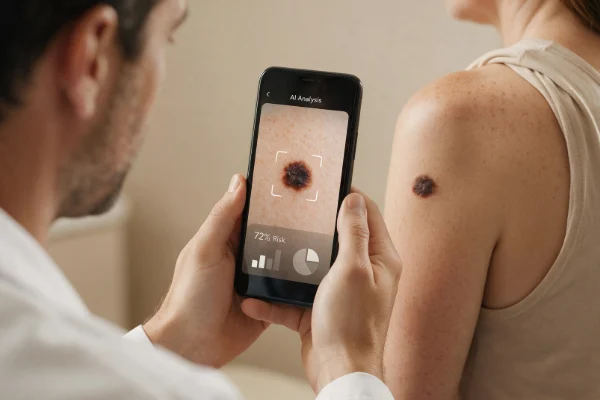
The intersection of artificial intelligence and healthcare continues to provoke intense debate, particularly regarding how patients perceive the value and reliability of automated diagnostic tools. A recent study conducted in the Netherlands has provided empirical insight into this dynamic, revealing that artificial intelligence tools designed for skin cancer detection are valued significantly higher by the public when they are supported and validated by a human teledermatologist. As healthcare systems globally grapple with integration timelines for machine learning technologies, understanding patient valuation, trust, and willingness to pay becomes paramount for policymakers, developers, and clinical practitioners alike.
The research, structured as a survey-based mixed-methods investigation embedded within a randomized controlled trial, sought to quantify consumer attitudes toward varying tiers of diagnostic support. Between August 2022 and February 2023, investigators reached out to a broad demographic pool across the Netherlands to gauge financial valuation and qualitative perceptions of modern dermatological screening methods. Out of 11,621 individuals formally invited to participate in the study, a total of 1,953 completed the comprehensive questionnaire.
Demographic analysis of the respondent pool indicated a mean participant age of 58.4 years, reflecting a population demographic that is statistically more vulnerable to dermatological malignancies and skin conditions. Women comprised 57.6 percent of the final cohort, while an overwhelming 95.4 percent of respondents self-reported possessing a light skin type, a well-established risk factor for various forms of skin cancer, including melanoma. Furthermore, the educational background of the participants skewed notably high, with nearly half reporting advanced academic credentials. Familiarity with digital health technology was also prevalent among the cohort, as 79.4 percent noted that they had previously utilized an artificial intelligence-based application for health or lifestyle tracking.
Methodological Framework and Valuation Metrics
The core objective of the investigation was to assess the financial valuation—measured as willingness to pay—across three distinct, hypothetical modalities for skin cancer risk detection. These modalities formed a gradient of human-to-machine integration: an autonomous artificial intelligence-based application operating entirely without human intervention, an artificial intelligence app operating in tandem with review and verification by a teledermatologist, and a traditional, in-person consultation with a physical dermatologist.
When presented with these scenarios, participants revealed a clear hierarchy of financial valuation that heavily favored human clinical oversight. The median willingness to pay for an autonomous, AI-only detection application stood at a modest five euros. This figure quadrupled when teledermatologist involvement was introduced into the workflow, with the median willingness to pay rising to twenty euros. However, the highest valuation was reserved for conventional medical practice, with respondents reporting a median willingness to pay of fifty euros for a face-to-face consultation with a certified dermatologist.
Statistical regression models utilized within the study evaluated various demographic and behavioral characteristics to determine which factors influenced these financial valuations. Intriguingly, age emerged as the sole characteristic that showed a consistent, positive association with willingness to pay across all three tested scenarios. Older participants, despite often being stereotyped as hesitant toward digital transformation, demonstrated a higher financial valuation for health screening tools broadly, which researchers attribute to an increased health consciousness or a higher perceived personal risk profile regarding dermatological diseases. Conversely, other variables such as prior app usage or educational attainment did not exhibit a uniform positive correlation across every tested modality.
Qualitative Insights and Underlying Trust Deficits
Beyond quantitative financial metrics, the study incorporated qualitative assessments to unpack the underlying reasoning behind participant responses. The feedback provided critical context for why autonomous artificial intelligence applications garnered such low financial valuations compared to their hybrid and human counterparts.
A predominant theme emerging from the qualitative data was a pervasive, underlying skepticism regarding the diagnostic accuracy and safety of unassisted algorithms. Many participants expressed reservations that extended beyond simple technological illiteracy, pointing instead to a perceived lack of clinical empathy, contextual awareness, and accountability inherent in software-only solutions. Respondents frequently noted that a photograph analyzed by an algorithm alone could miss critical contextual nuances, such as tactile sensations, changes over time that are poorly captured by static imagery, or localized patient symptoms that require clinical dialogue.
Additionally, the qualitative analysis highlighted systemic expectations surrounding healthcare financing. A notable segment of respondents indicated that their low willingness to pay for digital health tools stemmed from the expectation that medically necessary screenings should be fully covered by standard health insurance packages rather than out-of-pocket consumer spending. Others simply questioned the intrinsic value of software applications when compared against the gold standard of physical, tactile examinations performed by medical specialists.
Background Context and Chronology of the Research
The investigation into patient perceptions of algorithmic dermatology arrives at a critical juncture in the evolution of digital health. Over the past decade, rapid advancements in computer vision and deep learning have catalyzed the development of numerous direct-to-consumer mobile applications designed to screen for melanoma and other skin lesions. Proponents of these technologies argue that they democratize access to preliminary diagnostics, reduce unnecessary in-person clinic visits, and alleviate the burden on strained healthcare systems where wait times for specialist dermatologists can stretch for months.
The timeline of the Dutch study—spanning the late summer of 2022 through the winter of 2023—coincided with a broader post-pandemic surge in the adoption of telehealth and remote monitoring services. During this period, regulatory bodies in Europe and North America wrestled with how to classify, evaluate, and approve software as a medical device (SaMD). While technical validation studies consistently demonstrate that advanced neural networks can match or occasionally exceed the diagnostic accuracy of general practitioners in controlled settings, real-world adoption has consistently lagged behind technological capability.
The integration of teledermatology as a middle tier represents an industry-wide effort to bridge the trust gap. By embedding a human medical professional into the review loop—ensuring that an algorithm’s output is verified by a specialist before a patient receives definitive guidance—developers and healthcare providers hoped to reassure consumers. The findings from the Netherlands validate this strategic pivot, proving that the introduction of a teledermatologist quadruples consumer valuation compared to unassisted artificial intelligence.
Industry Implications and Clinical Analysis
The implications of these findings extend far beyond consumer economics, offering vital strategic lessons for healthcare providers, software developers, and public health policymakers.
For commercial entities developing direct-to-consumer health applications, the data serves as a stark commercial warning. A standalone business model relying strictly on autonomous artificial intelligence encounters significant consumer resistance and low perceived value. Users are evidently unwilling to invest substantial personal capital in a software tool that lacks human validation. Consequently, future product roadmaps within the digital health sector are likely to pivot decisively toward hybrid service delivery models. By structuring applications as teledermatology triage platforms—where artificial intelligence acts as a high-speed sorting mechanism rather than an autonomous diagnostician—companies can align their offerings with consumer trust expectations.
From a clinical perspective, the persistent preference for in-person consultations—reflected in the fifty-euro median valuation—underscores the irreplaceable nature of the physical physician-patient relationship. Dermatology is inherently a visual and tactile medical discipline; dermatologists rely not only on visual inspection under specialized lighting but also on palpation to assess the depth, texture, and induration of cutaneous lesions. Artificial intelligence, constrained by two-dimensional photographic inputs, cannot replicate this comprehensive physical examination.
Furthermore, healthcare economists point out that patient willingness to pay serves as a reliable proxy for perceived clinical utility. The steep drop in valuation from an in-person visit to an AI-assisted remote review suggests that while patients recognize the efficiency of digital triage, they still view it as an inferior substitute for comprehensive physical care. For public health authorities designing reimbursement policies, this divergence dictates caution. Insurers and national health services must carefully evaluate how to subsidize hybrid digital tools without undermining public confidence in comprehensive medical evaluations.
Broader Regulatory and Ethical Considerations
As artificial intelligence systems become more deeply embedded in the diagnostic pathway, regulatory frameworks must adapt to address the nuances highlighted by patient valuation studies. Issues of liability, data privacy, and transparency remain at the forefront of policy discussions. When a teledermatologist reviews and confirms an artificial intelligence-generated risk assessment, questions of medical malpractice and diagnostic responsibility become complex. Determining whether liability rests with the software vendor, the reviewing teledermatologist, or the primary healthcare provider is a legal frontier that courts and regulatory agencies are only beginning to navigate.
Moreover, the demographic composition of the study’s participant pool—specifically the high percentage of individuals with light skin types—highlights a longstanding systemic challenge within dermatological artificial intelligence: algorithmic bias. Most existing machine learning models have been trained primarily on datasets comprising Fitzpatrick skin types I through III, resulting in significantly lower diagnostic accuracy when applied to darker skin tones. While the Dutch study’s participant demographic accurately reflects the national population distribution of the Netherlands, it underscores the urgent need for future research to evaluate how patients of diverse racial and ethnic backgrounds perceive and value artificial intelligence tools that may historically have been less reliable for their specific physiological profiles.
Conclusion and Future Directions
The Dutch investigation provides a vital empirical baseline for understanding how modern consumers evaluate the blending of artificial intelligence and human medical expertise. By demonstrating that public willingness to pay jumps markedly when an algorithm is backed by a teledermatologist, the research confirms that human oversight remains the decisive factor in establishing consumer trust and market viability for digital health tools.
As the medical community continues to test, refine, and deploy machine learning diagnostics, the path forward appears clear. Autonomous artificial intelligence in dermatology is unlikely to replace clinical judgment in the near term, nor is it viewed by patients as a standalone solution for serious health concerns. Instead, the future of dermatological care lies in synergistic models where advanced algorithms enhance clinical efficiency, reduce preliminary diagnostic bottlenecks, and empower teledermatologists to deliver faster, safer, and more trusted care to patients in need.
