

China has officially cemented its ambition to spearhead the future of global food production, releasing a comprehensive strategic framework aimed at revolutionizing agrifood systems through artificial intelligence and sustainable technology. Announced at the conclusion of the World Agri-Food Innovation (WAFI) conference in Beijing’s Pinggu District, the newly published "Pinggu Consensus" outlines six core objectives designed to pivot the nation’s immense agricultural infrastructure toward a green, technology-driven future.
The high-profile summit drew international policymakers, leading researchers, agritech investors, and global food industry stakeholders to deliberate on the critical intersection of food security, climate change, and economic modernization. Central to these discussions was the accelerated integration of artificial intelligence and the mainstream adoption of alternative proteins—spanning plant-based, fermentation-derived, and cell-cultured foods—as vital pillars for planetary and public health.
Background and Context: The Evolution of China’s Agrifood Strategy
For decades, China has faced the immense challenge of feeding approximately 20% of the global population with less than 10% of the world’s arable land and roughly 6% of its freshwater resources. Traditional livestock farming, while central to historical dietary needs, exerts a heavy ecological toll, consuming massive quantities of grain, water, and energy while contributing significantly to greenhouse gas emissions.
Recognizing these structural limitations, Beijing has steadily elevated food security to a matter of national sovereignty. In recent years, the Chinese government has increasingly turned to high-tech interventions, viewing agriculture not merely as a traditional primary industry, but as a high-tech frontier ripe for industrial upgrading. The WAFI conference served as the premier stage to operationalize this vision, bringing together domestic ministries and international thought leaders to forge a unified path forward.
Chronology of the WAFI Summit and the Birth of the Pinggu Consensus
The path to the Pinggu Consensus was paved over several days of intensive panels, keynote presentations, and bilateral meetings in Beijing’s Pinggu District.
- Day One: Discussions opened with a heavy focus on the vulnerabilities of global supply chains and the pressing need to decouple food production from resource degradation. Experts highlighted the staggering resource inefficiencies inherent in conventional animal agriculture.
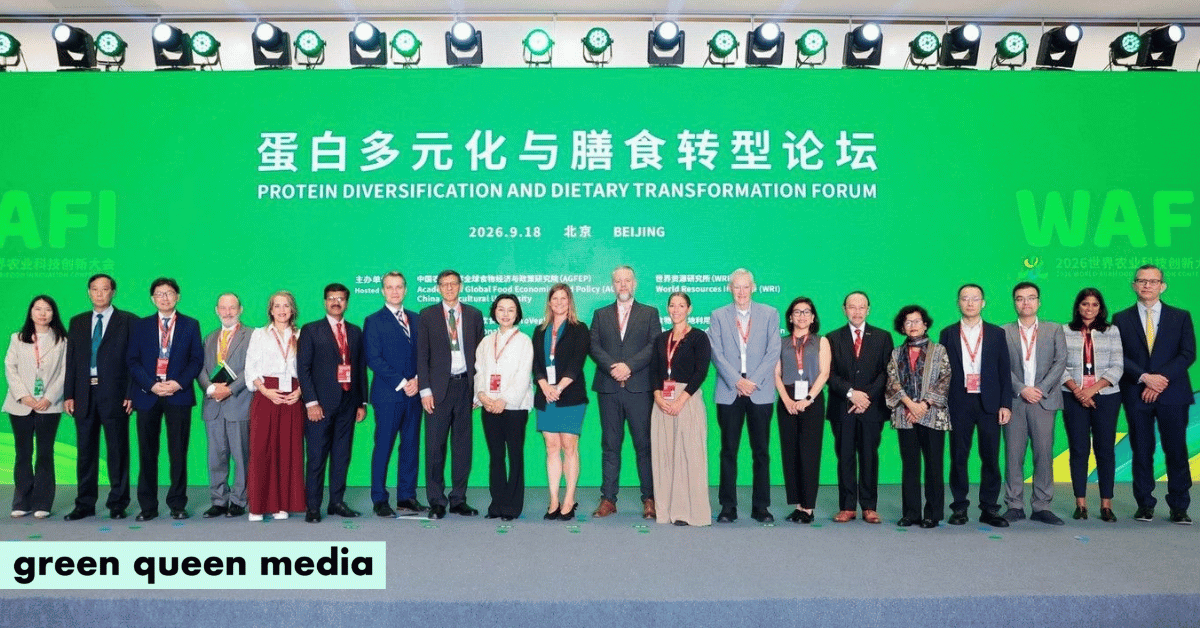
- Day Two: The spotlight shifted to protein diversification. Bruce Friedrich, founder and president of the Good Food Institute (GFI), delivered a landmark keynote address at the Protein Diversification and Dietary Transformation Forum, drawing direct parallels between the renewable energy revolution and the future of food.
- Final Day: The summit culminated in the official publication of the Pinggu Consensus by Chinese government officials and conference participants, establishing a formal blueprint for agrifood transformation.
The Six Core Objectives of the Pinggu Consensus
The Pinggu Consensus establishes a rigorous, multifaceted roadmap divided into six foundational pillars:
- Advanced Resource-Recycling and Food Waste Reduction: The first objective mandates deep innovations in circular economic models. By minimizing food loss across every stage of the supply chain and advancing waste-conversion technologies, policymakers aim to fortify the baseline of national and international food security.
- AI-Driven Agricultural Transformation: The second goal focuses on leveraging artificial intelligence to reshape the global agricultural landscape. This entails constructing sophisticated digital application systems, bolstering foundational data infrastructure, and ensuring inclusive technological access through cross-sector collaboration to build a resilient agrifood sector.
- Ecosystem Protection and Input Optimization: Acknowledging the ecological strain of modern farming, the third objective calls for the strict control of resource inputs, the safeguarding of arable land ecosystems, and the synchronization of food production with ecological conservation and enhanced farmer livelihoods.
- Nutritional Research and Industrial Scaling: The fourth pillar links agrifood modernization directly to public health. It emphasizes upgrading nutritional research, refining industry standards, expanding consumer guidance, and simultaneously scaling up novel food industries to elevate societal nutrition.
- Global South Collaboration and Grassroots Innovation: Recognizing that food security is a global challenge, the consensus champions strengthened agricultural cooperation across the Global South. It prioritizes the rapid dissemination of advanced technologies and the international expansion of China’s "Science and Technology Backyard" initiative to foster grassroots research and educational integration.
- High-Level Policy Coordination and Action: The final objective underscores the necessity of high-level policy dialogue. By convening diverse stakeholders, aligning international development strategies, and sharing best practices, the framework seeks to rapidly translate theoretical consensus into practical, scalable execution.
Parallels to the Green Energy Playbook: Insights from Industry Leaders
A defining theme of the summit was the strategic comparison between China’s dominance in electric vehicles (EVs) and solar power, and its emerging trajectory in alternative proteins.
"New proteins are the food equivalent of renewable energy," Bruce Friedrich asserted during his keynote. Friedrich emphasized that the proven industrial playbook China utilized to become the world’s undisputed leader in green energy manufacturing can be—and is already being—applied to protein diversification.
This sentiment was reinforced by findings from a recent report published by the Good Food Institute Asia-Pacific (GFI APAC). According to the think tank, China is uniquely positioned to scale alternative proteins because of its advanced manufacturing capabilities. Rather than building novel infrastructure from scratch, the country is actively repurposing its world-leading pharmaceutical production network to manufacture novel food ingredients. Analysts note that government backing combined with private sector agility positions Chinese manufacturers to produce alternative proteins at competitive price points unmatched globally.
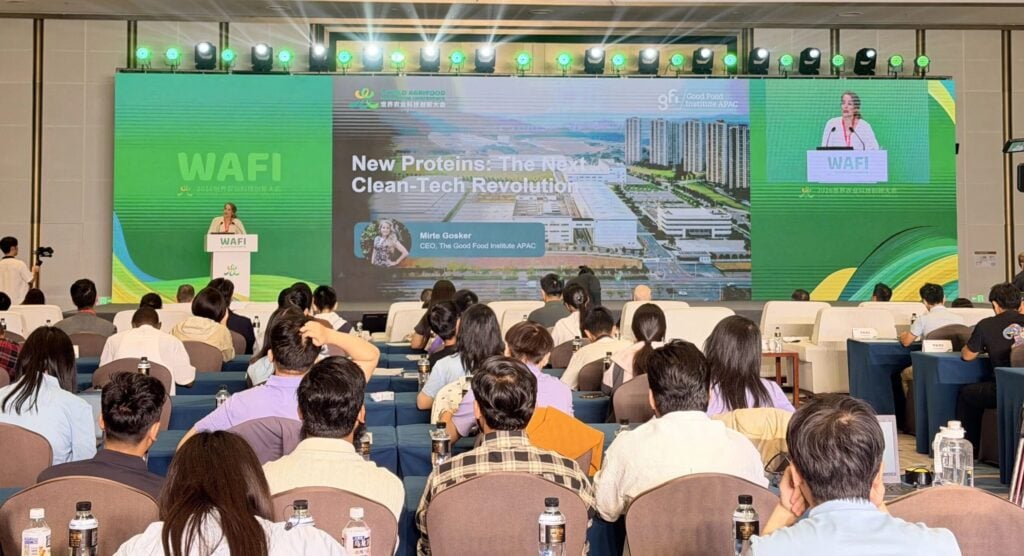
Mirte Gosker, CEO of GFI APAC, underscored this strategic urgency during the World Youth Forum at WAFI. Gosker pointed out that treating alternative protein manufacturing and R&D as a matter of national strategic priority—much like solar energy and EVs—will not only secure long-term domestic food supplies but also unlock decades of economic growth and catalyze the global protein transition.
Fact-Based Analysis: Implications of Top-Down Policy Implementation
The weight of the Pinggu Consensus lies not merely in its aspirational language, but in the unique mechanics of Chinese policy implementation. Unlike decentralized markets where agricultural transitions rely entirely on consumer demand shifts, China’s industrial strategies operate through a structured, top-down mechanism.
When Beijing identifies a strategic sector, national policy decisions are established at the highest levels of government and systematically cascaded down to national, provincial, and municipal authorities. This coordinated alignment ensures that land-use policies, subsidies, research grants, and regulatory approvals move in unison.
By integrating AI into manufacturing and explicitly recognizing the ecological inefficiencies of traditional livestock, the Pinggu Consensus signals to domestic conglomerates and international investors that alternative proteins and agrifood tech are officially sanctioned areas for massive capital allocation. Analysts suggest this framework will dramatically shorten commercialization timelines for cultivated meat, precision fermentation, and advanced plant-based products originating in China.
Broader Global Impact and the Road to 2050
The publication of the Pinggu Consensus arrives at a critical juncture for global climate and food security discussions. With agriculture accounting for roughly one-third of global greenhouse gas emissions, traditional pathways are increasingly viewed as incompatible with international climate targets.

Recent analytical reports, including an April study published by Systemiq and the Gordon and Betty Moore Foundation, have explicitly mapped out China’s potential pathway to becoming an alternative protein leader by 2050. These studies indicate that early indicators point toward a systematic industrial rollout in agriculture mirroring the rapid transitions witnessed in China’s mobility and energy sectors.
As the Global AgriFood Innovation Alliance and international research partners begin operationalizing the proposals outlined in Beijing, the Pinggu Consensus may well serve as the foundational text that bridges the gap between traditional farming and the high-tech, sustainable food systems of the twenty-first century.
