

The landscape of American food safety regulation is undergoing its most profound transformation in decades. As the US Food and Drug Administration (FDA) moves forward with monumental proposals to dismantle the traditional Generally Recognized as Safe (GRAS) self-affirmation pathway, food producers, ingredient manufacturers, and regulatory compliance firms are bracing for severe operational bottlenecks. In response to this impending regulatory crunch, scientific assessment firm SciPinion has officially launched the SciBridge Safety Suite, an artificial intelligence-enabled toolkit designed to streamline the process of proving ingredient similarity to established FDA-cleared precedents in a matter of minutes.
The introduction of SciBridge arrives at a precarious time for the food and beverage sector. For over half a century, the food industry has relied heavily on the GRAS mechanism—established by Congress in 1958 and expanded with self-affirmation provisions in 1972—to bring novel ingredients and additives to market efficiently. However, growing political and public scrutiny regarding ultra-processed foods and regulatory oversight has placed the self-affirmation pathway squarely in the crosshairs of federal policy change.
Background Context and Regulatory Evolution
The origins of the current regulatory turbulence trace back to decades-old statutory frameworks governing food additives. Under the original 1958 Food Additives Amendment, any substance intentionally added to food is deemed a food additive and requires pre-market approval by the FDA, unless it is generally recognized among qualified experts as safe under its conditions of use. In 1972, the agency introduced the GRAS self-affirmation process, allowing companies to independently determine the safety of their substances without mandatory prior notification to or formal review by the federal government.
While this self-affirmation pathway offered a cheaper and significantly faster route to commercialization, critics have increasingly characterized it as a regulatory loophole. High-profile figures, including US Health and Human Services officials and prominent health advocates like Robert F. Kennedy Jr., have frequently targeted the practice, arguing that it lacks sufficient transparency and public oversight. Compounding these criticisms, the sheer volume of modern food innovations—ranging from precision-fermented proteins to novel alternative fats—has strained the FDA’s capacity. Historically, the agency evaluates roughly 75 formal GRAS notices annually, with each individual review cycle taking up to 180 days or longer.

The turning point arrived in August, when the FDA published a sweeping proposed rule to completely scrap the self-affirmation pathway. If finalized, the new rule will mandate that all food producers submit formal GRAS notifications directly to the agency, complete with comprehensive scientific dossiers detailing how their ingredients were determined to be safe.
The Impending Administrative Backlog
The operational consequences of this proposed regulatory pivot cannot be overstated. Industry analysts and government officials alike predict that forcing every manufacturer to undergo a formal agency review will trigger a colossal backlog, suffocating the FDA’s human foods program and delaying the commercial rollout of innovative ingredients.
These concerns were underscored during recent legislative proceedings. Testifying before senators in a confirmation hearing, Heidi Overton—President Donald Trump’s nominee for the next FDA commissioner—freely acknowledged the impending operational strain. Overton admitted that the agency would require a massive infusion of resources into its human foods program simply to cope with the influx of mandatory notifications.
Recognizing that the agency’s internal resources will be stretched to their absolute limits, food firms have begun scrambling for solutions. Vanessa Feher Castagna, SciPinion’s director of food safety and claims, noted that the FDA’s own proposed rule explicitly invites comments on how to facilitate the use of data from previously submitted GRAS notices—a strategic opening that directly inspired the architectural framework of the SciBridge suite.
Decoding the SciBridge Safety Suite
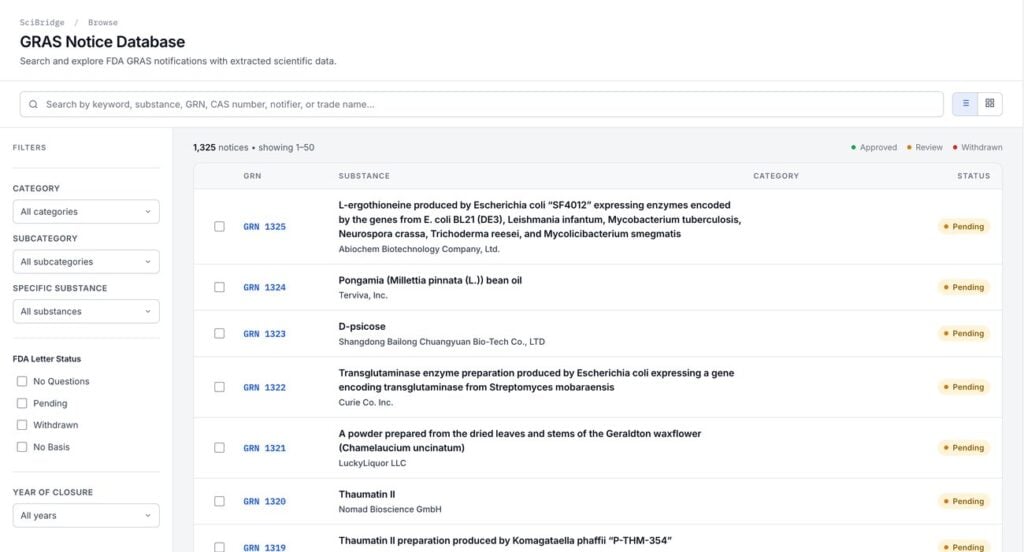
SciBridge is engineered to target a specific, highly valuable provision embedded within the FDA’s proposed regulatory overhaul. Under the draft rules, companies are exempt from submitting a brand-new, ground-up GRAS notice if a previous notification already covers their specific ingredient, provided that it utilizes the exact same manufacturing process, meets identical purity parameters, adheres to the same conditions of intended use, and has successfully secured a "no questions" letter from the FDA.
However, capitalizing on these exemptions is far from straightforward. Proving that a new preparation shares "substantial similarity" to an FDA-cleared precedent requires rigorous, field-by-field scientific documentation regarding identity, purity, and functionality. Traditionally, conducting these comparative assessments manually can take months of expert labor and rack up hundreds of thousands of dollars in consulting fees.
Dennis Keefe, former director of the FDA’s Office of Food Additive Safety, highlighted the sheer complexity of the challenge. According to Keefe, demonstrating equivalence among different preparations of similar substances demands high-level scientific expertise, which historically has made GRAS reviews exceptionally time-intensive.
To dismantle this barrier, SciPinion’s SciBridge suite combines specialized artificial intelligence software with professional human expert oversight. The platform is structured around three core operational modules:
- Browse: A synchronized, highly structured index of the entire historical GRAS notice database, equipped with an advanced side-by-side comparison utility.
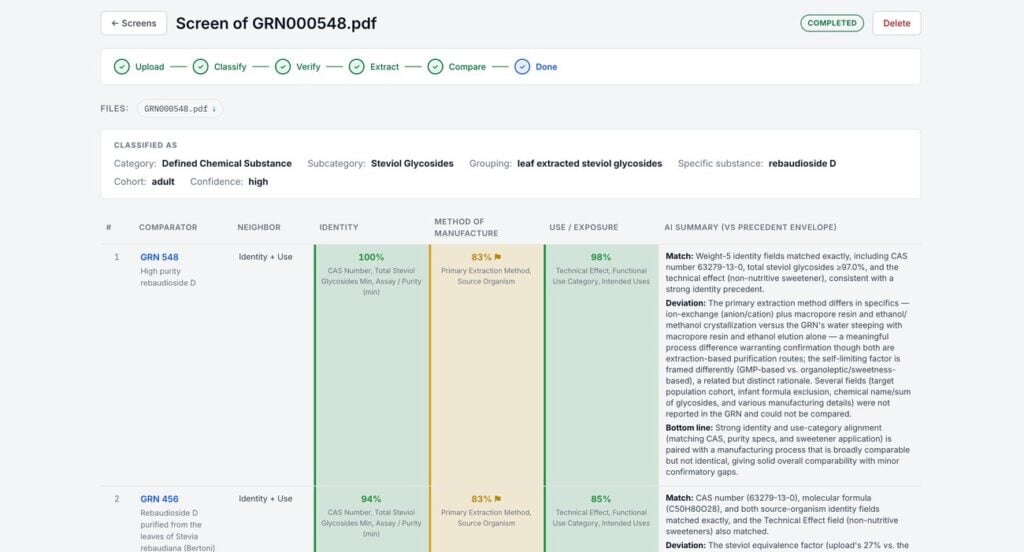
- Screen: A rapid similarity-screening engine that automatically ranks a novel substance against established precedent notices.
- Bridge: A rigorous, field-by-field substantial similarity evaluation tool capable of comparing an ingredient against up to three distinct historical comparators, complete with a downloadable report and a fully traceable audit trail.
According to SciPinion CEO Sean Hays, the platform effectively condenses months of painstaking manual research into an automated, defensible similarity report generated in approximately 10 minutes. "What makes SciBridge’s report something you can put in front of a regulator is the method: our platform fixes the comparison approach before it ever sees your ingredient," Hays explained.
Industry Reception and Broader Implications
The introduction of AI-driven compliance tools has drawn cautious optimism from regulatory consultants, legal professionals, and pioneering food-tech companies alike. Among the early adopters and vocal supporters of structured data navigation is TurtleTree, a prominent precision-fermentation enterprise backed by Novonesis that secured an FDA "no questions" letter for its animal-free lactoferrin last year.
Aletta Schnitzler, Chief Scientific Officer at TurtleTree, reflected on the historical hurdles of navigating the regulatory landscape. "At the time when we achieved GRAS for our recombinant bovine lactoferrin, there was no template for proving substantial similarity to an existing ingredient," Schnitzler said. "Our teams never lacked data—the entire GRAS record is public. What the industry lacked was a structured way to navigate the key information in the regulatory data. SciBridge is the only tool I’ve seen that uses the FDA record as the template itself."
Experts emphasize that the utility of SciBridge extends far beyond individual corporate cost-savings. By encouraging standardized, systematic data reviews, the toolkit offers a dual benefit: it relieves the crushing administrative burden on cash-strapped federal regulators while equipping industrial stakeholders with defensible documentation that bolsters consumer transparency and public trust.
As the public consultation period for the FDA’s proposed rule progresses, legal and regulatory analysts remain divided on whether the agency possesses the sweeping statutory authority to mandate GRAS notifications without explicit congressional intervention. Nevertheless, market pragmatism dictates that food producers will increasingly demand rigorous, audit-ready compliance pathways to eliminate regulatory ambiguity.
By fusing advanced machine learning algorithms with strict human scientific peer review, SciPinion’s SciBridge platform represents a significant evolutionary step in food safety management. As the regulatory ground shifts beneath the feet of American food producers, tools that bridge the gap between historical precedent and modern innovation may well become the defining prerequisite for commercial survival in the evolving food-tech economy.
