
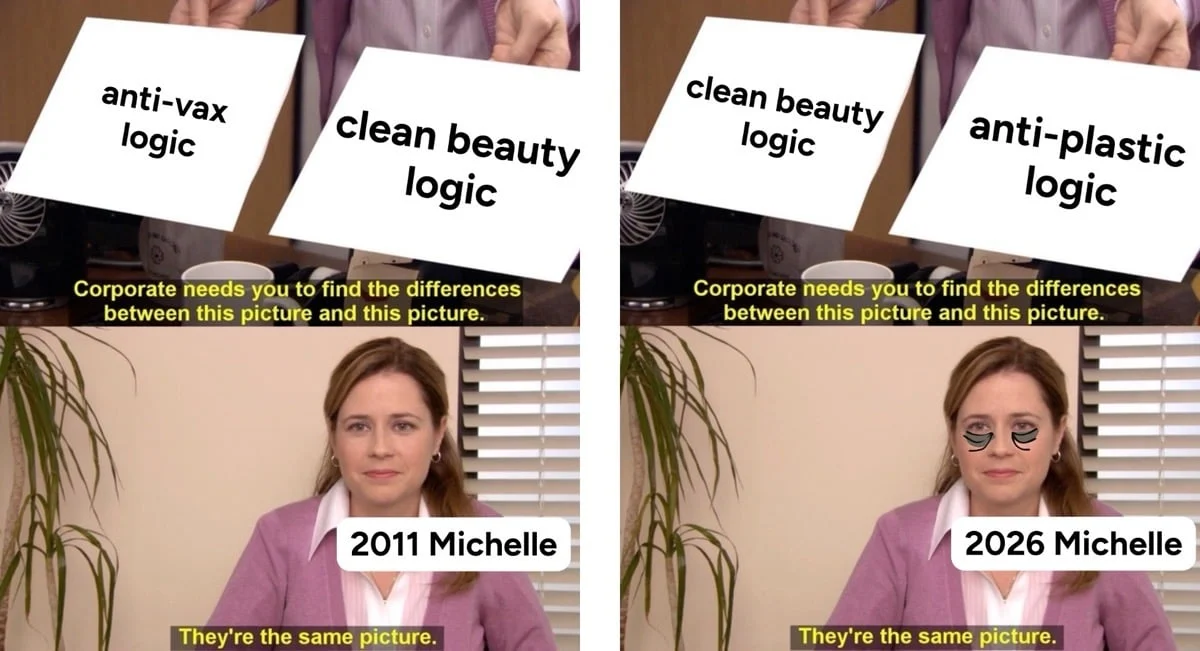
The modern consumer landscape is currently undergoing a significant ideological shift, pivoting away from traditional packaging and synthetic materials under the banner of environmental stewardship. Much like the clean beauty movement that gained immense momentum over the past decade, the contemporary anti-plastic crusade has captured public imagination, influencing purchasing habits, corporate marketing strategies, and regulatory discussions worldwide. However, scientific communicators and researchers are increasingly raising alarms that this well-intentioned movement mirrors the psychological and logical pitfalls of earlier pseudoscientific trends. By examining the structural parallels between anti-vax rhetoric, clean beauty marketing, and modern anti-plastic sentiment, experts argue that blanket rejections of synthetic materials often undermine actual human and environmental health goals.
The emergence of the clean beauty industry in the early 2010s established a playbook for marketing based on fear rather than evidence. Promoters of clean beauty popularized the "non-toxic" narrative, which demonized specific chemical substances—such as aluminum and formaldehyde—while ignoring fundamental toxicological principles, most notably the maxim that "the dose makes the poison." Over time, science communicators observed that the logic underpinning clean beauty shared a striking structural resemblance to anti-vaccine arguments. Both movements rely on appeals to nature, misinterpret scientific literature, and capitalize on public distrust of established industries.
Today, this exact paradigm is being replicated in the widespread demonization of plastics. Influencers and beauty brands increasingly rely on blanket "plastic-free" claims and generalized fearmongering regarding microplastics. While legitimate scientific concerns exist regarding the accumulation of plastic waste and the potential health impacts of microparticles, the mainstream discourse frequently overblows these risks. Just as removing "dirty" ingredients in skincare did not automatically lead to safer or more effective formulations, substituting plastics with alternative materials without empirical backing often generates counterproductive outcomes for sustainability and product safety.
The Appeal to Nature Fallacy in Modern Packaging
At the core of both the clean beauty movement and the anti-plastic trend lies the appeal to nature fallacy—the presupposition that anything natural is inherently safe and beneficial, while anything synthetic or man-made is inherently harmful. This binary worldview extends to bioplastics, which are marketed as eco-friendly solutions simply because their raw starting materials are derived from biological sources rather than petrochemicals.
From a scientific perspective, the origin of a substance does not dictate its physiological or environmental impact. Some of the most potent toxins and allergens known to science are entirely natural, whereas numerous synthetic compounds are thoroughly tested, highly stable, and safe for prolonged human use. When beauty brands market "plastic-free" alternatives as automatically superior, they commit the same logical error as clean beauty brands advertising products as "free from chemicals." Both assertions ignore the complex chemical reality of the substances in question.
Overlooking Sustainability Science and Life Cycle Assessments
A primary failing of the blanket anti-plastic movement is its tendency to disregard the foundational metrics of sustainability science. In professional environmental science, the gold standard for quantifying ecological impact is the Life Cycle Assessment (LCA). An LCA evaluates every phase of a product’s existence, including raw material extraction, manufacturing, distribution, utilization, and end-of-life disposal.
Public discourse surrounding plastics remains almost exclusively fixated on end-of-life impacts, such as marine pollution, landfill accumulation, and slow degradation rates. While these are critical environmental challenges, this narrow focus frequently overshadows climate change, which scientific consensus identifies as the single greatest threat to the global ecosystem. Paradoxically, plastic packaging often outperforms alternative materials like glass, aluminum, and paper when evaluated across a complete life cycle, particularly regarding carbon emissions and resource efficiency.
Comprehensive industry analyses have demonstrated that replacing plastic packaging with alternative materials can demand substantial increases in resource consumption. For instance, comprehensive manufacturing evaluations indicate that switching from flexible plastics to rigid alternatives can require significantly more raw material, higher energy expenditure during production, and markedly elevated carbon emissions due to increased transport weight. Plastics frequently win on climate metrics because their lightweight durability reduces fuel consumption during transit and minimizes product spoilage and food waste—factors that themselves carry massive environmental footprints.
Despite these empirical realities, beauty brands continue to promote alternative packaging materials while simultaneously driving high-volume consumption. Promotional strategies frequently feature limited-edition accessories, reusable items bundled with high-value purchases, or specialized bags constructed from synthetic textiles like nylon and polyester. Consumers frequently perceive these promotional items as environmentally superior purely because they deviate from traditional plastic bottles, highlighting a deep disconnect between marketing perception and actual environmental impact.
Methodological Flaws and Microplastic Research
Much of the current panic surrounding microplastics is fueled by studies suffering from severe methodological deficiencies. Measuring minute concentrations of synthetic polymers in complex biological matrices is exceptionally difficult, and many research groups lack the specialized analytical chemistry expertise required to prevent experimental artifacts.
A prominent example involves the widespread use of pyrolysis-gas chromatography-mass spectrometry (Py-GCMS) to quantify microplastics in human tissue samples. Under specific analytical conditions, endogenous biological fats can yield chemical signatures nearly identical to polyethylene unless rigorous corrective experiments are applied. Consequently, several high-profile studies have reported exaggerated microplastic concentrations, including dramatic claims regarding the accumulation of plastic particles in human brains.
Furthermore, environmental contamination represents a persistent vulnerability in microplastic research. Because microscopic synthetic fibers are ubiquitous in modern indoor environments, baseline contamination from laboratory equipment, protective gloves, and clothing frequently skews experimental results. When these flawed studies generate sensationalized headlines, they create a feedback loop of misinformation that is readily exploited by commercial entities seeking to market "plastic-free" alternatives.
Correlation Versus Causation in Health Studies
The leap from detecting microplastics in diseased human tissue to claiming those particles caused the pathology represents a fundamental misapplication of epidemiological principles. The detection of microplastics in arterial plaque or brain tissue samples from individuals with neurodegenerative conditions demonstrates correlation, not causation.
Alternative explanations for these findings are rarely considered in popular media reports. For instance, the presence of microscopic particles in compromised tissue could be a downstream consequence of the disease process itself, an artifact of sample preparation during diagnostic analysis, or a passive byproduct of living in an industrialized environment that has no direct pathogenic role. This exact pattern was observed during historical clean beauty controversies, such as the widely criticized study claiming to find parabens in breast tumors—a paper that notably failed to measure paraben levels in healthy control tissues.
Science-Washing and Motivated Reasoning
The commercialization of anti-plastic sentiment has given rise to a specialized form of corporate deception known as "science-washing." Similar to the fitness and wellness sectors, the beauty industry frequently utilizes cherry-picked data, simplified narratives, and sympathetic experts to validate commercial claims. Regulatory bodies in major jurisdictions, including the United States Federal Trade Commission (FTC), the United Kingdom Competition and Markets Authority (CMA), and the Australian Competition and Consumer Commission (ACCC), have increasingly targeted unsubstantiated sustainability claims as misleading and deceptive practices.
Despite regulatory crackdowns, identity-based motivated reasoning continues to distort public understanding. When major journalistic outlets or scientific institutions publish critical evaluations of flawed microplastic research—such as recent investigative reporting by The Guardian casting doubt on sweeping human contamination claims—they frequently face aggressive backlash from consumer advocacy groups and online commentators. Critics often dismiss these corrections by alleging financial conflicts of interest or ties to petrochemical industries, a phenomenon that runs counter to genuine critical thinking. As scientific analysts have noted, dismissing empirical evidence or methodological critiques solely based on the institutional affiliation of the researchers is a logical fallacy that prevents objective scientific discourse.
Ultimately, while society undeniably faces legitimate challenges regarding waste management and the environmental persistence of synthetic polymers, a reactionary, evidence-free war on plastics achieves little. Moving past performative greenwashing requires the same rigorous, data-driven scrutiny that scientists have long advocated for in chemical safety and environmental policy. True sustainability demands holistic lifecycle evaluations rather than dogmatic adherence to simplified ideological narratives.
