
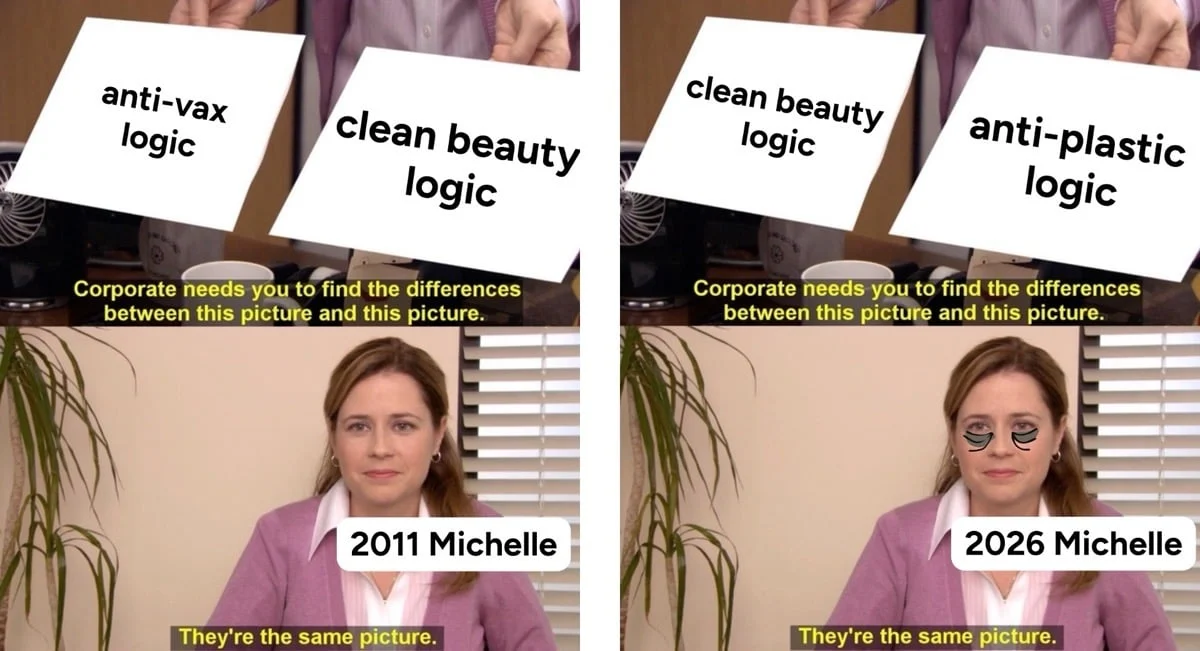
The global consumer goods market is witnessing a profound ideological shift as the cultural anxieties once driving the clean beauty movement migrate toward a broader crusade against synthetic polymers. Over the past decade, the wellness and cosmetics sectors have been dominated by "non-toxic" marketing narratives, which demonized chemical compounds such as aluminum and formaldehyde through frameworks frequently criticized by the scientific community as pseudoscientific. Today, that exact rhetorical architecture is being redeployed against synthetic materials, giving rise to an aggressive "plastic-free" movement. While legitimate ecological concerns regarding plastic waste and microplastic pollution are well-documented, science communicators and environmental researchers warn that the current wave of blanket anti-plastic messaging relies on the same logical fallacies, flawed methodologies, and emotional fearmongering that defined the clean beauty era.
The parallels between the two movements are striking. Both rely heavily on appeals to nature, ignore fundamental scientific principles such as toxicology and sustainability metrics, and frequently amplify sensationalized studies that collapse under rigorous peer review. Experts in materials science and environmental policy caution that uncritical shifts toward alternative packaging materials—such as glass, aluminum, or paper—can inadvertently increase carbon footprints, energy consumption, and material waste, ultimately undermining the very environmental goals these campaigns claim to champion.
Tracing the Evolution of Environmental and Wellness Misinformation
The roots of modern chemical skepticism can be traced back to the early 2010s, when digital influencers and niche wellness brands began marketing products as "chemical-free" or "free from nasties." Science communicators quickly identified that these campaigns relied on the appeal to nature fallacy—the erroneous assumption that natural substances are inherently safe while synthetic ones are inherently dangerous.
By the mid-2020s, this ideological framework expanded beyond personal care ingredients and into material sciences, targeting polyester, petrochemicals, and packaging plastics. Social media platforms have accelerated this transition, with viral posts drawing explicit links between anti-polyester sentiments and broader cultural pipelines. Brands and influencers now routinely market "plastic-free" alternatives as a moral imperative, often leveraging terms like "eco-friendly" and "sustainable" without backing these claims with empirical evidence. Regulatory bodies, including the United States Federal Trade Commission (FTC), the United Kingdom Competition and Markets Authority (CMA), and the Australian Competition and Consumer Commission (ACCC), have increasingly flagged unverified environmental marketing as misleading or deceptive, prompting calls for stricter oversight of corporate greenwashing.
Decoding the Science: Life Cycle Assessments Versus End-of-Life Fixation
A central flaw in the modern anti-plastic narrative is the disproportionate focus on end-of-life disposal—such as ocean litter, landfills, and slow degradation rates—while ignoring the broader spectrum of environmental impacts captured by Life Cycle Assessments (LCAs). LCA is the internationally standardized scientific methodology used to quantify the total environmental footprint of a product from raw material extraction through manufacturing, transportation, use, and final disposal.
When analyzed through comprehensive LCAs, plastic packaging frequently outperforms alternatives regarding greenhouse gas emissions and resource utilization. A prominent industry analysis conducted by Denkstatt demonstrated that replacing plastic packaging with alternative materials like glass, paper, or aluminum would, on average, require 3.6 times more raw material, 2.2 times more energy, and 2.7 times more carbon emissions. These discrepancies arise because plastics are lightweight, highly durable, and efficient to transport, significantly reducing fuel consumption during distribution and preventing food spoilage through superior barrier properties.
Despite these documented efficiencies, consumer preference frequently favors heavy or resource-intensive alternatives based on superficial perceptions of sustainability. Researchers note that beauty brands often capitalize on this cognitive bias by promoting metal or paper alternatives while simultaneously encouraging high-volume consumption through limited-edition merchandise, sample kits, and accessories that offset any marginal environmental gains achieved by eliminating plastic.
Methodological Flaws in Microplastic Research
The acceleration of anti-plastic sentiment has been heavily fueled by high-profile scientific studies reporting the widespread presence of microplastics in human tissues, including blood vessels, placenta, and brain matter. However, independent replication and methodological reviews have cast substantial doubt on the validity of many of these findings.
In January 2026, scientific scrutiny reached a turning point when major journalistic outlets, including The Guardian, published detailed examinations questioning the methodology of prominent microplastic studies. Analytical techniques frequently employed to quantify microplastic particles—such as pyrolysis-gas chromatography-mass spectrometry (Py-GCMS)—are prone to significant error margins. For instance, organic fats and biological lipids can register identical signatures to polyethylene unless meticulous corrective calibrations are performed, frequently leading researchers to over-report plastic concentrations. Furthermore, environmental contamination remains a pervasive challenge; because microscopic plastic fibers are ubiquitous in indoor air and laboratory environments, sampling equipment and protective garments frequently contaminate test subjects, generating false positives and inflated headlines.
Critics of these flawed studies emphasize that detecting the mere presence of a substance in diseased or healthy tissue does not establish causation. Drawing direct links between localized microplastic particles and complex medical pathologies—such as dementia or cardiovascular disease—violates core epidemiological principles, echoing historical clean beauty panics, such as unverified claims regarding parabens in breast tissue.
The Danger of Motivated Reasoning and Financial Skepticism
As scientific journalism attempts to correct the record regarding microplastic quantification errors, commentators have observed a surge in identity-based motivated reasoning among consumers and online communities. When mainstream media organizations publish critiques of flawed microplastic studies, critics frequently dismiss the reporting as "bought by Big Plastic," often disregarding the consensus of independent public-institution scientists and formal peer-reviewed correspondence.
Cosmetic scientists and researchers specializing in environmental communication, such as Jen Novakovich of The Eco Well, have repeatedly emphasized that discounting scientific data solely based on institutional affiliation or funding sources represents a fundamental failure of critical thinking. Comprehensive evaluations require assessing the validity of experimental design, statistical power, and reproducibility rather than relying on ad hominem dismissals.
Implications for Industry and Regulators
The convergence of clean beauty ideology and anti-plastic rhetoric presents significant challenges for both consumer education and corporate accountability. Unnuanced "plastic bans" and blanket material demonization risk shifting environmental burdens onto alternative sectors that demand higher energy outputs and greater resource extraction.
Industry analysts stress that meaningful progress requires moving away from performative marketing campaigns and toward evidence-based sustainability strategies. Brands seeking to minimize their ecological footprint must utilize verified Life Cycle Assessments, consult qualified sustainability experts, and adhere strictly to regulatory frameworks governing environmental claims. Without these rigorous standards, the "plastic-free" movement risks repeating the pseudoscientific trajectory of clean beauty—trading verified environmental stewardship for emotional marketing narratives that ultimately serve neither human health nor the planet.
