
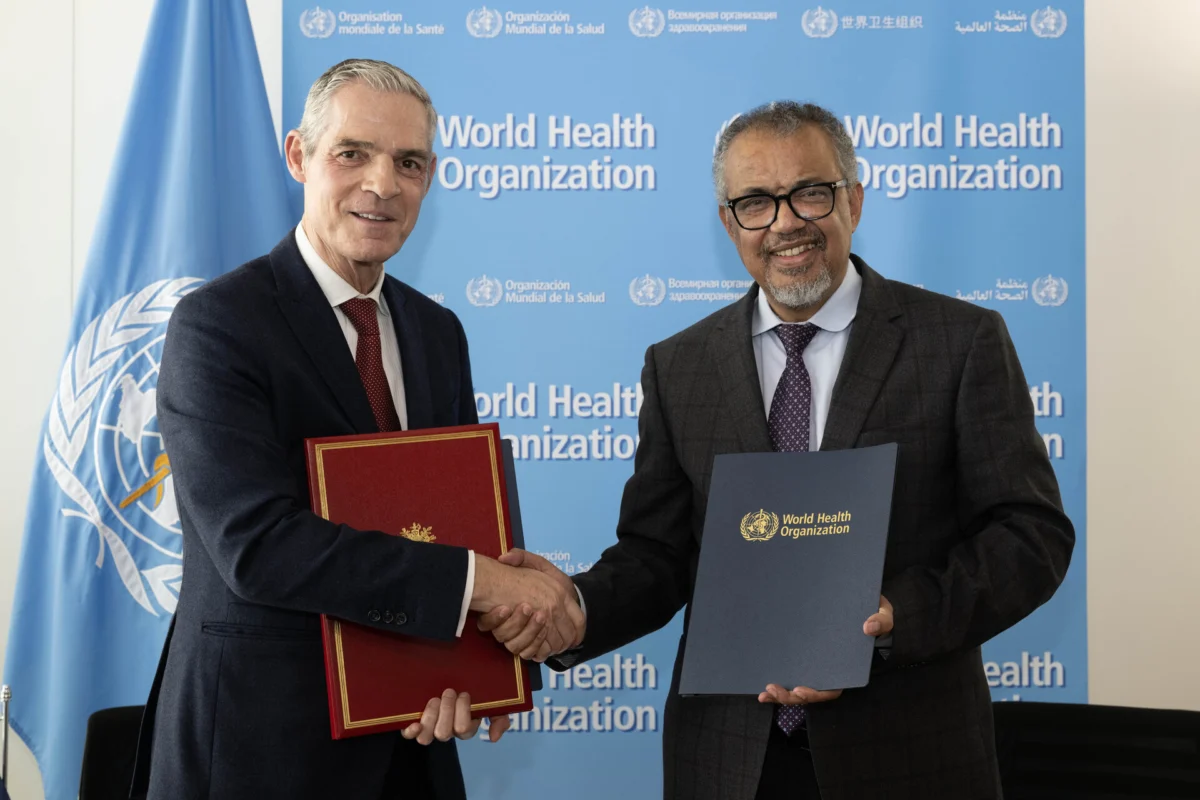
GENEVA — In a significant boost to international health governance, the French government has formalized a €24 million contribution to the World Health Organization (WHO), underscoring a deepening strategic alliance aimed at addressing some of the most complex health crises of the 21st century. The agreement, signed on October 17, 2024, at the WHO headquarters in Geneva, serves as a cornerstone of the ongoing France-WHO Framework Agreement (2020–2025), a pact designed to align administrative, legal, and financial resources with the organization’s overarching global priorities.
The signing ceremony, presided over by His Excellency Mr. Jérôme Bonnafont, Permanent Representative of France to the United Nations in Geneva, and WHO Director-General Dr. Tedros Adhanom Ghebreyesus, represents more than a simple financial transaction. It marks a deliberate effort by a G7 nation to bolster the WHO’s operational capacity during a period of unprecedented geopolitical instability and climate-related health risks.
The Strategic Allocation of Resources
The €24 million package is notable not only for its scale but for its strategic distribution. A central component of the agreement is the €4.5 million allocated to the Core Voluntary Contributions Account (CVCA). Unlike restricted funding, which is earmarked for specific projects, these fully flexible funds allow the WHO to pivot rapidly in response to emerging threats, filling critical gaps in core operations that might otherwise remain underfunded.
Beyond flexible funding, the contribution is meticulously segmented to address specific thematic priorities:
- Non-Communicable Diseases (NCDs): Recognizing that heart disease, cancer, and diabetes remain the leading causes of mortality globally, France’s support aims to scale up prevention and management programs.
- Emergency Response: Significant funding has been set aside for the WHO Contingency Fund for Emergencies (CFE), as well as targeted operations in high-risk zones, including Gaza, the management of cholera outbreaks, and mental health initiatives in Ukraine.
- One Health and Urban Health: The inclusion of "One Health"—the integrated approach that recognizes the interconnection between people, animals, and the environment—reflects a forward-looking strategy to prevent future zoonotic pandemics.
- The Lyon Hub: France continues to provide essential support for the WHO emergencies center in Lyon, which serves as a vital command node for epidemic preparedness and logistical coordination.
A Chronology of Partnership
The relationship between France and the WHO has evolved significantly over the last decade, transitioning from a traditional donor-recipient dynamic to a more integrated policy partnership.

The 2020–2025 Framework Agreement acted as the catalyst for this maturation. Following the onset of the COVID-19 pandemic, France identified the need for a more robust, predictable, and agile global health body. By providing multi-year financial commitments, France has allowed the WHO to shift away from "short-termism," where projects were often stalled by the uncertainty of annual budget cycles.
This recent contribution follows several years of intensified collaboration. In 2023, France was instrumental in discussions regarding the Pandemic Accord, advocating for equitable access to medical countermeasures. The current 2024 injection of funds is a direct follow-up to the adoption of the Fourteenth General Programme of Work (2025–2028), which was approved by the World Health Assembly earlier this year.
The Financial Landscape: Why Flexible Funding Matters
The global health landscape has become increasingly volatile. Data from the WHO’s 2024 financial reporting indicates that while overall funding has seen modest increases, the majority remains "earmarked," meaning the WHO cannot reallocate it if a crisis shifts.
The reliance on earmarked funding often leaves the organization’s "core" functions—such as standard-setting, research coordination, and global health policy oversight—under-resourced. By allocating €4.5 million in fully flexible funding, France is actively championing the "Investment Round" model, which seeks to secure a more sustainable financial future for the WHO. This move is part of a broader push by the WHO leadership to transition toward a model where 50% of the organization’s budget is derived from predictable, flexible assessed contributions.
Official Statements and Diplomatic Context
During the ceremony, Ambassador Bonnafont emphasized that the contribution is a reflection of France’s commitment to multilateralism. "France remains deeply committed to supporting the World Health Organization in its efforts to tackle critical global health challenges," Bonnafont stated. "These agreements reflect our shared priorities of promoting health equity, responding to emergencies, and strengthening healthcare systems worldwide."
Dr. Tedros Adhanom Ghebreyesus, in his response, noted the vital nature of this partnership during a time of global fatigue regarding international institutions. "We are immensely grateful to the French Government for its steadfast support to WHO, continued partnership, and leadership in global health," Dr. Tedros said. "This contribution will enable us to address key health threats, from non-communicable diseases to emergency response, helping to save lives and protect the most vulnerable populations."

Broader Impact and Global Health Implications
The implications of this agreement extend beyond the balance sheet. By aligning its national health strategy with the WHO’s Fourteenth General Programme of Work, France is signaling to other member states that the WHO remains the central pillar of global health security.
Experts in international relations note that this financial support serves as a stabilizing force. As climate change exacerbates the spread of infectious diseases and urban migration puts pressure on fragile health systems, the ability of the WHO to deploy technical expertise to "urban health labs" becomes a primary defense against large-scale outbreaks.
Furthermore, the focus on mental health in conflict-affected regions like Ukraine highlights a sophisticated understanding of modern crises. Health is no longer viewed solely through the lens of physical medicine; it now encompasses psychosocial support, structural stability, and the resilience of national health systems.
Looking Toward 2025 and Beyond
As the current framework agreement approaches its 2025 conclusion, the success of this contribution will likely serve as a blueprint for future negotiations. France has positioned itself as one of the lead proponents of the WHO’s inaugural Investment Round, a strategy aimed at mobilizing the resources necessary for the 2025–2028 period.
For the international community, the message is clear: the path to global health security requires more than just reactive emergency aid. It requires the sustained, flexible, and strategic investment that France has demonstrated with this latest commitment. By bridging the gap between immediate crisis response and long-term systemic strengthening, France and the WHO are attempting to build a health architecture capable of withstanding the unpredictable challenges of the coming decade.
This partnership remains a test case for whether international organizations can effectively reform their funding structures while simultaneously managing the most urgent health crises of the day. For now, the agreement stands as a testament to the efficacy of consistent, diplomatic, and financial engagement in the pursuit of a safer, more equitable global health future.
