
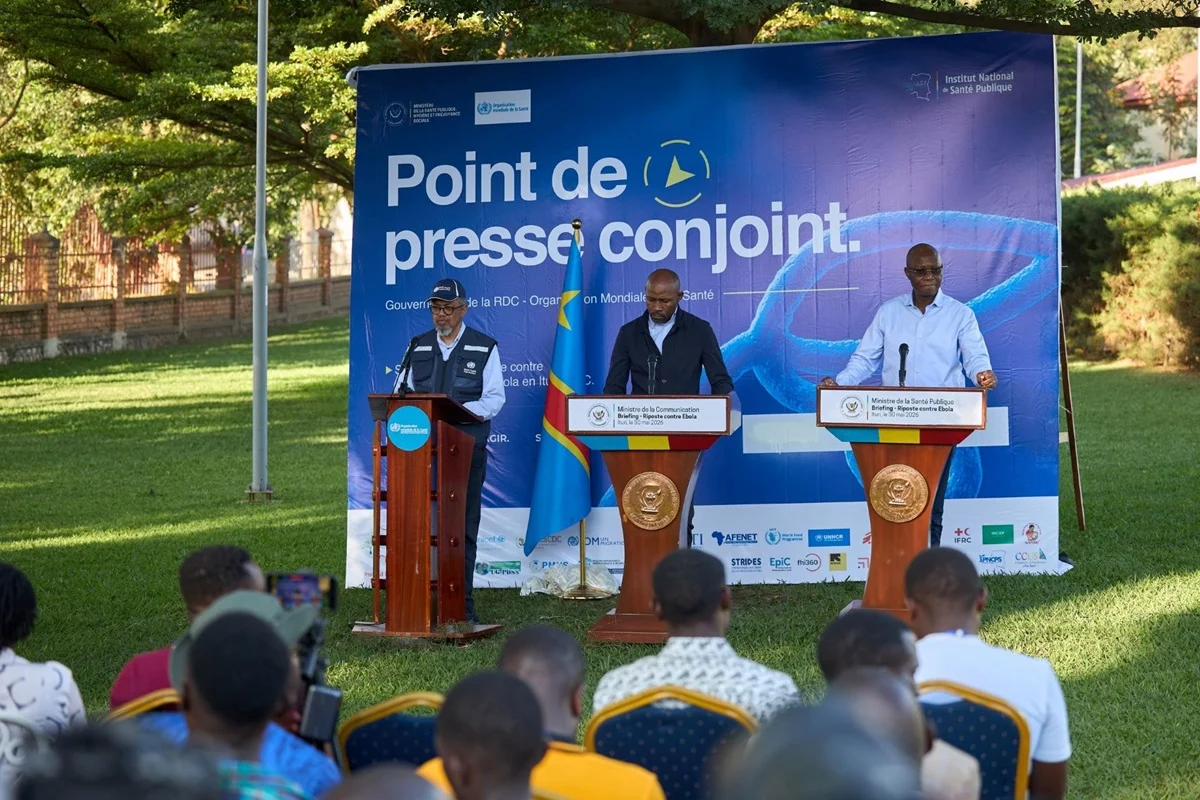
The Government of the Democratic Republic of the Congo (DRC) and the World Health Organization (WHO) have formally reaffirmed their strategic partnership and shared commitment to safeguarding public health in the wake of a burgeoning Ebola virus disease (EVD) outbreak. This high-level consolidation of efforts follows a critical joint mission to Bunia, the capital of Ituri Province, led by a delegation of senior officials including Dr. Samuel Roger Kamba, the Minister of Public Health, Hygiene, and Prevention, and Mr. Patrick Muyaya Katembwe, the Minister of Communication and Media. The mission was further bolstered by the presence and active participation of WHO Director-General Dr. Tedros Adhanom Ghebreyesus, signaling the international community’s heightened concern regarding the current epidemiological trajectory in eastern DRC.
This diplomatic and technical intervention arrives at a pivotal moment for the nation, which is currently grappling with an outbreak specifically caused by the Bundibugyo virus (BDBV) strain of Ebola. According to the latest situational reports from the Ministry of Health, the outbreak is characterized by a rapidly evolving transmission chain, with confirmed cases and fatalities reported across multiple health zones in the provinces of Ituri, North Kivu, and South Kivu. In response, the DRC government, with technical and logistical backing from the WHO and various international partners, has launched an intensified campaign focused on three primary pillars: enhanced surveillance, expanded laboratory diagnostic capacity, and specialized patient care. The overarching objective is to interrupt the transmission of the virus within the shortest possible timeframe while minimizing the socioeconomic disruption to the affected regions.
Historical Context and the Bundibugyo Challenge
The Democratic Republic of the Congo is no stranger to the Ebola virus; the pathogen was first identified in the country’s northern region near the Ebola River in 1976. Since then, the DRC has managed more than a dozen distinct outbreaks, earning a reputation for having some of the world’s most experienced frontline health workers and epidemiologists. However, the current outbreak presents a unique set of complexities due to the specific viral strain involved. Unlike the Zaire ebolavirus (EBOV), which was the cause of the devastating 2014–2016 West Africa epidemic and the massive 2018–2020 outbreak in eastern DRC, the Bundibugyo strain is historically less frequent but equally lethal in its potential for societal disruption.
The Bundibugyo virus was first identified in 2007 in the Bundibugyo District of neighboring Uganda. While the Zaire strain has benefited from the development and subsequent licensure of highly effective vaccines like Ervebo (rVSV-ZEBOV), there is currently no licensed vaccine or specific therapeutic treatment for the Bundibugyo strain. This pharmaceutical gap necessitates a return to fundamental public health interventions. The Ministry of Health and the WHO have emphasized that in the absence of a vaccine, the response must rely heavily on rapid case identification, rigorous contact tracing, and the isolation of infected individuals. Furthermore, the authorities have announced plans to fast-track randomized controlled trials (RCTs) for candidate vaccines and experimental treatments, aiming to provide a scientific foundation for future prevention strategies.
Chronology of the Current Outbreak and Response
The timeline of the current crisis highlights the speed at which the government and international agencies have mobilized. Following the initial notification of unexplained deaths and hemorrhagic symptoms in Ituri, provincial health authorities triggered an emergency alert system.
- Initial Detection: Local health facilities in Ituri Province reported a cluster of suspected viral hemorrhagic fever cases.
- Laboratory Confirmation: Samples sent to the Institut National de Recherche Biomédicale (INRB) in Kinshasa confirmed the presence of the Bundibugyo virus.
- National Mobilization: Minister Samuel Roger Kamba declared a public health emergency, activating the national response plan and coordinating with the WHO Regional Office for Africa.
- International Support: Dr. Tedros Adhanom Ghebreyesus and WHO technical teams arrived in the DRC to conduct a field assessment and coordinate with the Ministry of Communication to ensure transparent information dissemination.
- Operational Expansion: Surveillance teams were deployed to North and South Kivu to monitor potential cross-border transmission between provinces, while treatment centers were established in Bunia and surrounding health zones.
This chronology underscores the importance of the DRC’s previous experience. The "unparalleled experience" cited by the government refers to the institutional memory built during the 10th Ebola outbreak in North Kivu, which was managed under the shadow of armed conflict and community resistance. This history has allowed for a faster deployment of logistical assets than in previous decades.
Epidemiological Surveillance and Laboratory Data
The success of the containment strategy is fundamentally tied to data-driven decision-making. The WHO and the DRC’s Ministry of Health are currently tracking several key indicators to measure the intensity of the outbreak. Current data indicates that the transmission is not limited to a single epicenter but is appearing in sporadic clusters across the three eastern provinces.
Laboratory testing has been decentralized to allow for faster turnaround times. Portable PCR (polymerase chain reaction) machines have been deployed to field sites, reducing the time from sample collection to result from days to hours. This is critical for the Bundibugyo strain, as early supportive care—rehydration and symptomatic treatment—can significantly increase the chances of survival, even without a specific antiviral drug.
Health officials are also monitoring the "case fatality rate" (CFR). Historically, the Bundibugyo virus has shown a CFR ranging from 25% to 50%, which, while lower than the 60% to 90% often seen with the Zaire strain, remains a catastrophic threat to public health. The current response aims to keep the CFR at the lower end of the spectrum through early intervention and the establishment of "Safe and Dignified Burials" (SDB) teams to prevent post-mortem transmission, which has historically been a major driver of Ebola spread.
The Role of Community Engagement and Local Leadership
A central tenet of the joint Government-WHO strategy is the recognition that technical interventions are ineffective without the trust and cooperation of the local population. In many parts of Ituri and North Kivu, years of insecurity and misinformation have created a trust deficit between the population and centralized authorities. To counteract this, the response is placing local communities at the heart of the solution.
National and provincial authorities, supported by WHO experts in social and behavioral sciences, are intensifying dialogue with a broad spectrum of local stakeholders. This includes:
- Community Leaders and Elders: Who serve as the primary conduits of information in rural areas.
- Religious Organizations: Given the deep influence of the church and mosque in Congolese daily life, religious leaders are being trained to incorporate health messaging into their services.
- Youth and Women’s Groups: These groups are being mobilized to lead peer-to-peer education campaigns, focusing on the importance of early care-seeking behavior.
- The Private Sector: Local businesses are being engaged to ensure that hand-washing stations and temperature checks are standardized in marketplaces and transport hubs.
By co-developing solutions that are culturally sensitive—such as adapting burial practices to honor local traditions while maintaining biosafety—the government hopes to avoid the civil unrest and resistance that hampered previous Ebola responses.
Strengthening Health System Resilience and Long-Term Legacy
Both the DRC government and the WHO have emphasized that the response to the Ebola outbreak should not be viewed in isolation. Instead, it is being integrated into a broader strategy to strengthen primary health care and long-term health system resilience. Dr. Samuel Roger Kamba noted that the investments currently being made—ranging from the training of thousands of health workers to the upgrading of provincial laboratories—will leave a lasting legacy for the people of the DRC.
The objective is to ensure that when the Ebola outbreak is eventually declared over, the infrastructure remains in place to handle other endemic threats, such as malaria, measles, and cholera. This "dual-track" approach ensures that essential health services, including maternal and child health programs and routine vaccinations, are not suspended during the emergency response.
Furthermore, the government is calling for "sustained solidarity" from the international community. While initial funding has been provided by various global partners, the long-term cost of surveillance and health system strengthening requires consistent financial commitment. The DRC’s leadership has also highlighted the importance of keeping borders open for the movement of medical supplies and personnel, urging neighboring countries to implement entry controls that are based on scientific evidence rather than fear-based closures that could stifle the regional economy.
Regional Implications and Future Outlook
The current outbreak has significant implications for the broader Great Lakes region. The proximity of the affected health zones to the borders of Uganda and Rwanda necessitates a high degree of cross-border coordination. The Africa Centres for Disease Control and Prevention (Africa CDC) is working alongside the WHO to synchronize surveillance efforts and share real-time data with neighboring ministries of health.
As the DRC moves forward with its randomized control trials for Bundibugyo vaccines, the global health community watches closely. Success in these trials would not only help contain the current outbreak but would also provide the world with a new tool to prevent future epidemics of this specific strain.
In conclusion, the partnership between the DRC government and the WHO represents a comprehensive, multi-faceted approach to a complex public health crisis. By combining high-level political will with grassroots community engagement and rigorous scientific inquiry, the DRC is leveraging its vast experience to protect its citizens. The mission led by Dr. Kamba, Minister Muyaya, and Dr. Tedros serves as a reminder that while the challenges in Ituri and the Kivus are significant, the collective expertise and renewed international solidarity provide a firm foundation for bringing the Bundibugyo Ebola outbreak under control. The focus remains on rapid intervention, equitable distribution of resources, and the ultimate goal of building a health system capable of withstanding future shocks.
