
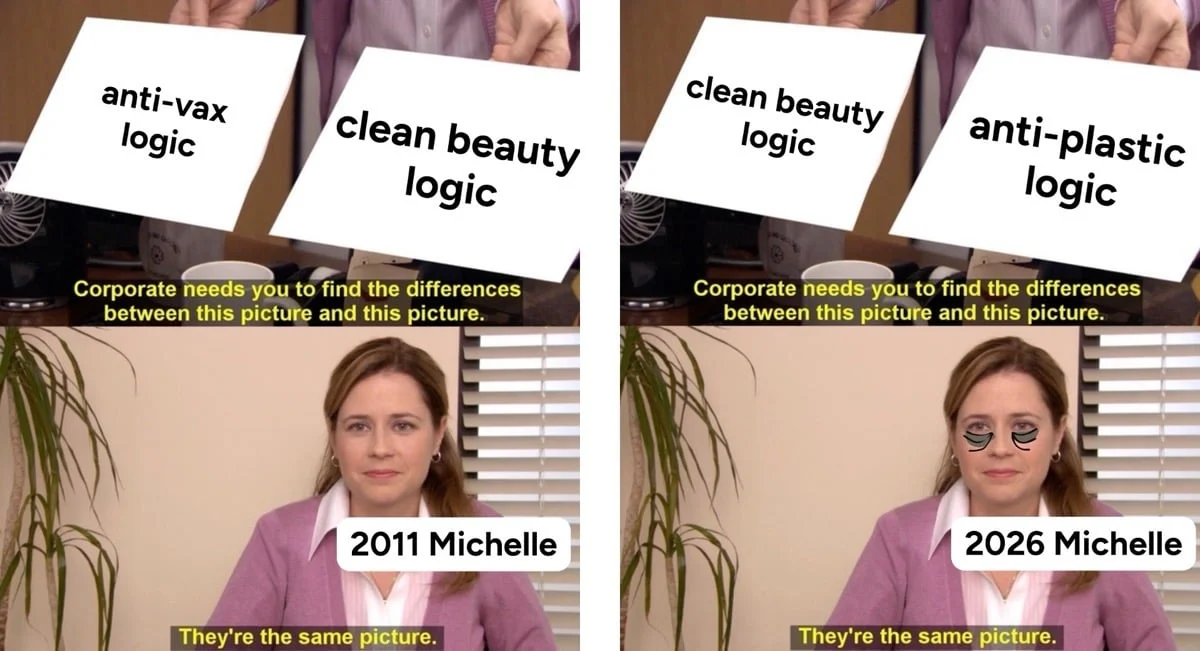
A growing concern among science communicators and experts is the emergence of the "plastic-free" movement as a contemporary parallel to the "clean beauty" and even "anti-vax" phenomena, driven by similar patterns of misinformation and logical fallacies. This critical perspective, highlighted recently by beauty science expert Michelle Wong of Lab Muffin Beauty Science, suggests that while reducing plastic waste is a laudable goal, the blanket demonization of plastics often leads to misguided efforts that can inadvertently worsen environmental and health outcomes. The alarm was recently triggered by a social media post from @idea.soup on Threads in January 2026, which posited a "weird feeling" that the "anti-polyester movement is about to become a right-wing pipeline." This observation resonated deeply with Wong, who founded her science communication platform in 2011 specifically to counter the "non-toxic" clean beauty movement, recognizing its potential as a gateway to anti-vaccination beliefs due to shared logical frameworks and the demonization of common substances like aluminum and formaldehyde.
The current anti-plastic trend, according to Wong, exhibits many of these same problematic characteristics. Beauty brands and influencers frequently employ broad "plastic-free" claims and engage in fearmongering about microplastics, echoing the unsubstantiated anxieties that defined the clean beauty narrative. A notable irony is that many individuals who readily debunk the pseudoscience of clean beauty appear to overlook how their own arguments apply to the anti-plastic discourse. Even respected scientific outlets, which typically uphold rigorous standards, have occasionally fallen into clean beauty tropes, underscoring the pervasive nature of these informational pitfalls. The core issue, however, is not a dismissal of legitimate environmental concerns; Wong explicitly states that overconsumption of plastic is a problem and microplastics warrant investigation. Instead, the critique targets the exaggeration of concerns and the uncritical adoption of "eco" alternatives without robust evidence, which ultimately undermines the genuine goals of improved human and environmental health.
Understanding the Parallels: A Deep Dive into Misinformation
The similarities between the anti-plastic movement and its predecessors, clean beauty and anti-vax, are striking and can be categorized into several key areas of logical and scientific missteps.
1. The Appeal to Nature Fallacy
At the heart of many "plastic-free" claims lies the appeal to nature fallacy, which posits that anything "natural" is inherently good, and anything "synthetic" or "man-made" (like plastic) is inherently bad. This oversimplified binary ignores the fundamental truth that a substance’s origin provides no direct information about its safety or environmental impact. For instance, some of the most potent toxins known to humanity, such as arsenic, cyanide, and botulinum toxin, are entirely natural. Conversely, many synthetic materials are benign or even life-saving.
In the context of clean beauty, this fallacy manifests as the rejection of "chemicals" in favor of "natural ingredients," even when the "natural" alternatives are less effective, more allergenic, or less sustainable in their production. For plastics, this translates into a blanket condemnation, often extending to bioplastics derived from natural feedstocks, without a critical assessment of their full life cycle impact. This approach overlooks the nuanced reality that the environmental footprint of a material is far more complex than its perceived naturalness.
2. Disregarding Foundational Science: Life Cycle Assessment
Just as clean beauty advocates often ignore basic toxicology principles like "the dose makes the poison," the widespread "plastic-free = better for the environment" assertion frequently disregards the fundamentals of sustainability science, particularly Life Cycle Assessment (LCA). LCA is the scientific standard for quantitatively measuring the environmental impact of a product across its entire life cycle, from raw material extraction and processing, manufacturing, transport, usage, to its final disposal or recycling.
Crucially, LCA often reveals that the "end-of-life" stage, which dominates public discourse around plastics (e.g., microplastics, landfills, ocean waste), is not always the most impactful phase. Public perception, often lacking a comprehensive understanding of supply chains, tends to disproportionately focus on waste, leading to incorrect judgments about which options are truly environmentally superior. Climate change, widely acknowledged by scientists as the paramount environmental threat, is frequently overlooked in plastic discussions.
Numerous LCA studies indicate that plastic packaging often presents a lower carbon footprint compared to alternatives. For example, one analysis cited by Symphony Environmental found that switching from plastic to glass, paper, or aluminum would, on average, necessitate 3.6 times more material, 2.2 times more energy, and result in 2.7 times more carbon emissions. This is largely due to plastic’s inherent advantages: its lightweight nature reduces transport emissions, its durability minimizes product damage and waste (especially food waste), and its efficiency in material use often requires less energy for production compared to heavier, more resource-intensive alternatives. While these are not universal truths for every product and every scenario, they highlight the oversimplification inherent in blanket anti-plastic statements. Each case demands a holistic, evidence-based assessment through LCA, which, it must be noted, can also be manipulated for greenwashing, especially with bioplastics. The overarching principle remains that consuming less is always the most sustainable option; however, substituting plastic with other materials often shifts environmental burdens rather than eliminating them, a fact frequently ignored by brands promoting "eco" alternatives without addressing overall consumption patterns.
3. Methodological Flaws in Research and Dissemination
A significant concern within the anti-plastic narrative mirrors issues seen in clean beauty: the selective citation and misinterpretation of studies, particularly those with serious methodological limitations. Many microplastic studies, despite good intentions, are plagued by experimental design flaws that render their results questionable or exaggerated. Measuring minute quantities of any substance is challenging, but microplastics introduce unique difficulties. Common issues, such as contamination and analytical errors, often lead to false positives or inflated numbers, which unfortunately generate sensational headlines.
For instance, pyrolysis-GCMS (Py-GCMS), a commonly used quantification method, can misidentify fats as polyethylene unless meticulously corrected through additional experiments. This can lead researchers to report higher microplastic concentrations than actually present, as seen in the widely circulated, though now questioned, claim of a "spoon’s worth of microplastics in our brains." Furthermore, pervasive contamination is a chronic problem; microplastics are ubiquitous, leading many studies to mistakenly count airborne particles, fibers from lab equipment, or even gloves as originating from the sample itself. Given the esoteric nature of these analytical challenges, ample opportunities arise for misinformation to spread unchallenged, fueling public anxiety without a solid scientific basis.
4. The Fallacy of Presence Equaling Harm
Another recurring theme is the assumption that the mere presence of a substance automatically implies harm. In the context of microplastics, finding these particles in diseased tissues, such as arterial plaque or the brains of individuals with dementia, is often presented as evidence of causation. However, as in clean beauty’s "parabens in breast tumors" study (which notably lacked a control group measuring paraben levels in normal tissue), correlation does not equal causation.
Such findings could be explained by various confounding factors: microplastics might simply accumulate in diseased tissues without causing the disease, or the disease process itself might make tissues more susceptible to microplastic accumulation. Alternatively, both the disease and the microplastic presence could be influenced by a third, unmeasured variable. Establishing a causal link requires rigorous epidemiological studies, dose-response analyses, and controlled experiments, none of which are adequately addressed by simply detecting microplastics in a particular biological sample.
5. Overlooking Multidimensional Benefits of Plastics
The wholesale condemnation of plastics often ignores the extensive and varied benefits they provide beyond their environmental impact (or lack thereof, when assessed holistically). Plastics offer unparalleled advantages in numerous applications, often contributing to safety, hygiene, accessibility, and economic viability.
In healthcare, sterile plastic packaging is indispensable for medical devices and pharmaceuticals, preventing contamination and ensuring patient safety. In food preservation, plastic packaging significantly extends shelf life, reducing food waste—a major environmental problem. Its lightweight nature is crucial for reducing fuel consumption in transport, contributing to lower carbon emissions. Plastics also offer durability, cost-effectiveness, and design flexibility, enabling products that are more accessible, safer, and more efficient. For example, the use of lightweight plastic containers can make products easier for elderly or infirm individuals to handle. The "clean beauty" movement similarly demonized parabens, overlooking their efficacy as powerful preservatives that, due to their potency, are required in smaller, safer concentrations than many "natural" alternatives, often leading to fewer allergic reactions and better product stability.
6. The Art of Science-Washing and Convenient Experts
A pervasive issue across these movements is "science-washing"—the deceptive practice of using scientific language, imagery, or selective data to lend credibility to claims that lack robust scientific backing. Many brands and influencers, while professing a commitment to science, promote anti-plastic narratives by cherry-picking evidence and endorsing "experts" who align with their predetermined conclusions. This phenomenon is not unique to the beauty industry; it mirrors tactics seen in fitness and wellness sectors where scientific jargon is leveraged to sell products.
Regulators worldwide are increasingly scrutinizing these misleading sustainability claims. Agencies like the US Federal Trade Commission (FTC), the UK Competition and Markets Authority (CMA), and the Australian Competition and Consumer Commission (ACCC) have issued guidelines to combat greenwashing, emphasizing the need for verifiable evidence behind environmental assertions. Brands that genuinely wish to avoid misleading consumers are advised to consult independent sustainability experts and adhere to their counsel. Furthermore, there’s a pattern of brands and influencers lacking a true understanding of relevant scientific expertise. They may prioritize credentials or perceived authority over actual subject matter knowledge, resulting in the promotion of flawed information. This can involve dismissing qualified experts who challenge their narrative or elevating individuals whose expertise is tangential or unverified.
Motivated Reasoning and Identity-Based Thinking
A critical factor fueling these trends is motivated reasoning and confirmation bias, where individuals selectively accept evidence that aligns with their political, social, or personal identities and beliefs. This has long been evident in anti-science movements. The anti-plastic movement is now exhibiting similar patterns.
A recent example unfolded in January 2026, when The Guardian, a mainstream media outlet, published an article titled "‘A bombshell’: doubt cast on discovery of microplastics throughout human body," which discussed significant methodological issues in microplastic measurement and corrected previous reporting on the "brain microplastic" study. This willingness to delve into complex science and correct prior misinformation is a commendable act of journalistic integrity. However, the article faced accusations of being "bought by Big Plastic" simply because it quoted a former Dow chemist. These accusations persisted despite The Guardian also quoting two independent scientists from public institutions who echoed the same concerns, and referencing a response letter penned by nine European scientists also affiliated with public institutions. As cosmetic scientist Jen Novakovich of The Eco Well rightly points out, "Discounting something solely based on funding source or affiliation is actually the opposite of critical thinking." While financial conflicts of interest are a valid consideration, they should not be the sole basis for dismissing an argument. The more challenging, yet essential, task is to critically evaluate the arguments themselves, a process made accessible even to non-experts through clear communication in articles like The Guardian’s.
Broader Implications and the Path Forward
The implications of the "plastic-free" movement mirroring the trajectory of "clean beauty" and "anti-vax" are profound. Firstly, it risks misdirecting environmental efforts. By fixating on less impactful changes or adopting counterproductive alternatives, genuine progress on more critical environmental challenges, such as climate change, can be hampered. Secondly, it erodes public trust in science and legitimate environmental advocacy. When consumers are repeatedly exposed to sensationalized or unsubstantiated claims, they become less discerning and more susceptible to future misinformation, making it harder for credible science to gain traction. This can lead to policy decisions based on flawed premises, potentially resulting in inefficient or even harmful regulations.
The work of science communicators like Michelle Wong and Jen Novakovich (who is pursuing a PhD on the impacts of environmental misinformation) is more crucial than ever. They advocate for a return to evidence-based decision-making, encouraging consumers and brands alike to engage in critical thinking rather than succumbing to emotional appeals or simplified narratives. While reducing plastic waste is a necessary goal, it must be pursued through informed choices grounded in comprehensive scientific assessment, not through blanket demonization or the uncritical adoption of alternatives that may, in fact, exacerbate environmental problems. Only by embracing scientific rigor and a holistic perspective can society truly advance towards better human and environmental health.
