
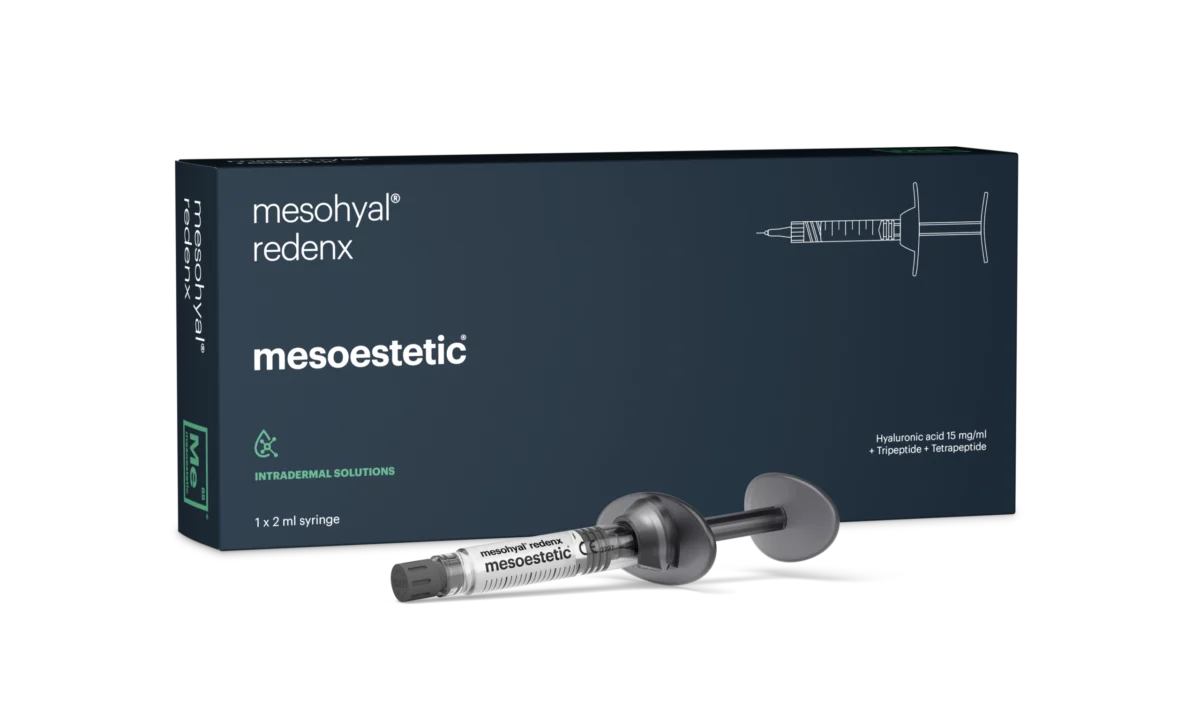
Global aesthetic manufacturer mesoestetic has officially announced the launch of mesohyal redenx, a sophisticated skin booster designed to address the complex challenges of moderate aging, tissue sagging, and the loss of dermal density. This latest addition to the company’s renowned mesohyal range represents a strategic advancement in the field of medical aesthetics, focusing on a regenerative, non-inflammatory pathway to restore the skin’s structural integrity. By combining high-concentration hyaluronic acid with a specialized complex of biomimetic peptides, the treatment aims to provide medical practitioners with a versatile tool for enhancing facial vitality and firmness, particularly in the lower third of the face where signs of gravitational aging are most prominent.
The introduction of mesohyal redenx comes at a time when the global medical aesthetics market is shifting toward "biorevitalisation" and "regenerative medicine." Unlike traditional dermal fillers that primarily provide volume through mechanical displacement, skin boosters like mesohyal redenx are formulated to improve the biological quality of the skin from within. The product is engineered to support the reorganization of the extracellular matrix (ECM) and promote long-lasting hydration, utilizing a formula that mimics the body’s natural physiological signaling to trigger repair mechanisms without the necessity of a localized inflammatory response.
Scientific Innovation and Formulation Profile
At the core of mesohyal redenx is a high-performance blend of active ingredients meticulously selected for their synergistic effects on skin biology. The formulation features a concentration of 15 mg/ml of non-crosslinked hyaluronic acid. Hyaluronic acid (HA) is a naturally occurring glycosaminoglycan in the human body, celebrated for its ability to retain up to 1,000 times its weight in water. In the context of mesohyal redenx, this HA serves as a powerful humectant, providing immediate and sustained deep-tissue hydration while creating an optimal environment for fibroblast activity.
Beyond simple hydration, the "redenx" formula distinguishes itself through the inclusion of advanced tripeptides and tetrapeptides. These biomimetic peptides are short chains of amino acids that act as chemical messengers. In the skin, they are designed to "mimic" the signals that the body naturally produces when it needs to repair damaged tissue. By binding to specific cell receptors, these peptides stimulate the production of essential structural proteins, including Collagen Type I and elastin. This process is critical for addressing "moderate aging," a stage characterized by a visible decrease in skin thickness and a reduction in the elastic fibers that prevent sagging.
The manufacturer emphasizes that the treatment operates through a non-inflammatory pathway. While some biostimulatory treatments rely on causing a controlled "injury" or inflammatory response to trigger collagen production, mesohyal redenx focuses on "biorevitalisation." This approach minimizes patient downtime and reduces the risk of post-procedural complications, making it an attractive option for patients seeking natural-looking results with minimal recovery periods.
The Evolution of the Mesohyal Range
The launch of mesohyal redenx marks a significant milestone in mesoestetic’s long-standing history of innovation. Based in Barcelona, Spain, mesoestetic has spent decades establishing itself as a leader in the pharmacological and aesthetic sectors. The mesohyal line is one of the most comprehensive ranges of CE-marked intradermal medical devices available on the market, offering practitioners the ability to customize treatments for a variety of skin concerns, from cellulite and hair loss to localized fat and facial aging.
Historically, the mesohyal range has included mono-substances and pre-mixed cocktails, such as mesohyal NCTC109 for intensive cell biorevitalisation and mesohyal Vitamin C for antioxidant protection. The development of redenx follows a clear chronology of moving toward more complex, multi-functional formulas. As the aesthetic industry has evolved, there has been an increasing demand for "hybrid" products that offer more than just a single benefit. By integrating peptides directly with hyaluronic acid, mesoestetic is responding to a clinical trend that prioritizes dermal thickening and structural "redensification" over mere surface hydration.
This product reflects years of research and development conducted at mesoestetic’s state-of-the-art facilities. The company’s commitment to scientific rigor ensures that each product in the mesohyal line undergoes extensive testing for safety and efficacy, adhering to the strict regulatory standards required for medical-grade aesthetic treatments in Europe and beyond.
Clinical Application and Targeted Treatment Areas
The clinical administration of mesohyal redenx is performed via intradermal injection, a technique that delivers active ingredients directly into the dermis where they can most effectively influence cellular behavior. Mesoestetic specifically recommends the product for use in the lower third of the face. This region is often the most difficult to treat non-surgically, as it is prone to the "jowl" effect, marionette lines, and a general loss of definition along the jawline due to the degradation of the dermal matrix and the effects of gravity.
By improving skin density in this specific zone, mesohyal redenx helps to provide a subtle lifting effect and smooths the appearance of moderate wrinkles. Practitioners are encouraged to use the treatment as part of a broader rejuvenation protocol, often involving multiple sessions to achieve cumulative benefits. The intradermal delivery ensures that the hyaluronic acid and peptides are distributed evenly across the treated area, promoting a global improvement in skin texture and firmness rather than just filling specific lines.
Emily Short, the aesthetic training lead at mesoestetic, highlighted the scientific philosophy behind the new launch. "mesohyal redenx marks a new era in medical aesthetics where science meets skin biology," Short stated. "By combining advanced biomimetic peptides with deep hydration technology, it delivers a refined, regenerative approach to improving skin density, firmness and vitality." This statement underscores the industry-wide shift toward treatments that respect and enhance the body’s innate biological processes.
Market Context and the Rise of Regenerative Aesthetics
The introduction of mesohyal redenx occurs within a thriving global market for skin boosters and biostimulators. According to various market research reports, the global medical aesthetics market is projected to grow at a compound annual growth rate (CAGR) of approximately 10% to 12% through 2030. Within this sector, "injectable skin boosters" are one of the fastest-growing categories. This growth is driven by a demographic shift often referred to as "pre-juvenation," where younger patients (millennials and Gen Z) seek preventative treatments to delay the signs of aging.
Simultaneously, older demographics are moving away from the "over-filled" aesthetic that was prevalent in the early 2000s. There is a growing preference for "quiet beauty"—results that look natural and healthy rather than obviously "done." Mesohyal redenx aligns perfectly with this trend. By focusing on skin quality and density rather than changing facial contours, it appeals to a broad patient base that values subtlety and long-term skin health.
Furthermore, the emphasis on a "non-inflammatory pathway" is a significant competitive advantage. Many traditional biostimulators, such as those based on poly-L-lactic acid (PLLA) or calcium hydroxylapatite (CaHA), can sometimes lead to the formation of nodules if not administered correctly, as they rely on a robust tissue response. A peptide-based, non-inflammatory booster like redenx offers a safer profile for a wider range of skin types, including those with sensitive skin or those prone to hyperpigmentation.
Supporting Data and Technical Specifications
To understand the impact of mesohyal redenx, it is essential to look at the technical specifications that differentiate it from other products in the mesohyal line. The concentration of 15 mg/ml of hyaluronic acid is strategically chosen to provide significant hydration without the excessive puffiness sometimes associated with higher concentrations of non-crosslinked HA.
The inclusion of tripeptides and tetrapeptides is backed by a growing body of dermatological research. Tripeptides are known to stimulate the synthesis of Glycosaminoglycans (GAGs) and collagen, while tetrapeptides are often used to improve skin elasticity and prevent the breakdown of collagen by inhibiting matrix metalloproteinases (MMPs). Together, these ingredients work to reorganize the extracellular matrix, which is essentially the "scaffolding" of the skin. When this scaffolding is strong and dense, the skin appears smoother and more resilient.
Practitioners who have integrated similar peptide-based treatments into their clinics report high patient satisfaction levels. Data from internal studies often indicate that patients notice an improvement in "skin glow" and "tightness" within two to four weeks following the initial treatment, with optimal results appearing after a series of three sessions spaced approximately one month apart.
Professional Responses and Industry Implications
The aesthetic community has responded positively to the launch of mesohyal redenx, recognizing it as a necessary tool for addressing the "gap" between topical skincare and invasive surgical procedures. Aesthetic doctors and nurses have noted that while fillers are excellent for restoring volume loss in the cheeks or temples, they do little to improve the actual "fabric" of the skin. Mesohyal redenx fills this gap by treating the skin itself as a living organ that requires nourishment and specific signaling to maintain its youthful properties.
Industry analysts suggest that the launch of such targeted products will likely encourage more practitioners to adopt a "multi-modal" approach to facial rejuvenation. This involves combining different types of injectables—such as toxins for dynamic wrinkles, fillers for volume, and boosters like redenx for skin quality—to achieve a more harmonious and comprehensive result.
Safety remains a paramount concern in the industry, and mesoestetic’s adherence to high manufacturing standards provides a level of reassurance for both clinicians and patients. The use of biomimetic ingredients reduces the likelihood of adverse allergic reactions, as the body recognizes these peptides as familiar biological components.
Future Outlook for Mesoestetic and the Aesthetic Sector
Looking forward, the launch of mesohyal redenx is expected to solidify mesoestetic’s position as a frontrunner in the regenerative aesthetics space. As consumer awareness regarding skin health continues to grow, the demand for products that offer "biological restoration" will likely outpace the demand for traditional fillers.
The success of mesohyal redenx may also pave the way for further innovations in peptide technology within the mesoestetic portfolio. The company’s ongoing research into epigenetics—how external factors and lifestyle choices influence gene expression in the skin—suggests that future iterations of the mesohyal range may become even more personalized, targeting specific genetic markers associated with aging.
In conclusion, the introduction of mesohyal redenx represents a sophisticated convergence of science, biology, and clinical aesthetics. By addressing the fundamental causes of skin aging—density loss and structural degradation—through a non-inflammatory, peptide-driven approach, mesoestetic is providing a forward-thinking solution for the modern aesthetic patient. As the industry continues to move toward more natural and regenerative outcomes, products like mesohyal redenx are set to become staples in the toolkit of medical aesthetic professionals worldwide.
