
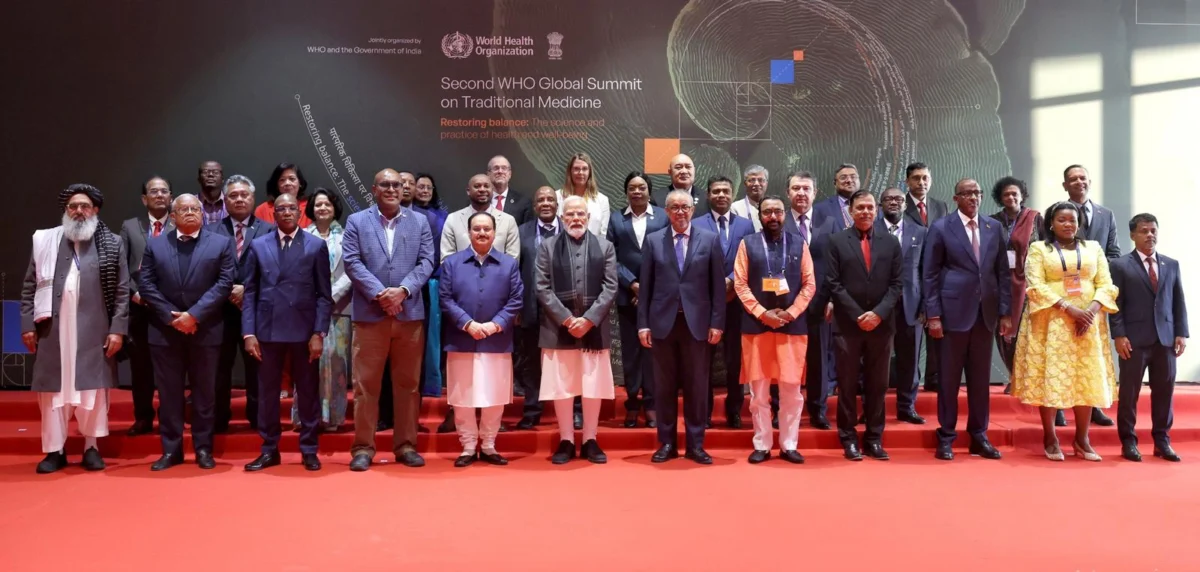
The second World Health Organization (WHO) Global Summit on Traditional Medicine reached its conclusion today in New Delhi, India, establishing a transformative framework for the integration of traditional, complementary, and integrative medicine (TCIM) into mainstream global healthcare systems. The high-level gathering, organized in partnership with the Government of India, served as a massive convening of the global health community, drawing more than 16,000 online participants and 800 physical delegates from over 100 countries. Among the attendees were health ministers from 20 nations, 160 expert speakers, and a diverse assembly of scientists, Indigenous leaders, and clinical practitioners. The summit’s primary objective was to harmonize ancient wisdom with modern science, ensuring that traditional medicine (TM) is utilized as a safe, evidence-based, and affordable pillar of universal health coverage.
The event took place against a backdrop of increasing global reliance on traditional healing practices. According to WHO data, approximately 80% of the world’s population uses some form of traditional medicine, including herbal treatments, acupuncture, yoga, and indigenous healing rituals. Despite this widespread usage, the sector has historically faced challenges regarding standardization, regulatory oversight, and scientific validation. The New Delhi summit addressed these gaps head-on, transitioning from theoretical discussions to concrete, actionable strategies aimed at the next decade of global health policy.
A Digital Leap: The Launch of the Traditional Medicine Global Library
A central highlight of the summit was the unveiling of the Traditional Medicine Global Library (TMGL), a digital infrastructure project designed to bridge the information gap between traditional knowledge and modern clinical research. The library serves as a first-of-its-kind repository, consolidating over 1.6 million resources. These include scientific papers, clinical trial results, historical manuscripts, and documented Indigenous knowledge that has, until now, been fragmented across various regional and cultural silos.
The TMGL is equipped with sophisticated technological features, including Evidence Gap Maps, which allow researchers to identify areas where further clinical study is required to prove the efficacy and safety of specific treatments. Furthermore, the WHO introduced "TMGL GPT," an artificial intelligence-powered tool designed to assist policymakers and healthcare providers in navigating complex traditional medicine data. By providing a trusted, centralized source of information, the library aims to accelerate the global research agenda and prevent the misappropriation of Indigenous knowledge while fostering legitimate scientific innovation.
Fostering Innovation through Health and Heritage
The summit also emphasized the role of modern technology in validating and scaling traditional practices through the launch of the Health & Heritage Innovations (H2I) initiative. This program was created to nurture startups and research projects that apply cutting-edge technologies—such as genomics, artificial intelligence, and digital health monitoring—to traditional medicine.
The initiative saw an overwhelming response, receiving more than 1,000 submissions from innovators worldwide. During the summit, 21 finalists were selected to enter a rigorous, year-long acceleration program. These finalists will receive scientific mentorship, regulatory guidance, and opportunities to connect with global investors. The goal of H2I is to move traditional medicine beyond "alternative" status by proving its utility through the same rigorous technological lenses used in conventional pharmaceutical development. For example, genomic sequencing is being used to authenticate the purity of herbal ingredients, while AI is being deployed to analyze the multi-molecular interactions of complex traditional formulations.
Strengthening Governance: The Role of STAG-TM
To ensure the long-term sustainability and scientific integrity of these efforts, the WHO announced the formation of the Strategic and Technical Advisory Group on Traditional, Complementary and Integrative Medicine (STAG-TM). This new advisory body consists of 19 independent experts selected for their expertise in medicine, public health, ethics, and traditional practices.
The STAG-TM held its inaugural meeting during the New Delhi summit, setting an immediate agenda focused on four pillars: evidence generation, preservation of traditional knowledge, digital innovation, and capacity building. This group will act as the primary advisory organ for the WHO’s Global Traditional Medicine Strategy 2025–2034. Their mandate includes developing international standards for traditional medicine products and advising Member States on how to safely integrate these practices into their national health systems. The establishment of this group signals a shift toward a more formalized, expert-driven approach to traditional medicine at the highest levels of global governance.
The Delhi Declaration: A Political Commitment to Action
The summit’s political climax was the adoption of the Delhi Declaration, a collective commitment signed by 26 Member States. This declaration represents a significant shift in how nations perceive traditional medicine, moving from mere cultural recognition to active systemic integration. The signatories pledged to incorporate traditional medicine into their primary healthcare frameworks, ensuring that patients have access to holistic care that is both culturally relevant and scientifically sound.

Key commitments within the Delhi Declaration include:
- Strengthening national regulatory frameworks to ensure the safety and quality of traditional medicine products.
- Investing in large-scale clinical research to build a robust evidence base for TCIM.
- Developing interoperable data systems to monitor the health outcomes of patients using traditional treatments alongside conventional medicine.
- Protecting the intellectual property rights and biodiversity associated with Indigenous knowledge.
Dr. Tedros Adhanom Ghebreyesus, WHO Director-General, emphasized the necessity of this political will, stating that traditional medicine is uniquely positioned to address the "syndemic" of modern health challenges. He noted that the growing burden of non-communicable diseases (NCDs), inequitable access to healthcare, and the health impacts of climate change require a more person-centered and holistic approach than conventional medicine sometimes offers on its own.
Chronology of Progress: From Gandhinagar to New Delhi
The New Delhi summit is the second major milestone in a timeline that began with the establishment of the WHO Global Centre for Traditional Medicine (GCTM) in Jamnagar, India, in 2022. The GCTM, supported by an investment of $250 million from the Government of India, serves as the global hub for the WHO’s traditional medicine work.
The first Global Summit on Traditional Medicine was held in Gandhinagar in August 2023, which resulted in the "Gujarat Declaration." That initial summit focused on identifying the potential of traditional medicine to achieve Universal Health Coverage (UHC). The 2024 New Delhi summit has built upon that foundation by moving into the implementation phase. While Gandhinagar was about "potential," New Delhi was about "delivery," as evidenced by the launch of the Global Library and the H2I accelerator. The trajectory now leads toward the full implementation of the Global Traditional Medicine Strategy 2025–2034, which will be the guiding document for the next decade.
Analysis of Global Implications and Economic Impact
The implications of this summit extend beyond public health into the realms of economics and environmental sustainability. The global market for traditional and complementary medicine is currently valued at billions of dollars and is projected to grow significantly as consumer demand for "natural" and "preventative" healthcare increases. By standardizing these practices, the WHO and its Member States are attempting to bring order to a market that has often been unregulated, protecting consumers from fraudulent products while allowing legitimate businesses to thrive.
Furthermore, the focus on "heritage" underscores the importance of biodiversity. Many traditional medicines rely on specific plant species and ecosystems. The summit highlighted that the preservation of traditional medicine is inextricably linked to the preservation of the planet. As climate change threatens various medicinal plant species, the WHO’s strategy includes a focus on sustainable sourcing and the protection of the natural environments that provide the raw materials for traditional healing.
From a healthcare delivery perspective, integrating traditional medicine into primary care could significantly reduce the burden on tertiary hospitals. In many developing nations, traditional practitioners are the first point of contact for rural populations. By training these practitioners in basic modern diagnostics and ensuring their traditional methods are safe, countries can create a more resilient and inclusive healthcare workforce.
Conclusion and Future Outlook
As the delegates depart New Delhi, the focus shifts to the national level. The WHO has committed to working closely with Member States to turn the pledges of the Delhi Declaration into domestic policy. The success of this initiative will be measured by the degree to which traditional medicine becomes a "driver of results" rather than a "parallel system."
The Global Traditional Medicine Strategy 2025–2034 provides a bold roadmap for a future where healthcare is no longer a choice between "ancient" and "modern," but a synthesis of both. Through the combination of the Traditional Medicine Global Library, the H2I innovation hub, and the expert guidance of the STAG-TM, the global health community has laid the groundwork for a more inclusive, evidence-based, and culturally grounded era of medicine. The New Delhi summit has effectively signaled that the future of global health lies in an integrative approach that respects heritage while embracing the rigors of modern science.
