
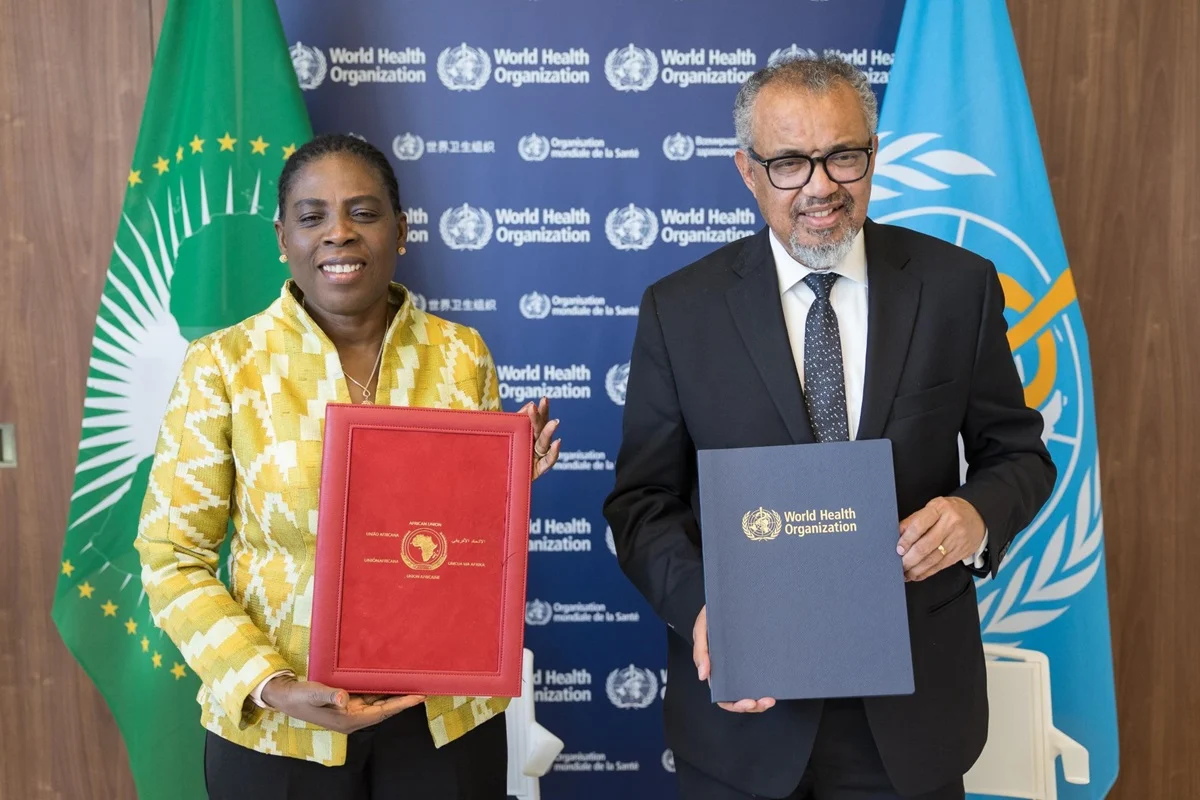
The World Health Organization (WHO) and the African Union (AU) Commission have officially renewed their strategic partnership through an updated Memorandum of Understanding (MoU), signed on the sidelines of the 78th World Health Assembly in Geneva. This landmark agreement serves as a formal commitment to accelerate universal health coverage, fortify regional health security, and foster sustainable development across Africa. At a moment when global health financing is facing severe volatility and contraction, this alliance aims to transition the continent from a paradigm of aid dependency to one of self-reliant health sovereignty.
The signing ceremony featured Her Excellency Ambassador Amma Adomaa Twum-Amoah, Commissioner for Health, Humanitarian Affairs and Social Development at the African Union Commission, and Dr. Tedros Adhanom Ghebreyesus, the WHO Director-General. By reinforcing the collaboration between these two entities, the agreement positions the AU’s Department of Health, Humanitarian Affairs, and Social Development as the central engine for continental health policy implementation.
A Chronology of Cooperation: From 2019 to 2024
The partnership between the WHO and the AU is not a new development, but rather a deepening of a long-standing diplomatic and technical relationship. The foundational framework for this current iteration was established in 2019, when the two organizations first signed a comprehensive MoU to harmonize their activities.
Over the past five years, that initial agreement provided the structural support necessary to coordinate responses to a variety of health challenges, most notably the COVID-19 pandemic. The pandemic served as a stress test for the 2019 agreement, revealing both the strengths of regional cooperation and the fragility of global supply chains. Since 2020, the AU and WHO have collaborated on the establishment of the Africa Centres for Disease Control and Prevention (Africa CDC), the expansion of mRNA vaccine manufacturing hubs in South Africa and Rwanda, and the harmonization of regulatory frameworks across AU member states. This new 2024 MoU serves as an evolution of that history, moving beyond emergency response toward long-term systemic health resilience.
The Economic Landscape: Why This Timing Matters
The renewal of the MoU occurs during an era of "unprecedented financial challenges." Recent data from the World Bank and the IMF suggest that many African nations are currently managing high debt-to-GDP ratios, which has limited the fiscal space available for domestic health spending. As bilateral aid from traditional donor nations in the Global North becomes increasingly unpredictable or tied to shifting geopolitical priorities, the necessity for African nations to pool resources has never been greater.
Dr. Tedros Adhanom Ghebreyesus highlighted the urgency of this transition, noting that cuts to bilateral aid programs now threaten the progress made over the last two decades in fighting malaria, tuberculosis, and HIV/AIDS. By aligning their technical and normative resources, the WHO and the AU are attempting to create a more efficient delivery mechanism for health interventions, reducing administrative duplication and ensuring that available funding reaches the community level more effectively.
Strategic Pillars and Technical Alignment
The new agreement is built upon five core pillars of collaboration designed to streamline the interface between the WHO’s global technical expertise and the AU’s regional political mandate. While the specific details of these pillars are being integrated into the workplans of individual member states, they broadly cover:
- Epidemic Preparedness and Response: Standardizing surveillance systems to detect and contain pathogens before they reach pandemic potential.
- Universal Health Coverage (UHC): Assisting member states in creating robust primary health care systems that provide equitable access for all citizens.
- Health Financing: Developing strategies for domestic resource mobilization, reducing reliance on external donors, and promoting public-private partnerships.
- Health Workforce Development: Addressing the critical shortage of trained medical personnel through regional education initiatives and the retention of health talent.
- Regulatory Harmonization: Strengthening the capacity of the African Medicines Agency (AMA) to ensure the safety, efficacy, and affordability of medical products across the continent.
Official Responses and the Vision for Sovereignty
During the ceremony, Commissioner Amma Adomaa Twum-Amoah articulated a shift in the AU’s strategic philosophy. "We need to move from budgeting for survival to planning for health sovereignty," she stated. This rhetoric reflects a broader movement within the African Union to assert the continent’s agency in global health governance.
The Commissioner emphasized that the AU is no longer content to be a passive recipient of global health policy; rather, it intends to be a primary architect. This is supported by the African Union’s recent admission to the G20, which has provided the continent with a platform to advocate for its health priorities at the highest levels of global economic decision-making.
Dr. Tedros echoed these sentiments, affirming that the WHO’s role is to support this transition. "We are proud to stand with the African Union in driving forward the health priorities of the continent," he said. The Director-General’s remarks suggest that the WHO is evolving its own operational model to be more responsive to regional bodies, recognizing that a centralized "one-size-fits-all" approach to global health is increasingly outdated.
Broader Implications: The Shift in Global Health Governance
The implications of this agreement are far-reaching. By centralizing health policy coordination under the AU-WHO umbrella, the partnership is likely to influence how other international organizations and NGOs operate within Africa. The move toward "health sovereignty" implies a stricter requirement for international partners to align their programs with the AU’s specific development agenda, rather than imposing external priorities on member states.
Furthermore, this partnership addresses the "missing middle" in global health: the gap between local community-level implementation and high-level international policy. By strengthening the capacity of the AU Commission to manage health initiatives, the agreement provides a bridge that can carry resources from the international stage directly to the national and sub-national levels with greater accountability.
Looking Ahead: Implementation and Accountability
The success of this renewed partnership will be judged by its ability to translate policy into measurable outcomes. The technical teams from both organizations, led by experts such as Professor Julio Rakotonirina (AU) and Stéphanie Seydoux (WHO), are tasked with developing a robust monitoring and evaluation framework to track the implementation of the MoU’s provisions.
Key indicators of success will include:
- Increased Domestic Health Spending: Tracking the progress of member states toward the Abuja Declaration targets (allocating 15% of national budgets to health).
- Vaccine and Medicine Production: Evaluating the operational output of regional manufacturing hubs.
- Response Times: Measuring the speed and efficacy of regional responses to localized health outbreaks.
As the global community faces a future defined by climate-induced health crises and the potential for future pandemics, the partnership between the WHO and the AU represents a critical attempt to insulate the African continent from the shocks of a fractured international system. By prioritizing regional unity, structural reform, and self-reliance, the two organizations are signaling that the future of health in Africa must be forged in Africa, by Africans, and for the benefit of all its citizens.
Contact Information for Further Inquiries
For those seeking detailed technical documentation or further information regarding the implementation of the agreement, the respective offices have provided the following points of contact:
- Professor Julio Rakotonirina, Director of the Department of Health, Humanitarian Affairs, and Social Development at the African Union Commission, can be reached at [email protected].
- Ms. Stéphanie Seydoux, Director and WHO Envoy for Multilateral Affairs, is available for inquiries regarding the WHO’s strategic role in this partnership at [email protected].
The WHO Media Team and representatives from the African Union Commission remain the primary sources for ongoing updates as the joint workplans are finalized in the coming months. This agreement, while symbolic in its signing, represents a rigorous and necessary step toward a more resilient, self-determined health future for the African continent.
