
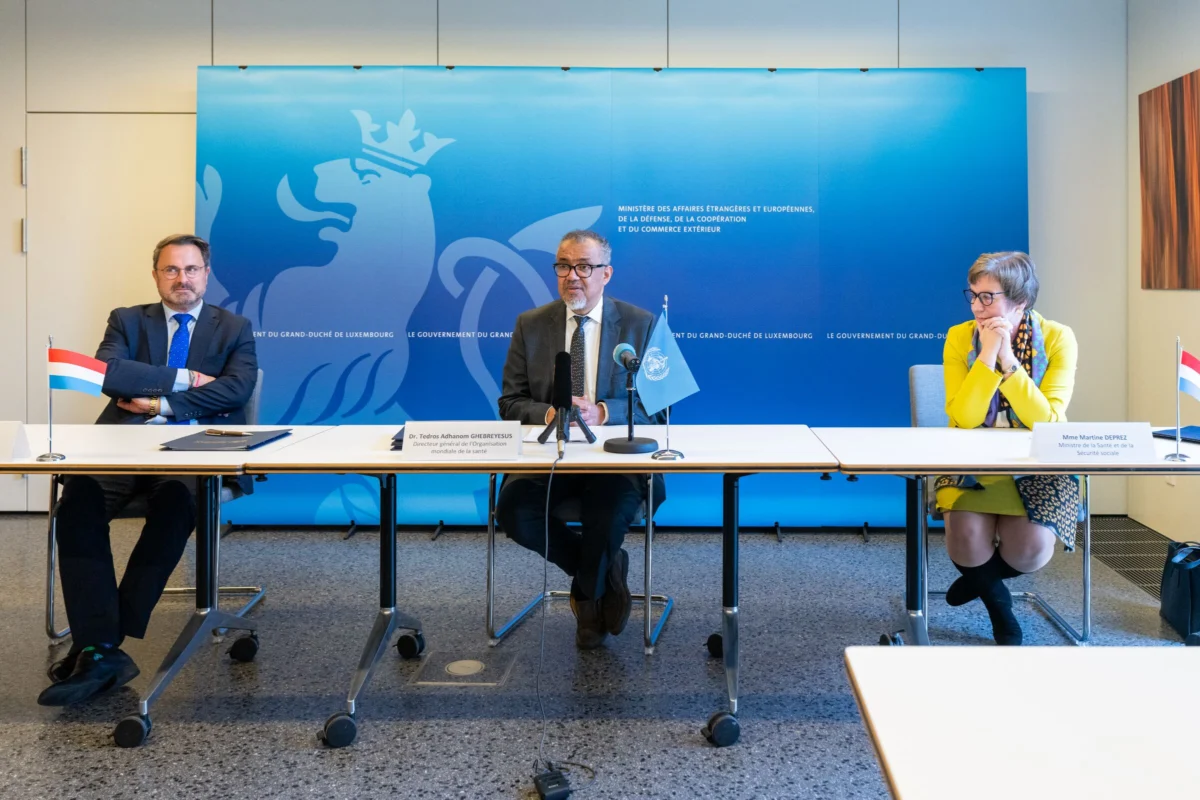
In a landmark development for international public health, the Grand Duchy of Luxembourg and the World Health Organization (WHO) formalized a multi-year cooperation strategy on December 20, 2024, marking a significant escalation in the nation’s commitment to multilateral health initiatives. The signing ceremony, which took place on the International Day of Solidarity, saw the ratification of two separate agreements totaling €47.5 million. This financial commitment represents the largest single contribution agreement ever brokered between the WHO and Luxembourg, signaling a profound shift in the country’s role as a key financier of global health stability.
The core of this investment is a Strategic Partnership Framework (SPF) worth €46.5 million, managed through the Ministry of Development Cooperation and Humanitarian Affairs. Complementing this is a separate €1 million agreement from the Ministry of Health and Social Safety—a historic first for the nation as its inaugural voluntary contribution to the WHO’s health-specific mandates. This dual-track funding approach aims to bolster the WHO’s operational capacity between 2025 and 2028, ensuring the organization remains adequately resourced to navigate the complex health challenges defining the mid-2020s.
The Strategic Architecture of the Investment
The allocation of the €46.5 million SPF is designed to balance immediate crisis response with long-term systemic health strengthening. A substantial portion of these funds is classified as "fully flexible," granting the WHO the autonomy to direct resources toward emergent health crises or areas of acute, unforeseen need. This financial agility is a cornerstone of the WHO’s current reform agenda, which seeks to move away from strictly earmarked funding that can often leave vital, but less "visible," public health programs underfunded.
The remaining funds are strategically earmarked for high-impact initiatives, including:
- The Universal Health Coverage (UHC) Partnership: A critical program supporting nations in building robust health systems that ensure access to services without financial hardship.
- Tropical Disease Research: Funding for neglected tropical diseases (NTDs), which disproportionately affect impoverished populations, ensuring research into vaccines and treatments remains active.
- Polio Eradication: Continued support for the global effort to eliminate polio, an initiative that has been a hallmark of international health cooperation for decades.
By integrating both flexible and thematic funding, Luxembourg has positioned itself as a sophisticated donor capable of supporting both the granular work of clinical research and the broad, systemic work of policy implementation and infrastructure building.

Contextualizing the Partnership: A Historical Timeline
The relationship between Luxembourg and the WHO has evolved steadily over the past two decades. Historically, Luxembourg has been a reliable, if modest, donor, focusing primarily on humanitarian aid and regional European health issues. However, the COVID-19 pandemic served as a major catalyst for change, highlighting the interconnectedness of global health and the necessity for multilateral cooperation.
- 2020–2021: The pandemic forced a reassessment of international health security. Luxembourg increased its engagement with the WHO to support the ACT-Accelerator, a global collaboration to speed up the development and equitable distribution of COVID-19 tests, treatments, and vaccines.
- 2022: Consultations began regarding a more structured, long-term funding relationship that would provide the WHO with the predictability required for multi-year project planning.
- 2023: Negotiations for the current SPF were initiated, with a focus on aligning Luxembourg’s development cooperation priorities with the WHO’s "Triple Billion" targets—which aim to provide 1 billion more people with universal health coverage, 1 billion more with better protection from health emergencies, and 1 billion more with better health and well-being.
- December 20, 2024: The formalization of the €47.5 million agreements, marking the most significant milestone in the bilateral relationship to date.
Official Perspectives and Diplomatic Significance
The signing ceremony, attended by WHO Director-General Dr. Tedros Adhanom Ghebreyesus, Luxembourg’s Deputy Prime Minister and Minister of Foreign and European Affairs, Xavier Bettel, and Minister of Health and Social Safety, Martine Deprez, served as a platform for reaffirming the value of multilateralism.
Minister Martine Deprez emphasized the intersection of health security and social equity. "From now till 2028, this contribution will help finance priority areas in Luxembourg’s collaboration with WHO, notably for sanitary crisis preparedness and response and the fight against health inequalities, with a special focus on gender," she stated. Her comments reflect a growing awareness within global health policy that biological health outcomes cannot be separated from social determinants, such as gender-based access to care and the vulnerability of marginalized groups during health crises.
Deputy Prime Minister Xavier Bettel highlighted the proactive philosophy underpinning the partnership: "We launch these agreements with WHO because we believe the best way to avoid is to prevent." His statement underscores a strategic pivot toward preventative medicine and robust surveillance systems, which are significantly more cost-effective than the reactive measures required during the height of a pandemic.
Dr. Tedros Adhanom Ghebreyesus offered a poignant reflection on the timing of the signing, noting, "It is a strong statement of solidarity by Luxembourg, not just with WHO, but with the people of the world." By linking the signing to the International Day of Solidarity, the parties aimed to frame global health as a fundamental moral imperative rather than a mere geopolitical transaction.
The Role of Technical Norms and Global Standards
A critical, often overlooked, component of the new partnership is the support for the WHO’s core work in developing technical products. While funding for disease-specific research captures headlines, the WHO’s role as the global arbiter of health guidelines, norms, and standards is arguably its most impactful function.

These guidelines—covering everything from pharmaceutical manufacturing standards to clinical protocols for treating infectious diseases—are the bedrock upon which national health ministries build their own regulations. By funding this "core" work, Luxembourg is supporting the underlying infrastructure of global healthcare. This ensures that countries with less-developed health bureaucracies have access to high-quality, evidence-based technical assistance, thereby harmonizing health standards globally and facilitating better cross-border responses to future pandemics.
Analysis: Implications for Global Health Governance
The implications of this agreement are twofold: they provide the WHO with the fiscal space to maneuver, and they reinforce the legitimacy of multilateral institutions in an era of increasing nationalist rhetoric.
- Fiscal Stability: The shift toward multi-year funding allows the WHO to move away from a "hand-to-mouth" budgetary cycle. This stability is essential for recruiting specialized personnel and committing to long-term research projects that cannot be interrupted by the vagaries of annual political budget cycles in donor nations.
- Addressing Health Inequalities: By emphasizing gender-focused health initiatives, the agreement addresses a specific, persistent gap in global health. Women and girls frequently face the highest barriers to accessing basic healthcare services; by prioritizing this, the funding directly supports Sustainable Development Goal 5 (Gender Equality) alongside Goal 3 (Good Health and Well-being).
- Strengthening Multilateralism: In a fragmented global political climate, Luxembourg’s commitment serves as a signal to other mid-sized nations. It demonstrates that countries, even those with limited populations, can exert significant influence and provide essential leadership in global governance through targeted, strategic financial contributions.
Looking Ahead: The 2025–2028 Horizon
As the partnership enters its implementation phase, the focus will shift to monitoring and evaluation. The success of this €47.5 million investment will be measured not only by the funds disbursed but by tangible improvements in health metrics in the regions where the WHO operates.
The 2025–2028 window is particularly critical. It encompasses the post-pandemic recovery period, during which the global health community must reconcile the lessons learned from COVID-19 with the ongoing threats posed by climate change, antimicrobial resistance, and the resurgence of preventable diseases. Luxembourg’s contribution ensures that the WHO remains a stable, reliable partner capable of leading this transition.
Ultimately, this agreement is more than a financial transaction; it is a declaration of intent. By choosing to invest in the global health architecture at this juncture, Luxembourg has reaffirmed its position as a dedicated architect of the international order, prioritizing the collective health of the global population over short-term domestic considerations. As the world faces an increasingly unpredictable health landscape, such partnerships are the essential building blocks for a more resilient, equitable, and prepared global community.
