
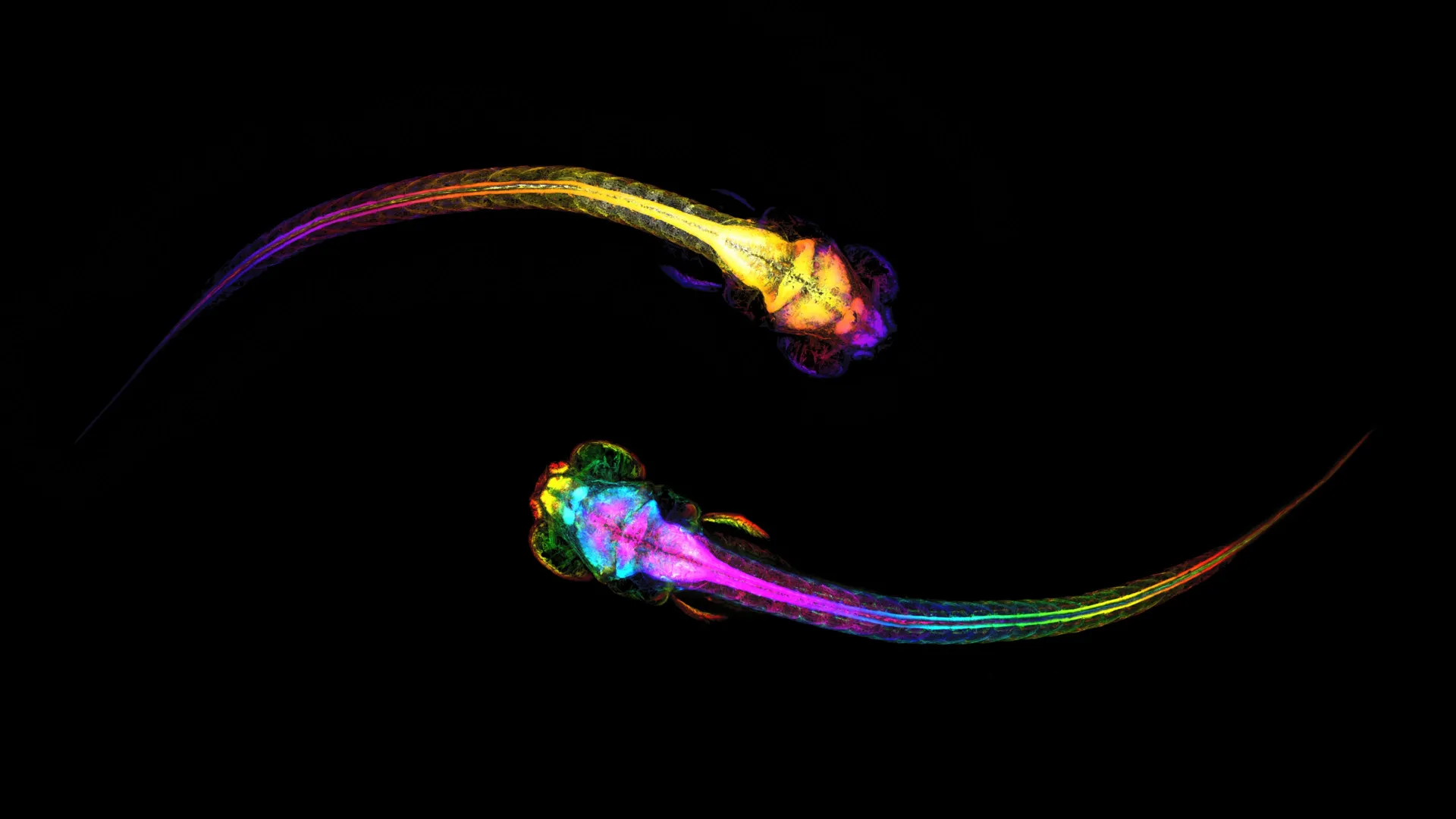
A groundbreaking study from the Hebrew University of Jerusalem has unveiled a fascinating insight into the intricate neural processes that precede social engagement. For the first time, researchers have identified a distinctive, brain-wide pattern of neural activity that emerges several seconds before an individual initiates an approach toward another. This discovery, detailed in a recent publication, not only sheds light on the fundamental mechanisms driving social behavior but also suggests that the strength of this neural signature is directly correlated with an individual’s inherent social motivation.
The research, spearheaded by Dr. Lilah Avitan and conducted by PhD student Imri Lifshitz alongside other members of the Avitan laboratory at the Edmond and Lily Safra Center for Brain Sciences (ELSC) at the Hebrew University of Jerusalem, utilized zebrafish as a model organism. This choice was strategic, as zebrafish offer an exceptional capacity for real-time monitoring of brain activity at the cellular level, a crucial element for observing pre-motor neural events.
Unveiling the Pre-Social Neural Symphony
The core of the investigation involved the creation of an innovative experimental setup designed to meticulously track the genesis of social decisions. In this novel system, one zebrafish acted as an observer, its brain activity comprehensively monitored, while another conspecific swam in its vicinity, serving as the social stimulus. This controlled environment allowed the scientists to capture the unfolding neural cascade that leads from perceiving a social cue to initiating a behavioral response, all in real time. The researchers were able to observe and record neural events across the observer fish’s entire brain as it processed the presence of the nearby fish.
A Brain-Wide Pre-Decision Signal
The pivotal finding of the study was the observation of a distinct neural phenomenon preceding any physical movement toward another fish. Specifically, the researchers detected significant changes in brain activity that began several seconds before the observer fish would initiate swimming towards its social counterpart. This suggests that the brain is not merely reacting to stimuli but is actively preparing for social engagement.
Crucially, this preparatory activity did not originate from a single, isolated brain region. Instead, it involved a coordinated and widespread modulation of neural activity across multiple brain areas. The study pinpointed an increase in activity within the pallium, a brain region recognized for its role in higher-order cognitive functions and complex behaviors. Concurrently, activity diminished in other brain regions. This dynamic interplay of increasing and decreasing neural firing rates across the brain created what the researchers have termed a "neural pre-decision state." This state served as a powerful predictor, signaling that a social action was imminent and allowing researchers to anticipate the behavior before it manifested.
Quantifying Social Drive: The Neural Signature’s Strength
Beyond identifying the existence of this pre-social neural signal, the research also established a quantitative link between the signal’s strength and an individual’s social inclination. The study observed that the intensity of this brain-wide neural pattern varied significantly among the individual zebrafish. Fish exhibiting a more robust and pronounced neural signature tended to display more social behaviors overall. This correlation strongly implies that the neural signal serves as a direct reflection of an individual’s underlying "social drive" – their innate propensity to seek out and engage in social interactions.
The findings further underscored the critical role of the pallium in this process. The results suggest that this brain region is not just passively involved but actively contributes to generating the motivation required to approach others and participate in social exchanges. Dr. Lilah Avitan, the lead researcher, articulated the significance of their findings: "This study identifies a brain-wide neural signature of social approach that emerges before movement begins. This signature predicts not only whether an upcoming action will be social, but also how strongly socially driven the individual is."
Supporting Data and Methodological Advancements
The research team employed advanced neuroimaging techniques, likely involving genetically encoded calcium indicators or other fluorescent reporters, which allowed for the visualization and quantification of neuronal activity in awake, behaving zebrafish. The precise temporal resolution of these methods was critical in distinguishing the pre-motor neural activity from the motor commands themselves. The experimental design, which involved carefully controlled social encounters and simultaneous whole-brain recording, represents a significant advancement in the study of social neuroscience in animal models. While specific quantitative data on the duration of the pre-decision state (e.g., the average number of seconds before movement) or the correlation coefficient between neural signal strength and social behavior metrics were not detailed in the initial summary, further publications from the Avitan lab are expected to provide such granular data. However, the qualitative description of a "several seconds" lead time and a "stronger pattern" correlating with "more social overall" provides a clear indication of the magnitude of the observed effects.
Context and Chronology of the Research
The investigation into the neural underpinnings of social behavior is a burgeoning field within neuroscience. For decades, researchers have sought to understand the complex interplay of brain regions that govern how we interact with others. Early work often focused on specific neurotransmitter systems or localized brain areas implicated in reward and affiliation. However, more recent advancements in imaging and computational analysis have enabled a more holistic, system-level understanding.
The work by Avitan’s lab builds upon this foundation by employing a sophisticated model organism and a cutting-edge experimental paradigm. The timeline of this specific research likely spans several years, from the initial conceptualization and development of the experimental system to data acquisition, analysis, and eventual publication. The successful creation of a system that allows for real-time, whole-brain monitoring in a social context represents a significant milestone in this ongoing research effort.
Broader Implications and Potential Future Directions
The implications of this research extend far beyond understanding the basic mechanisms of social interaction in zebrafish. Given the conserved nature of brain structures and their functions across vertebrate species, including humans, these findings hold significant potential for illuminating human social cognition.
Understanding Individual Differences: The discovery that the neural signal strength correlates with social drive offers a potential neural basis for understanding why some individuals are naturally more outgoing and gregarious than others. This could pave the way for more nuanced investigations into personality traits and social preferences from a neurobiological perspective.
Clinical Relevance for Social Disorders: Conditions characterized by altered social behavior, such as autism spectrum disorder (ASD) and social anxiety disorder, could potentially benefit from this research. By identifying the neural signatures of healthy social engagement, researchers may be able to pinpoint deviations in these signatures in individuals with social deficits. This could lead to the development of more targeted diagnostic tools and therapeutic interventions. For instance, if future research confirms similar pre-decision neural patterns in humans, fMRI or EEG studies could potentially identify individuals who exhibit weaker or atypical patterns, suggesting a predisposition for social difficulties.
Neuroscience and Artificial Intelligence: The identification of a predictive neural state preceding action could also have implications for the field of artificial intelligence, particularly in the development of more sophisticated and socially aware AI systems. Understanding how biological brains prepare for social interaction could inform the design of AI agents capable of more natural and intuitive social engagement.
Expert Reactions and Inferred Statements
While direct quotes from external experts are not available in the provided text, the significance of this research is likely to be met with considerable interest within the neuroscience community. Leading researchers in social neuroscience, comparative neurobiology, and ethology would likely commend the innovative methodology and the clear, quantifiable findings.
One could infer that experts might highlight the study’s contribution to the growing body of evidence suggesting that complex behaviors are not initiated by simple stimulus-response mechanisms but involve intricate, anticipatory neural processes. The emphasis on a brain-wide network rather than a single "social center" is also a critical takeaway that aligns with modern understanding of brain function as a distributed system.
Conclusion: A New Window into Social Motivation
The research conducted at the Hebrew University of Jerusalem has opened a new window into the neural underpinnings of social behavior. By identifying a brain-wide neural signature that precedes social approach and linking its strength to an individual’s social drive, the study provides a foundational understanding of how our brains prepare to connect with others. This discovery not only deepens our appreciation for the complexity of social cognition but also offers promising avenues for future research into individual differences in sociability and the neurobiological basis of social disorders. As this line of inquiry progresses, it holds the potential to yield significant insights into what makes us social beings and how we can foster healthier social interactions. The precise chronological unfolding of this neural preparation, from the initial perception of a social cue to the emergence of the pre-decision state and subsequent motor action, is a complex dance that science is now beginning to decode, one neural impulse at a time.
