
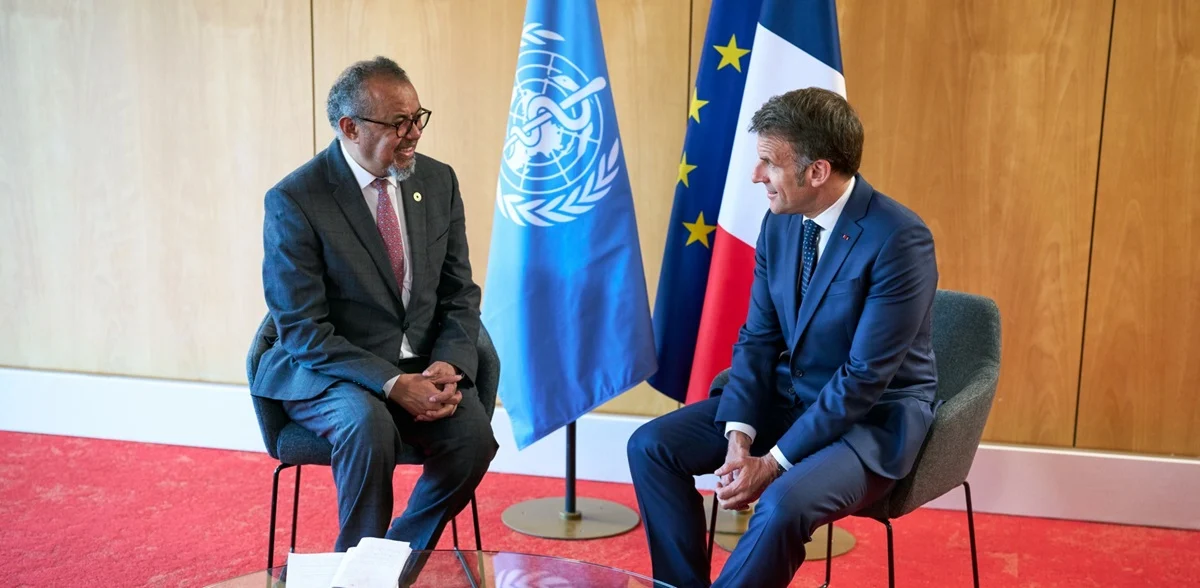
On World Health Day, global heads of state, scientific experts, and international health authorities gathered in France for the landmark One Health Summit, marking a pivotal moment in the global effort to restructure pandemic preparedness. Hosted by the French government in collaboration with the World Health Organization (WHO), the summit served as the primary stage for announcing a comprehensive suite of actions designed to safeguard the delicate balance between human populations, animal health, and the Earth’s ecosystems. Under the 2024 theme, "Together for health. Stand with science," the event transitioned the "One Health" concept from a theoretical framework into a series of binding international commitments and operational strategies.
The summit comes at a time of unprecedented environmental and biological volatility. Public health experts at the event underscored a sobering reality: the traditional silos of medical science, veterinary medicine, and environmental conservation are no longer sufficient to protect global populations. Current data indicates that approximately 60% of known infectious diseases in humans are zoonotic—meaning they originate in animals—and roughly 75% of all emerging infectious diseases follow this same cross-species pathway. The economic and human toll of failing to recognize these links was most recently illustrated by the COVID-19 pandemic, which resulted in an estimated 15 million excess deaths and triggered a global economic contraction valued in the trillions of dollars during the 2020–2021 period alone.
The One Health Philosophy: A Multidisciplinary Mandate
The "One Health" approach is predicated on the scientific understanding that human health does not exist in a vacuum. Instead, it is inextricably linked to the health of animals—both domestic and wild—and the integrity of the environments they inhabit. Factors such as rapid urbanization, deforestation, intensive agriculture, and the illegal wildlife trade have increased the frequency of contact between humans and potential viral reservoirs. By integrating the expertise of physicians, veterinarians, ecologists, and climate scientists, the WHO and its partners aim to create an early-warning system that can detect biological threats at their source before they escalate into global emergencies.
Dr. Tedros Adhanom Ghebreyesus, Director-General of the WHO, emphasized this interconnectedness during his keynote address. He noted that protecting one sector without addressing the others is a futile exercise in modern public health. The summit effectively positioned France as a diplomatic leader in this space, with President Emmanuel Macron reaffirming his nation’s commitment to scientific multilateralism. Macron stated that the well-being of the human race is inseparable from the systems that support life on Earth, calling for a shift from "ambition to implementation."
Strategic Actions: Four Pillars of the New Health Architecture
To give the One Health approach operational teeth, the WHO and the "Quadripartite"—a partnership including the Food and Agriculture Organization (FAO), the World Organisation for Animal Health (WOAH), and the UN Environment Programme (UNEP)—unveiled four major initiatives.
1. Launch of the Global Network of One Health Institutions
A central outcome of the summit was the plan to establish a Global Network of One Health Institutions. This network is designed to be the primary delivery vehicle for the One Health Joint Plan of Action. By inviting Quadripartite partners to join, the WHO seeks to mobilize a multidisciplinary pool of experts who can provide direct, coordinated support to individual nations.
This initiative aims to bridge the gap between high-level global guidance and on-the-ground reality. A key component of this network will be the WHO Academy, which will facilitate training and peer-to-peer learning for health workers and policy-makers. By creating a country-focused delivery model, the network ensures that even nations with limited resources can implement robust surveillance and response systems tailored to their specific ecological and social contexts.
2. Expansion of Scientific Oversight via OHHLEP
Recognizing that policy must be dictated by data rather than political expediency, the summit saw the formal extension and expansion of the One Health High-Level Expert Panel (OHHLEP). This body serves as the world’s premier scientific advisory group on the human-animal-environment interface.
The panel’s mandate has been extended through 2027, with a subsequent phase already planned for 2027–2029. The OHHLEP will focus on three priority areas: defining the global research agenda to close knowledge gaps in zoonotic transmission, providing the technical backbone for the Joint Plan of Action, and engaging in high-level advocacy to ensure that evidence remains at the forefront of international health governance.
3. Renewed Initiative for Rabies Elimination
In a move targeting a specific and preventable scourge, the WHO, WOAH, and the Institut Pasteur launched a renewed global strategy to eliminate dog-mediated human rabies deaths by 2030. Despite the existence of effective vaccines, rabies continues to claim nearly 60,000 lives annually, with a disproportionate impact on children in rural and underserved communities.
This initiative is significant not only for its immediate life-saving potential but also as a "proof of concept" for the One Health model. By focusing on mass dog vaccination, community-based surveillance, and improved access to post-exposure prophylaxis, the program demonstrates how animal-sector interventions directly produce human health outcomes. Success in rabies elimination is expected to provide a blueprint for managing other endemic zoonotic diseases.
4. Unified Strategy Against Avian Influenza
With the H5N1 strain of avian influenza causing increasing concern among virologists due to its spread among wild birds and mammals, the summit presented a new Strategic Framework for Collaboration on Avian Influenza. This framework addresses the fragmented nature of previous response efforts.
The new strategy harmonizes surveillance and risk assessment across the Quadripartite partners. It recognizes that avian influenza is not merely a poultry industry problem or a wildlife conservation issue, but a major threat to global food security, livelihoods, and public health. The framework facilitates faster data sharing and more coordinated preparedness measures to mitigate the risk of a potential pandemic strain emerging from the avian population.
Chronology and Diplomatic Context: A Week of Global Mobilization
The One Health Summit was part of a broader week of intense diplomatic and scientific activity in France. Following the high-level summit, the WHO launched its first Global Forum of WHO Collaborating Centres (CCs), which ran from April 7 to April 9. This forum brought together more than 800 institutions from over 80 countries, representing the world’s leading academic and research bodies.
The presence of health ministers from Germany, Indonesia, and South Africa, alongside the French Minister of Health, underscored the global nature of the challenge. The forum served as a technical counterpart to the summit’s political declarations, focusing on the "how" of scientific innovation—specifically data sharing protocols, coordinated research into "Pathogen X," and capacity building in the Global South.
This sequence of events is intended to inform upcoming international discussions, including the G7 and G20 meetings. As the WHO assumes the Chairmanship of the Quadripartite collaboration, it is taking on a heightened leadership role to ensure that these various threads of international cooperation are woven into a single, cohesive global health strategy.
Supporting Data and Economic Implications
The data supporting the necessity of this shift is compelling. Beyond the 15 million deaths attributed to COVID-19, the "One Health" approach addresses chronic issues that drain the global economy. For instance, antimicrobial resistance (AMR)—often fueled by the overuse of antibiotics in livestock—is projected to cause 10 million deaths annually by 2050 if left unchecked, with an economic impact comparable to the 2008 financial crisis.
Furthermore, environmental degradation is a primary driver of disease emergence. Studies have shown that for every 10% increase in deforestation, there is a roughly 3% increase in the incidence of malaria and other vector-borne diseases. By investing in the One Health framework now, global leaders are effectively purchasing an insurance policy. The World Bank estimates that the cost of bringing One Health systems to a functional level globally would be approximately $10 billion to $11 billion per year. While this is a significant sum, it pales in comparison to the estimated $11 trillion loss caused by the COVID-19 pandemic.
Analysis of Broader Impacts and Future Outlook
The transition of the WHO into the chair of the Quadripartite signals a more centralized and authoritative approach to global health governance. By streamlining governance and aligning the FAO, WOAH, and UNEP under a focused set of priorities, the international community is attempting to eliminate the bureaucratic redundancies that often slow down emergency responses.
However, the success of the One Health Summit will ultimately depend on two factors: sustained funding and political transparency. While the announcements in France provide a robust roadmap, the implementation phase requires nations to share sensitive data regarding disease outbreaks within their borders—a challenge that has historically been hampered by concerns over trade and tourism impacts.
The focus on "science-led action" is a direct response to the misinformation crises that plagued recent pandemic responses. By reinforcing bodies like the OHHLEP and the Global Network of One Health Institutions, the WHO is attempting to build an infrastructure where facts can be disseminated rapidly and accurately to all corners of the globe.
As the summit concluded, the message from Paris was clear: the era of reactive medicine is over. The global health community is moving toward a proactive, holistic model that views a virus in a forest, a pathogen in a livestock market, and a patient in a hospital as parts of the same story. Through the One Health approach, the international community is not just preparing for the next crisis; it is working to ensure that the next crisis never begins.
