
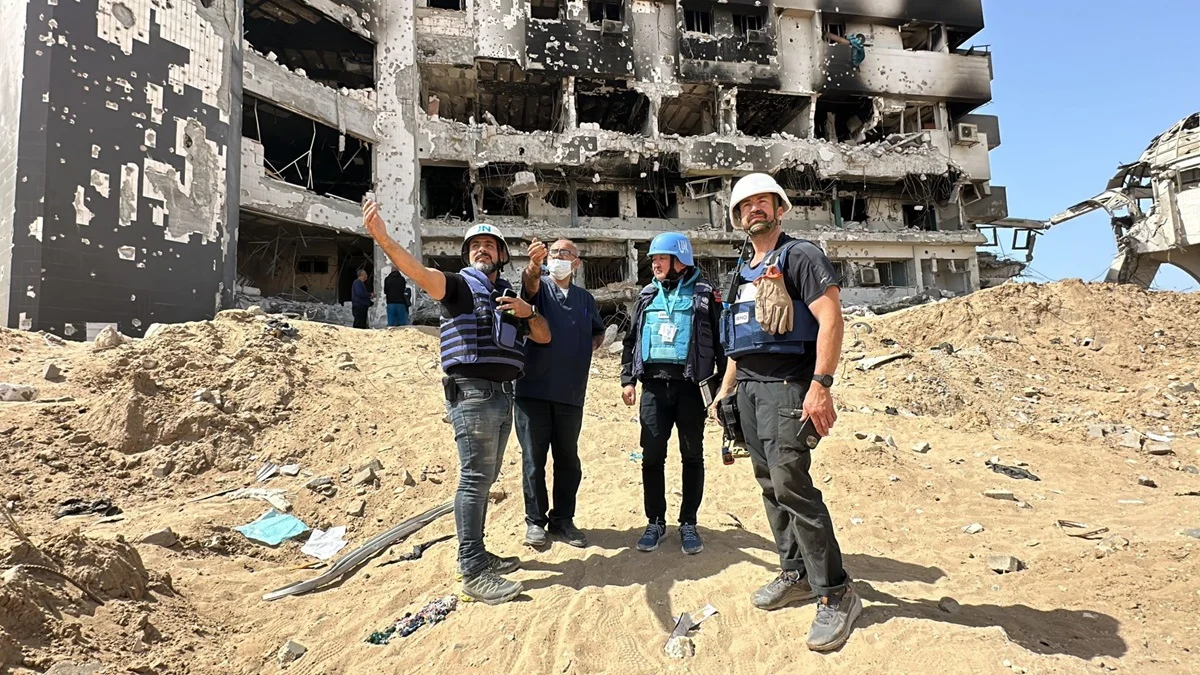
Ten years after the United Nations Security Council unanimously adopted Resolution 2286, intended to protect health care in zones of armed conflict, the international community faces a grim reality: the situation for medical workers and patients has deteriorated significantly rather than improved. This assessment comes from a joint urgent call for action issued by the leadership of the International Committee of the Red Cross (ICRC), the World Health Organization (WHO), and Médecins Sans Frontières (MSF). The heads of these organizations argue that the anniversary of the resolution marks not a milestone of progress, but a profound failure of the international political will to uphold the sanctity of medical neutrality during wartime.
In a rare unified front, Mirjana Spoljaric, President of the ICRC; Dr. Tedros Adhanom Ghebreyesus, Director-General of the WHO; and Dr. Christos Christou, International President of MSF, have warned that the unabated violence against medical facilities, transport, and personnel represents a "crisis of humanity." They assert that the rules and norms designed to limit the horrors of war are systematically breaking down, leaving entire populations without life-saving care at their most vulnerable moments.
The Legacy and Limitations of Resolution 2286
United Nations Security Council Resolution 2286 was adopted on May 3, 2016, in response to a terrifying surge in attacks on hospitals in Syria, Yemen, Afghanistan, and South Sudan. The resolution was hailed as a landmark moment, as it strongly condemned acts of violence, attacks, and threats against the wounded and sick, medical personnel, and humanitarian personnel. It urged states to conduct full, prompt, impartial, and effective investigations into such incidents and to take action against those responsible.
However, a decade later, the data suggests that the resolution’s "teeth" have remained largely theoretical. While the legal framework of International Humanitarian Law (IHL) remains clear—hospitals and medical workers are protected entities—the practical application of these laws has faltered. The joint statement from the ICRC, WHO, and MSF emphasizes that the failure lies not within the law itself, but in the lack of enforcement and the absence of political accountability for those who violate it.
A Chronology of Escalating Violence Against Health Care
To understand the current crisis, one must look at the timeline of health care protection and its subsequent erosion over the last twelve years:
- 2012: The World Health Assembly adopts Resolution 65.20, mandating the WHO to provide leadership at the global level in developing a system to collect and disseminate data on attacks on health care. This led to the creation of the Surveillance System for Attacks on Health Care (SSA).
- 2015: A series of high-profile attacks, including the U.S. airstrike on the MSF trauma center in Kunduz, Afghanistan, sparks global outrage and fuels the movement for a specific UN Security Council resolution.
- 2016: Resolution 2286 is adopted unanimously. The UN Secretary-General issues a set of actionable recommendations to member states to ensure the protection of medical services.
- 2017–2021: Despite the resolution, conflicts in Tigray (Ethiopia), Myanmar, and Yemen see systematic destruction of health infrastructure. Reports of "double-tap" strikes—where a second strike hits first responders—become increasingly common.
- 2022–2024: The conflicts in Ukraine, Gaza, and Sudan represent a catastrophic peak in the targeting of health care. In Gaza, the majority of hospitals have been rendered non-functional due to direct hits, sieges, or lack of fuel and supplies. In Ukraine, the WHO has verified over 1,500 attacks on health care since the 2022 invasion. In Sudan, the healthcare system has neared total collapse as facilities are occupied by combatants or looted.
Statistical Overview: The Data Behind the Crisis
The scale of the violence is reflected in the harrowing data collected by international monitors. According to the WHO’s Surveillance System for Attacks on Health Care, the number of verified attacks has remained consistently high, with a sharp upward trend in the severity of damage.
In 2023 alone, the WHO recorded hundreds of incidents across 19 countries and territories. These attacks resulted in the deaths of hundreds of medical staff and patients. The data reveals that the violence is not limited to "collateral damage." In many modern conflicts, medical facilities are being targeted strategically to weaken the resilience of civilian populations or to deny the "enemy" the ability to treat wounded combatants, which is a direct violation of the Geneva Conventions.
In the Gaza Strip, the situation reached an unprecedented level of intensity between October 2023 and May 2024. Reports indicate that nearly every major medical complex has been affected by military operations. Similarly, in Sudan, the Safeguarding Health in Conflict Coalition (SHCC) reported that as of early 2024, more than 70% of hospitals in conflict-affected areas were out of service, leaving millions of people without access to basic surgical or obstetric care.
The Humanitarian Toll: Beyond the Rubble
The destruction of a hospital is more than the loss of a building; it is the erasure of a community’s safety net. When health care is compromised, the "secondary" mortality rate—deaths not caused directly by bombs or bullets but by the absence of care—skyrockets.
The ICRC, WHO, and MSF highlight several specific humanitarian consequences:
- Maternal and Neonatal Mortality: Women are frequently forced to give birth in unsafe conditions, often without anesthesia or sterile equipment, leading to preventable deaths of both mothers and infants.
- Untreated Chronic Illness: Patients requiring dialysis, insulin, or chemotherapy face a death sentence when specialized clinics are destroyed or cut off from supply lines.
- Infectious Disease Outbreaks: The destruction of health infrastructure often coincides with the collapse of water and sanitation systems. Without functional clinics to monitor and treat outbreaks, diseases like cholera and polio can spread unchecked through displaced populations.
- The "Brain Drain" of Expertise: The targeted killing or kidnapping of doctors and nurses forces medical professionals to flee, leaving a vacuum of expertise that can take decades to rebuild.
Official Responses and the Call for Accountability
The joint statement from the three organizations is not merely a lament; it is a demand for specific policy shifts. They argue that states have a dual obligation: to respect the law themselves and to "ensure respect" by using their influence over allies and proxies.
The heads of the ICRC, WHO, and MSF have called upon all states to urgently implement the following measures:
- Implementation of the Secretary-General’s Roadmap: Reviving the 2016 recommendations, which include domestic legislative changes to protect medical personnel and the integration of IHL into military training and rules of engagement.
- Transparent Reporting: Strengthening the WHO’s ability to document attacks without fear of political reprisal. Consistent and transparent reporting is essential for building an evidence base for future prosecutions.
- Accountability and Justice: Moving beyond "condemnation" to actual legal consequences. This includes supporting the work of the International Criminal Court (ICC) and national jurisdictions in investigating war crimes related to the targeting of health care.
- Political Leadership: Ending the use of "dual-use" justifications—where combatants claim hospitals are being used for military purposes to justify attacks—without providing clear, verifiable evidence and following the strict IHL requirements of warning and proportionality.
Analysis: A Breakdown of Global Norms
The current disregard for Resolution 2286 reflects a broader trend in 21st-century warfare: the erosion of the "rules-based order." Analysts suggest that the normalization of attacks on health care is a symptom of a geopolitical environment where impunity has become the standard. When powerful states or their allies violate IHL without facing diplomatic or economic consequences, it signals to other actors that the "sanctity of health care" is a negotiable concept rather than an absolute requirement.
Furthermore, the nature of urban warfare has complicated the protection of medical facilities. As battles move into densely populated cities, hospitals often find themselves on the front lines. However, the ICRC emphasizes that the complexity of the battlefield does not absolve parties of their legal duties. The principles of distinction, proportionality, and precaution remain binding regardless of the environment.
Conclusion: The Crisis of Humanity
As the international community marks ten years since the adoption of Resolution 2286, the message from the world’s leading humanitarian and health organizations is clear: the law is sufficient, but the will to uphold it is absent. The "crisis of humanity" described by the ICRC, WHO, and MSF is a warning that if health care cannot be protected in war, no one is safe.
The joint appeal concludes with a stark reminder to world leaders: health care must never be a casualty of war. The next decade must not be another period of deteriorating norms and unjustifiable violence. Instead, it must be defined by a renewed commitment to the principle that even in the midst of the most brutal conflicts, the wounded must be healed, the sick must be tended, and those who provide that care must be shielded from harm. The failure of the last ten years serves as a tragic blueprint of what happens when the world looks away; the next ten years must be a testament to what happens when the world chooses to act.
